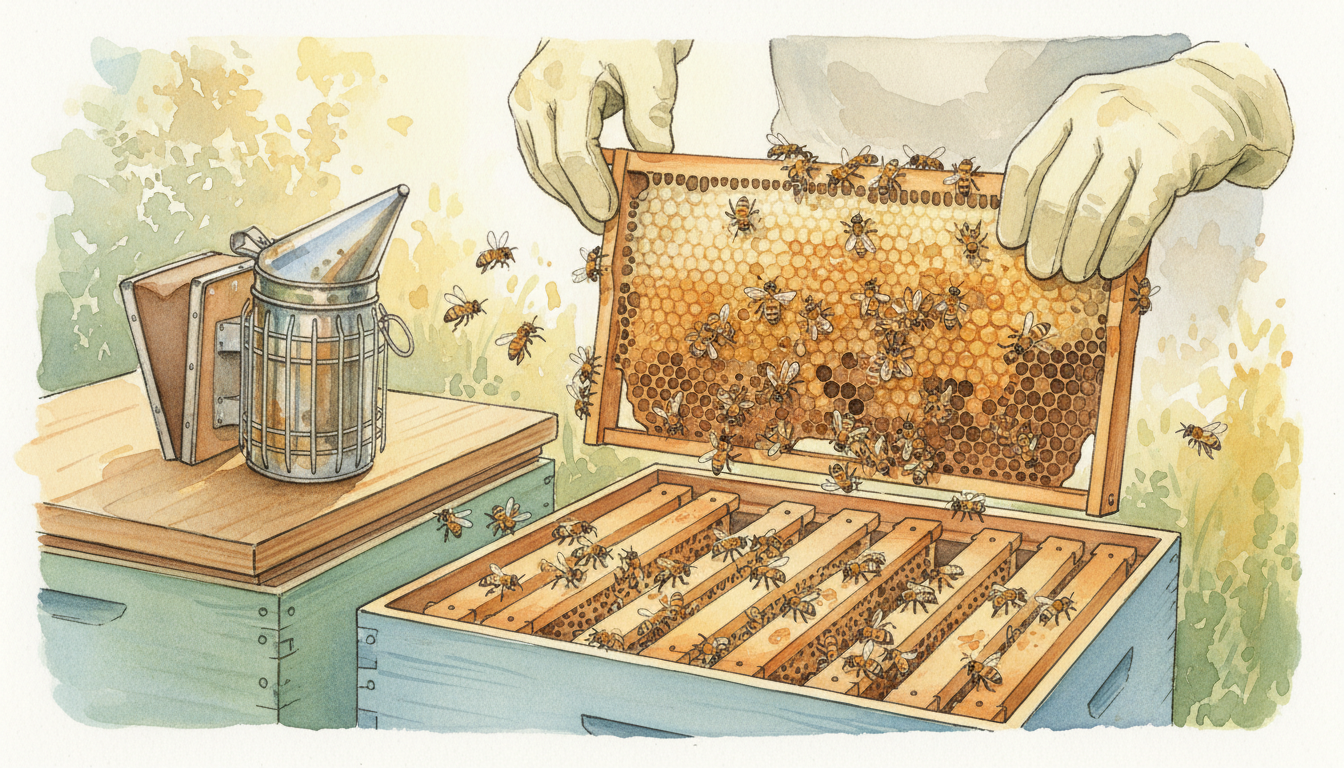
To Paper or Not to Paper
The question
The newspaper is insurance, not a law of nature. It buys a day or two for two colony odors to blend, and what that day is worth depends on the flow, the season and the queens far more than on the paper.
A word on terms first. Strictly, equalizing means moving frames of brood and bees from strong colonies to weaker ones to even them out; combining, or uniting, means merging two colonies into one. The paper belongs to combining, and that is where the argument lives.
Nearly every set of instructions online prescribes a sheet of newsprint between the boxes. Yet many experienced beekeepers skip it, and a few call it folklore. Both camps are describing something real; they are simply describing different conditions.
Why combining can go wrong
The danger the paper addresses is real: every colony wears its own scent, and guards reject bees that smell foreign. That scent is a blend of the bees’ cuticular hydrocarbons and compounds picked up from their own wax comb (Schmitt et al., Apidologie).
Comb matters more than most of us assume. When researchers swapped combs between colonies, acceptance of each other’s foragers rose from 3% to 23% one year and from 8% to 47% the next, fading within three weeks (D’Ettorre et al. 2006).
The decisive fact is that the guards’ threshold moves. Guards grow more accepting of strangers as nectar shifts from dearth to abundance, and robbing falls away to nothing (Downs & Ratnieks 2000, as summarized by Couvillon et al.). The reverse is fast: under staged robbing, acceptance of non-nestmates fell from 59% to 30% within 15 minutes (Couvillon et al. 2008).
Age matters too. Newly emerged bees carry fewer hydrocarbons and are taken in readily by unrelated colonies (Martin et al. 2018). That is why frame-swap equalizing with emerging brood seldom calls for paper.
The real stake is the queen. Worker scuffles are usually brief, but a queen can be balled in the confusion, and some writers warn this can happen even with paper (Bee Professor).
One caution: these studies watched guards at the entrance, not two colonies stacked in a single box. They explain why flow and dearth behave so differently; they do not directly test the newspaper.
The standard method
The newspaper combine became the default because it is cheap, forgiving and easy to teach. One sheet of plain newsprint goes over the top bars of the stronger colony, a few slits give the bees a start, and the weaker unit goes on top (Gabritsch, ABJ 2020). The bees chew through in roughly two to three days (Bee Professor).
The method has earned its reputation. PerfectBee calls it the most common approach (PerfectBee), and David Evans of The Apiarist says he cannot remember it ever failing him (The Apiarist). For a beginner who cannot yet read a colony’s mood, a method that rarely fails is worth a great deal.
Its costs are small but real:
- A return visit. Paper scraps should come out afterward, since wax moth larvae can shelter in them (Gabritsch, ABJ 2020).
- A tall stack to undo. Stacking leaves you with an extra brood box to consolidate later, which Evans finds a nuisance going into winter (The Apiarist).
- Delay. For a day or more the two units remain separate, which matters little in summer and a great deal in cold weather, as the next section shows.
Notably, even Evans concedes in a footnote that nobody has really shown the paper is what prevents fighting (The Apiarist). The method’s record is strong; the proof of its mechanism is mostly inherited.
The case against paper
The skeptics have a respectable lineage, and their strongest argument is the nectar flow. C. P. Dadant put it plainly in First Lessons in Beekeeping: “In a honeyflow uniting gives no difficulty.” He reserved the newspaper plan for the short days of fall (Dadant, 1976 ed.).
Others go further. Writing on comb honey in the American Bee Journal, Lloyd Spear dismissed the newspaper as an old beekeepers’ tale and said the bees would combine on their own without fighting (Spear, ABJ May 2014). His context matters, though: he was reuniting a colony with its own earlier split in late summer.
The sharpest practical objection is about cold. Zac Lamas, then running a 300-colony operation, advised that on cool nights you should combine without paper. Otherwise, he warned, you may end up with two separate colonies in one tower (Lamas, ABJ Nov 2018). A clustered colony does not chew; the paper becomes a wall.
Even paper’s defenders skip it when it suits them. Evans unites a queenright nuc straight into a dequeened brood box, masking colony odor with a light spray of air freshener (The Apiarist). A mid-century Wisconsin Horticulture note, surviving online only as a fragment, reports that USDA bee researcher C. L. Farrar believed paper uniting often triggered supersedure and did not recommend it (UW Digital Collections).
What the skeptics cannot offer is proof either. Their evidence, like the paper’s, is experience: many combines, few disasters, and conditions that often went unrecorded.
What actually decides the outcome
Five conditions matter more than the sheet of paper: the flow, the temperature, the queens, colony odor and the health of both units.
Flow. In a flow, guards are permissive and foragers are busy; in a dearth they are strict, and robbing can harden them within minutes (Couvillon et al. 2008). Paper buys the most when the bees are least forgiving.
Temperature. Paper only works if active bees chew it. Lamas warns that on cool nights it can leave two clusters stacked apart (Lamas, ABJ 2018). Yet Rusty Burlew reports using paper in the dead of winter to rescue a queenless colony (Honey Bee Suite). Both can be true; what likely decides it is whether the clusters can reach the paper at all.
Queens. Most failed combines are queen failures, not brawls. Remove one queen, clear queen cells from the queenless half, and avoid uniting a queenless half that still holds open brood, or it may raise emergency cells (Jane’s Native Bees). Here the paper’s delay can work against you. Evans once found the paper cleanly chewed, no fighting, and fresh queen cells below, perhaps because the halves had not truly mixed (The Apiarist).
Odor. Paper is one way to blur scent among several. Others include a light spray of air freshener (The Apiarist) and swapping empty comb between colonies before the merger, which research shows reduces fighting (Breed et al. 2012).
Health. No method rescues a sick unit. Combining a mite-heavy or diseased colony into a good one only spreads the trouble, so diagnose before you unite (Blythewood Bee Co.).
When to use paper, and when to skip it
Paper earns its keep when guards are strict and a queen is at risk; it loses its value during a flow and becomes a hazard once bees cluster.
| Situation | Paper? | Why |
|---|---|---|
| Strong flow; one unit weak or queenless | Optional | Guards are permissive and foragers busy; Dadant saw no difficulty |
| Equalizing with frames of emerging brood | No | Young bees carry little colony odor and are readily accepted |
| Summer dearth, robbing in the yard | Yes, or feed both units first | Guards are strict and harden within minutes under robbing |
| Cool nights, bees starting to cluster (roughly the mid-50s °F) | No; combine directly on a mild afternoon | A clustered unit may never chew through, leaving two colonies in one stack |
| Two queenright colonies | Yes, after removing one queen | The queen is the real stake; slower contact protects her |
| Queenless half with open brood or queen cells | Fix first: clear cells, then unite | The queenless half may raise its own queen during the delay |
| Either unit diseased or mite-heavy | Don’t combine | Combining spreads the problem rather than solving it |
The useful question at the hive is not whether newspaper is on hand but what the guards are doing today. A quiet entrance with foragers streaming in says one thing; guards grappling with robbers says another.
In the South Carolina Midlands the summer dearth begins in early June. A beekeeper who splits after the harvest will combine failed splits in that dearth and weak units in late fall, precisely the two rows where the answer flips.
Prudence or habit?
The newspaper persists because it is cheap, it rarely fails, and its failures are never charged to it. When an unpapered combine goes wrong, the missing sheet takes the blame; when a papered one succeeds, the sheet takes the credit.
No controlled comparison of papered and direct combines turned up in this review. Even for queen introduction, a closely related practice, a 2023 review found no comprehensive studies of which methods succeed most often (Smilga-Spalviņa et al. 2023).
Marcus Aurelius made a habit of stripping things of their reputation to see what they are. Stripped that way, the newspaper is a timer: a day or two of delay while two scents blend. Whether a timer is wise depends on what the delay buys and costs on that particular day.
Epictetus would add that the bees’ temper is not ours to command; only our judgment is. For the novice, who cannot yet read an entrance, the paper is prudence standing in for judgment. For the experienced keeper it can become habit, a rule kept after its reason has gone. The virtue is not in skipping the paper; it is in knowing why you reach for it.
Sources
Research
- D’Ettorre et al. (2006), Wax combs mediate nestmate recognition by guard honeybees, Animal Behaviour
- Couvillon et al. (2008), En garde: rapid shifts in honeybee guarding behaviour, Animal Behaviour
- Couvillon, Roy & Ratnieks, Recognition errors by honey bee guards, Journal of Apicultural Research (summarizes Downs & Ratnieks 2000)
- Schmitt et al., cuticular hydrocarbons and nestmate recognition, Apidologie
- Martin et al. (2018), salivary glands and recognition compounds, Journal of Chemical Ecology
- Breed et al. (2012), Use of flax oil to influence honey bee nestmate recognition, Journal of Economic Entomology
- Smilga-Spalviņa et al. (2023), review of queen introduction methods, CONECT
Beekeeping literature and practice
- C. P. Dadant, First Lessons in Beekeeping (1976 rev. ed.), excerpt
- Lloyd Spear, Comb Honey Basics, Part 3, American Bee Journal, May 2014
- Zac Lamas, The Heft Test and Leaving Them Alone, American Bee Journal, Nov 2018
- Darryl Gabritsch, How to Combine Weak Colonies Using the Newspaper Method, American Bee Journal, Jul 2020
- Wisconsin Horticulture fragment on C. L. Farrar, UW Digital Collections
- David Evans, Two into one does go, The Apiarist
- David Evans, When uniting goes wrong, The Apiarist
- Rusty Burlew, How to combine colonies using newspaper, Honey Bee Suite
- How to unite bees: the newspaper method, Jane’s Native Bees
- Combining Honeybee Colonies, PerfectBee
- Combining beehives, Bee Professor
- The Newspaper Combine for Weak Colonies, Blythewood Bee Co.