• Sassafras Bee Farm
  • About
  • Contact

Beekeeping365

~ The more I studied beekeeping, the less I knew, until, finally, I knew nothing. But, even though I knew nothing, I still had plenty to unlearn. Charles Martin Simon

Beekeeping365

Daily Archives: September 17, 2017

Beekeeping Vocabulary – “P” is for…

17 Sunday Sep 2017

Posted by Beekeeping365 in beekeeping, beekeeping vocabulary, honey bee vocabulary

≈ 3 Comments

Tags

beekeeping, beekeeping vocabulary, honey bee vocabulary

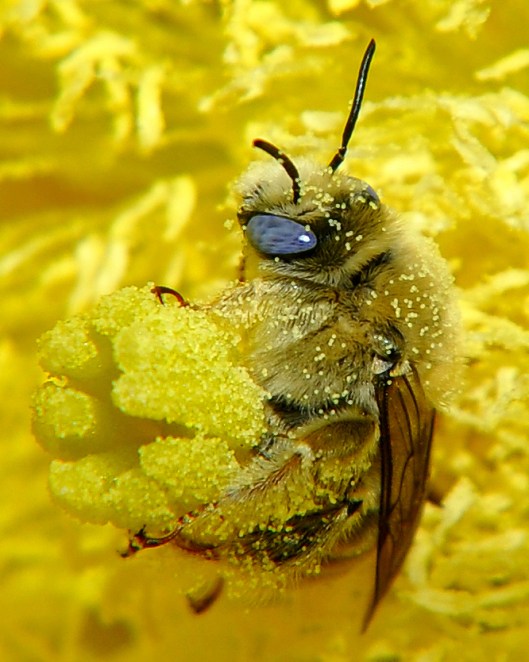
Diadasia_Bee_Straddles_Cactus_Flower_Carpels_close-up

By Jessie Eastland – Own work, CC BY-SA 4.0, https://commons.wikimedia.org/w/index.php?curid=58944849


This week’s beekeeping vocabulary word is “Pollen.”

Pollen is collected by honey bees and other pollinators and used as a food source. In the process of these pollinators travels they transfer pollen from one flow to another thus satisfying the reproductive needs of plants. The result is the production of a fruit, nut, seed by the flower of the pollinated plant. It’s a symbiotic relationship whereby the bee gathers a source of food containing proteins, lipids, and vitamins and the plant gets successfully pollinated.

From Wikipedia:

The transfer of pollen grains to the female reproductive structure (pistil in angiosperms) is called pollination. This transfer can be mediated by the wind, in which case the plant is described as anemophilous (literally wind-loving). Anemophilous plants typically produce great quantities of very lightweight pollen grains, sometimes with air-sacs. Non-flowering seed plants (e.g. pine trees) are characteristically anemophilous. Anemophilous flowering plants generally have inconspicuous flowers. Entomophilous (literally insect-loving) plants produce pollen that is relatively heavy, sticky and protein-rich, for dispersal by insect pollinators attracted to their flowers. Many insects and some mites are specialized to feed on pollen, and are called palynivores.

In non-flowering seed plants, pollen germinates in the pollen chamber, located beneath the micropyle, underneath the integuments of the ovule. A pollen tube is produced, which grows into the nucellus to provide nutrients for the developing sperm cells. Sperm cells of Pinophyta and Gnetophyta are without flagella, and are carried by the pollen tube, while those of Cycadophyta and Ginkgophyta have many flagella.

When placed on the stigma of a flowering plant, under favorable circumstances, a pollen grain puts forth a pollen tube, which grows down the tissue of the style to the ovary, and makes its way along the placenta, guided by projections or hairs, to the micropyle of an ovule. The nucleus of the tube cell has meanwhile passed into the tube, as does also the generative nucleus, which divides (if it hasn’t already) to form two sperm cells. The sperm cells are carried to their destination in the tip of the pollen tube. Double-strand breaks in DNA that arise during pollen tube growth appear to be efficiently repaired in the generative cell that carries the male genomic information to be passed on to the next plant generation.[12] However, the vegetative cell that is responsible for tube elongation appears to lack this DNA repair capability.[12]

Feel free to share this on:

  • Share on Facebook (Opens in new window) Facebook
  • Share on X (Opens in new window) X
  • Share on Pinterest (Opens in new window) Pinterest
  • Email a link to a friend (Opens in new window) Email
  • Share on LinkedIn (Opens in new window) LinkedIn
  • Share on Reddit (Opens in new window) Reddit
  • Share on Tumblr (Opens in new window) Tumblr
  • Print (Opens in new window) Print
  • Share on Telegram (Opens in new window) Telegram
  • Share on WhatsApp (Opens in new window) WhatsApp
Like Loading...
Follow Beekeeping365 on WordPress.com

Enter your email address to follow this blog and receive notifications of new posts by email.

Calendar

September 2017
S M T W T F S
 12
3456789
10111213141516
17181920212223
24252627282930
« Aug   Oct »

Posts by Month:

  • August 2026 (4)
  • July 2026 (1)
  • May 2026 (2)
  • January 2026 (3)
  • July 2025 (1)
  • April 2024 (1)
  • September 2022 (1)
  • July 2022 (1)
  • March 2022 (13)
  • February 2022 (17)
  • January 2022 (4)
  • December 2021 (4)
  • November 2021 (7)
  • October 2021 (1)
  • September 2021 (3)
  • August 2021 (11)
  • July 2021 (18)
  • June 2021 (5)
  • May 2021 (2)
  • April 2021 (9)
  • March 2021 (2)
  • February 2021 (5)
  • January 2021 (16)
  • December 2020 (15)
  • November 2020 (15)
  • October 2020 (11)
  • July 2020 (1)
  • February 2020 (1)
  • March 2019 (2)
  • February 2019 (4)
  • January 2019 (1)
  • December 2018 (10)
  • November 2018 (8)
  • October 2018 (15)
  • September 2018 (25)
  • August 2018 (3)
  • July 2018 (11)
  • June 2018 (27)
  • May 2018 (33)
  • April 2018 (20)
  • March 2018 (20)
  • February 2018 (12)
  • January 2018 (22)
  • December 2017 (18)
  • November 2017 (17)
  • October 2017 (25)
  • September 2017 (27)
  • August 2017 (21)
  • July 2017 (29)
  • June 2017 (28)
  • May 2017 (19)
  • April 2017 (17)
  • March 2017 (19)
  • February 2017 (12)
  • January 2017 (13)
  • December 2016 (5)

Posts by Categories:

  • absconding (1)
  • africanized honey bees (1)
  • apitherapy (1)
  • bee health (6)
  • bee law (2)
  • bee lining (2)
  • bee removals (2)
  • beekeeper (5)
  • beekeeper education (16)
  • beekeeping (612)
    • South Carolina (2)
  • beekeeping author (10)
  • beekeeping books (14)
  • beekeeping calendar (4)
  • beekeeping chores (8)
  • beekeeping equipment (26)
  • beekeeping history (49)
  • beekeeping management (37)
  • beekeeping pest management (8)
  • beekeeping seasons (23)
  • beekeeping vocabulary (16)
  • beeswax (13)
  • biography (4)
  • biology (14)
  • birthday (40)
  • birthdays (34)
  • book review (16)
  • breakfast (1)
  • calendar (4)
  • CCD (1)
  • chores (6)
  • comb (7)
  • comb honey (10)
  • commercial beekeeping (2)
  • cutouts (2)
  • dearth (3)
  • defensiveness (2)
  • diseases (9)
  • drawn comb (6)
  • ecology (4)
  • education (28)
  • equipment (25)
  • extracting (1)
  • fall nectar flow (1)
  • famous beekeepers (27)
  • feeding bees (7)
  • first blog entry (1)
  • folklore (1)
  • food (7)
  • forage (4)
  • hacks (3)
  • hive inspections (8)
  • hive placement (2)
  • hive products (6)
  • honey (90)
  • honey as food (22)
  • honey bee anatomy (3)
  • honey bee behavior (25)
  • honey bee biology (43)
  • honey bee genetics (4)
  • honey bee nutrition (1)
  • honey bee photos (6)
  • Honey Bee Research (1)
  • honey bee vocabulary (12)
  • honey bees (14)
  • honey judging (4)
  • honey recipe (65)
  • humor (13)
  • inspections (10)
  • journal (1)
  • log book (1)
  • making increase (3)
  • management (82)
  • mentoring (2)
  • mites (3)
  • national pollinator week (2)
  • nectar flow (6)
  • nomenclature (1)
  • opinion (8)
  • out yards (1)
  • outyards (1)
  • package bees (1)
  • pears (1)
  • pests (17)
  • plants for bees (3)
  • polish (1)
  • pollen (4)
  • pollination (11)
  • pollinators (7)
  • product review (1)
  • production (1)
  • products (3)
  • propolis (2)
  • queens (17)
  • raw honey (6)
  • recipe (88)
  • removals (1)
  • safety (3)
  • sales (2)
  • season (1)
  • seasons (21)
  • sideliner (1)
  • small hive beetles (1)
  • spring buildup (4)
  • state fair (2)
  • sustainable (7)
  • swarms (27)
  • ursurpation (1)
  • usurpation (1)
  • varroa (21)
  • varroa destructor (12)
  • varroa mites (24)
  • Winter (5)
  • winter solstice (2)
  • woodenware (3)
  • yellow jackets (2)

Sassafras Bee Farm on Facebook

Sassafras Bee Farm on Facebook

Sassafras Bee Farm

Sassafras Bee Farm

Recent Posts

  • Meeting Reality vs What Seems Deserved
  • Everything Starts with a Tasty Meal: The Science Behind a Beekeeper’s Best Pest-Management Insight
  • Pest Control
  • State Fair Wax Preparation
  • Sherlock Holmes and Beekeeping: A Unique Connection

Beekeeping365 on Facebook

Beekeeping365 on Facebook

Top Posts & Pages

  • Types of bees by Fat Daddy’s Apiary
    Types of bees by Fat Daddy’s Apiary
  • Meeting Reality vs What Seems Deserved
    Meeting Reality vs What Seems Deserved
  • Old-fashioned Honey Wafer Recipe by A Hundred Years Ago
    Old-fashioned Honey Wafer Recipe by A Hundred Years Ago

Blog Stats

  • 141,308 hits

Website Built with WordPress.com.

  • Subscribe Subscribed
    • Beekeeping365
    • Join 426 other subscribers
    • Already have a WordPress.com account? Log in now.
    • Beekeeping365
    • Subscribe Subscribed
    • Sign up
    • Log in
    • Report this content
    • View site in Reader
    • Manage subscriptions
    • Collapse this bar
Loading Comments...
%d