• Sassafras Bee Farm
  • About
  • Contact

Beekeeping365

~ The more I studied beekeeping, the less I knew, until, finally, I knew nothing. But, even though I knew nothing, I still had plenty to unlearn. Charles Martin Simon

Beekeeping365

Category Archives: package bees

The Comb You Didn’t Draw

18 Friday Sep 2026

Posted by Beekeeping365 in beekeeping history, package bees

≈ Leave a comment

Tags

nucleus hives, package bees

Pick up a nuc in April and there is a specific kind of gift sitting in that little five-frame box, and it is not the bees. Bees you can buy in a package with some sugar syrup and a queen. What you’re actually paying for in a nuc — what makes it worth more than a package’s price — is the comb. Five frames, built out cell by cell, worker-sized and true, brood in all stages, and a laying queen, working the day you install the nuc. A colony spends roughly six to eight pounds of honey to secrete one pound of wax. A single deep frame, drawn edge to edge, represents an otherwise quantity of honey from some other colony’s labor, converted at a brutal exchange rate into a structure you now own outright and did not build.


You didn’t draw that comb. Somebody’s bees did — a colony that may be gone now, split apart, requeened, sold off piecemeal into nucs just like this one, its actual members scattered or gone the way a summer bee goes, in five or six weeks, to old age. The comb outlived every bee that made it. You are standing in a beeyard handling the accumulated, compounded effort of colonies you never met, and starting your season several weeks ahead of the beekeeper next door who ordered a package and is watching bees chew wax into shape one sheet of foundation at a time.


Widen the frame and the whole hobby looks like this: You didn’t invent the movable frame — a Philadelphia preacher named Langstroth worked that out in 1851 so that nobody after him would have to destroy a colony to rob its honey or make splits. You didn’t isolate the mite that’s been quietly killing colonies since the eighties, or work out the oxalic acid dose that kills it without killing the bees, or breed the hygienic lines that groom mites off each other’s backs. You didn’t write the extension bulletins, run the queen-rearing trials, or lose the hives that taught somebody else what not to do, so that it could be written down and handed to you as a forum post you read for free on your phone at the kitchen table before you’d owned a single box. Every convenience in that beeyard was purchased by someone else’s now dead colonies, someone else’s ruined Saturday, someone else’s decades. You inherited all of it the moment you decided to keep bees.


So what do you do with the head start?


Some beekeepers take that comb, that mated queen, that inherited decades of other people’s mite trials, and build something with it — feed when the flow is thin, super ahead of the nectar instead of behind it, split before the bees decide to swarm and do it for you, and by June they’re standing over boxes heavier than anything they could have produced from foundation alone in their first season.

And some beekeepers take the identical box of gifts and let it sit. They hive the nuc on schedule and then don’t come back for three weeks, because there’s always something else — a show to finish, a group chat to keep up with, a Saturday that gets spent scrolling instead of driving out to the yard. The bees, given nothing further, do the ordinary thing bees do when nobody’s paying attention: they fill the box they were given, run out of room, and swarm out of it in April or May, taking half that inherited comb’s worth of bees with them into a tree somewhere, gone. The beekeeper who regains their interest in June or July finds a queenless remnant in a box that once held a running start and calls it bad luck.


No, the non-gratuitous beekeeper was handed five frames of brood and comb, a mated queen, a working five frame version of a production hive, a mite treatment protocol proven on somebody else’s dead colonies, and a whole discipline’s worth of knowledge accumulated and written down for their benefit, so that they could let the box sit unopened now complaining that the flow was short this year, wax moths killed the colony, that the queen was a dud, or that beekeeping is harder than the forums made it look.

The fact is it is not harder than it looks. It is easier than it has ever been in the history of anyone keeping bees, and the difficulty you’re running into most seasons is not the bees. It’s the beekeeper, standing at the truck, deciding whether to drive out this is the weekend. The comb is already drawn. The mated queen is already laying. Nobody is going to ask what you did with either of those things except you, standing over the box next October, looking at what got built on top of the generous start you were given for free, paid for by previous generations of beekeepers.

Feel free to share this on:

  • Share on Facebook (Opens in new window) Facebook
  • Share on X (Opens in new window) X
  • Share on Pinterest (Opens in new window) Pinterest
  • Email a link to a friend (Opens in new window) Email
  • Share on LinkedIn (Opens in new window) LinkedIn
  • Share on Reddit (Opens in new window) Reddit
  • Share on Tumblr (Opens in new window) Tumblr
  • Print (Opens in new window) Print
  • Share on Telegram (Opens in new window) Telegram
  • Share on WhatsApp (Opens in new window) WhatsApp
Like Loading...

How to inspect a honey bee package

12 Sunday Mar 2017

Posted by Beekeeping365 in beekeeper education, beekeeping, education, hive inspections, inspections, package bees

≈ Leave a comment

Tags

beekeeping, education

Source: How to inspect a honey bee package

I remember my first bee order.  I was excited and watched and read everything I could about installing bees into my hive.  The one thing that I never even thought about was if the bees I would pick up were healthy. It wasn’t until I was on my way to pick them up that I started to wonder about what a healthy package should look like.  I wasn’t really sure if I would be able to tell.

As I walked into the room with hundreds of boxes stacked on top of each other, the only thing I could think of, was that I wanted one with lots of bees and one with the screen secure and not leaking bees.

Here are the two packages that I chose:

Bee Package

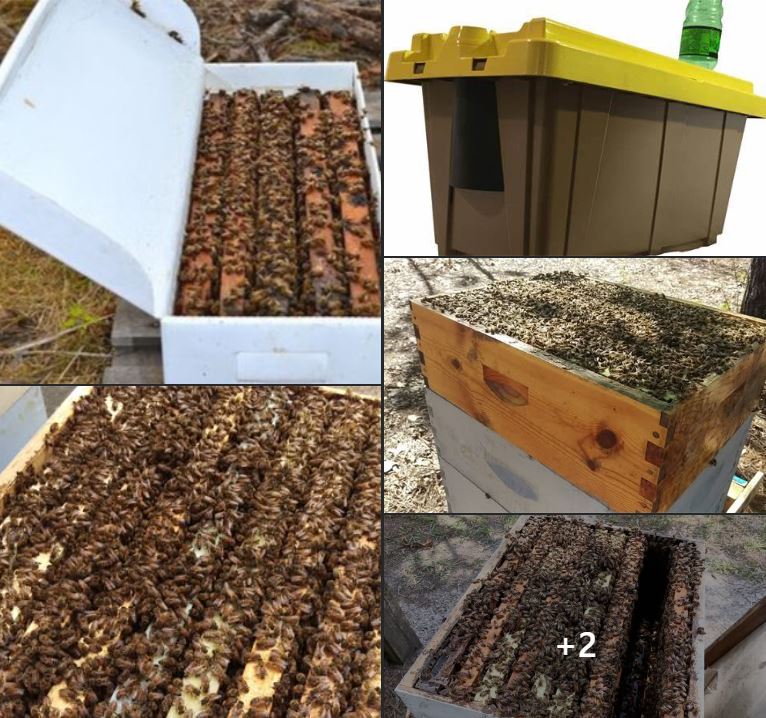
Each package consisted of a screened wooden box, 1 can of sugar syrup, 1 queen cage with a mated queen, 3# of bees and a wooden lid.  The amount of honey bees is dependent on what is ordered,  typically it’s 2 or 3 pounds of bees.

There’s a few things you should look for, when you get your package, before you pay. Once you pay, they are yours, even if they die within the week.  It is assumed that once they leave the beekeepers property it is in your hands to keep them alive and healthy:

  1. Bees should be in a cluster, as seen in the picture above.
  2. A few dead bees on the bottom is ok – you don’t want the package if there is a thick layer of dead bees on the bottom.
  3. There should be more workers (female bees) than drones (male bees) – drones are just a drain on resources. Drones do no work within the hive and they feed on stored honey or get the nurse bees to feed them.
  4. The screen on the box should be secure on all sides – bees flying around in your car is not always appreciated by your passengers.
  5. Bees should not appear swollen – swollen bees can be an indication that you have sick bees.

Once you have picked up your bees you should immediately install your bees into their new hive.  If you can’t:

  1. Store them in a cool place
  2. If weather is hot you can use a fan to lightly blow air through and around the cage – a sign of them being too hot is that they will no longer be in a cluster.
  3. If too hot, you can mist with water or a weak sugar solution on the screen to help cool them off.

I hope this helps you to choose the right package.

~May all your wandering take you to many wonderful places.

Source: How to inspect a honey bee package

Feel free to share this on:

  • Share on Facebook (Opens in new window) Facebook
  • Share on X (Opens in new window) X
  • Share on Pinterest (Opens in new window) Pinterest
  • Email a link to a friend (Opens in new window) Email
  • Share on LinkedIn (Opens in new window) LinkedIn
  • Share on Reddit (Opens in new window) Reddit
  • Share on Tumblr (Opens in new window) Tumblr
  • Print (Opens in new window) Print
  • Share on Telegram (Opens in new window) Telegram
  • Share on WhatsApp (Opens in new window) WhatsApp
Like Loading...
Follow Beekeeping365 on WordPress.com

Enter your email address to follow this blog and receive notifications of new posts by email.

Calendar

October 2026
S M T W T F S
 123
45678910
11121314151617
18192021222324
25262728293031
« Sep    

Posts by Month:

  • October 2026 (15)
  • September 2026 (32)
  • August 2026 (6)
  • July 2026 (1)
  • May 2026 (2)
  • January 2026 (3)
  • July 2025 (1)
  • April 2024 (1)
  • July 2022 (1)
  • March 2022 (13)
  • February 2022 (17)
  • January 2022 (4)
  • December 2021 (4)
  • November 2021 (4)
  • August 2021 (11)
  • July 2021 (18)
  • June 2021 (5)
  • May 2021 (2)
  • April 2021 (9)
  • March 2021 (2)
  • February 2021 (5)
  • January 2021 (16)
  • December 2020 (15)
  • November 2020 (5)
  • October 2020 (2)
  • July 2020 (1)
  • February 2020 (1)
  • March 2019 (2)
  • February 2019 (4)
  • January 2019 (1)
  • December 2018 (10)
  • November 2018 (8)
  • October 2018 (13)
  • September 2018 (18)
  • August 2018 (3)
  • July 2018 (11)
  • June 2018 (27)
  • May 2018 (33)
  • April 2018 (20)
  • March 2018 (20)
  • February 2018 (12)
  • January 2018 (22)
  • December 2017 (18)
  • November 2017 (15)
  • October 2017 (19)
  • September 2017 (17)
  • August 2017 (21)
  • July 2017 (29)
  • June 2017 (28)
  • May 2017 (19)
  • April 2017 (17)
  • March 2017 (19)
  • February 2017 (12)
  • January 2017 (13)
  • December 2016 (5)

Posts by Categories:

  • absconding (1)
  • africanized honey bees (1)
  • apitherapy (1)
  • bee health (7)
  • bee law (2)
  • bee lining (2)
  • bee removals (2)
  • beekeeper (5)
  • beekeeper education (17)
  • beekeeping (604)
    • South Carolina (3)
  • beekeeping author (10)
  • beekeeping books (12)
  • beekeeping calendar (6)
  • beekeeping chores (9)
  • beekeeping equipment (23)
  • beekeeping history (48)
  • beekeeping management (35)
  • beekeeping pest management (8)
  • beekeeping seasons (26)
  • beekeeping vocabulary (15)
  • beeswax (11)
  • biography (5)
  • biology (12)
  • birthday (37)
  • birthdays (31)
  • book review (16)
  • breakfast (1)
  • calendar (6)
  • CCD (1)
  • chores (6)
  • comb (6)
  • comb honey (10)
  • commercial beekeeping (1)
  • cutouts (2)
  • dearth (4)
  • defensiveness (1)
  • diseases (9)
  • drawn comb (5)
  • ecology (4)
  • education (30)
  • equipment (21)
  • extracting (1)
  • fall nectar flow (1)
  • famous beekeepers (25)
  • feeding bees (8)
  • first blog entry (1)
  • folklore (1)
  • food (7)
  • forage (4)
  • hacks (3)
  • hive inspections (6)
  • hive placement (2)
  • hive products (6)
  • honey (85)
  • honey as food (22)
  • honey bee anatomy (3)
  • honey bee behavior (23)
  • honey bee biology (42)
  • honey bee genetics (4)
  • honey bee losses (1)
  • honey bee nutrition (1)
  • honey bee photos (6)
  • Honey Bee Research (1)
  • honey bee vocabulary (11)
  • honey bees (14)
  • honey judging (3)
  • honey recipe (65)
  • humor (13)
  • inspections (9)
  • journal (1)
  • log book (1)
  • making increase (3)
  • management (82)
  • mentoring (2)
  • mites (4)
  • national pollinator week (2)
  • nectar flow (6)
  • nomenclature (1)
  • opinion (5)
  • out yards (1)
  • outyards (2)
  • package bees (2)
  • pears (1)
  • pests (17)
  • plants for bees (3)
  • polish (1)
  • pollen (4)
  • pollination (11)
  • pollinators (7)
  • product review (1)
  • production (1)
  • products (3)
  • propolis (2)
  • queens (17)
  • raw honey (6)
  • recipe (88)
  • removals (1)
  • safety (3)
  • sales (2)
  • season (1)
  • seasons (21)
  • sideliner (1)
  • small hive beetles (1)
  • spring buildup (4)
  • state fair (2)
  • sustainable (8)
  • swarms (27)
  • ursurpation (1)
  • usurpation (1)
  • varroa (20)
  • varroa destructor (11)
  • varroa mites (23)
  • Winter (6)
  • winter solstice (2)
  • woodenware (3)
  • yellow jackets (2)

Sassafras Bee Farm on Facebook

Sassafras Bee Farm on Facebook

Sassafras Bee Farm

Sassafras Bee Farm

Recent Posts

  • It Always Starts with Assessment
  • Happy Birthday Jay J. Smith
  • Miracles by Walt Whitman
  • What Do You Know?
  • Fall Nectar Flow

Beekeeping365 on Facebook

Beekeeping365 on Facebook

Top Posts & Pages

  • Swarms
    Swarms
  • To the (bee) Veils! by sassafrasbeefarm
    To the (bee) Veils! by sassafrasbeefarm
  • The Russian Scion
    The Russian Scion

Blog Stats

  • 145,440 hits

Website Built with WordPress.com.

  • Subscribe Subscribed
    Beekeeping365
    Join 417 other subscribers

    Have a WordPress.com account? Log in now.

  • Beekeeping365
    View site in Reader
    Manage subscriptionsSign upLog in
    Report this content
    Collapse this bar
Loading Comments...
%d