• Sassafras Bee Farm
  • About
  • Contact

Beekeeping365

~ The more I studied beekeeping, the less I knew, until, finally, I knew nothing. But, even though I knew nothing, I still had plenty to unlearn. Charles Martin Simon

Beekeeping365

Daily Archives: March 5, 2022

In the Blink of an Eye

05 Saturday Mar 2022

Posted by Beekeeping365 in beekeeping

≈ 1 Comment

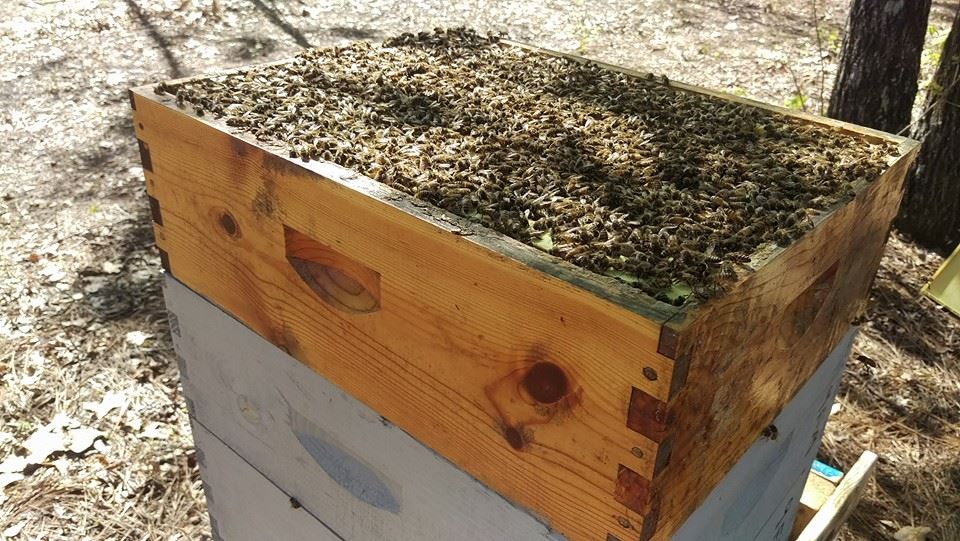
I had one of my bee buddies call me yesterday. He was headed out of town for a few days. He wanted to tell me how well his colonies were doing on the lower Congaree River. Booming! He had just come from inspecting them and said they were dripping out when he lifted the inner cover. He said he rotated boxes and placed a super.

My question to him was, “How much capped brood did you see?” He replied that there were multiple, multiple frames of deep frames with capped brood.

From my experience, if they have not yet started queen cells his efforts may work for a few days tops. By then they will probably start queen cells and swarm. Why? Because a deep frame of capped brood with clinging bees represents about 9000 bees (very close to a package worth). That’s 1000 of clinging bees on each side and ~3700 capped cells per side. Cappped on day 9 and emerged on day 21 means within the next 12 days all of those capped cells will emerge (and all the ones on other frames as well). That’s roughly 7000+ more bees in that brood nest per capped frame in a short period of time. One of the “events” leading to swarming is congestion of bees in the brood nest which can happen very fast this time of year. And my friend said he had multiple frames of capped brood.

Another way of thinking about this is simply that the queen is laying 1000- 1500 eggs a day. Therefore, every day 1000-1500 new bees will emerge. Probably a minimum of 7000 – 12000 per week – about a package worth of bees per week.

Why am I so concerned about all this? Well, it’s the bees end-game to swarm. Swarming = Success They started this effort back in the fall and upped their game in January. And about 4 weeks ago they started the spring buildup. Bees start final swarm preparations 2-4 weeks prior to actually leaving the parent hive. My friend’s efforts are appropriate if there were no swarm cells but his efforts will be short lived unless he takes measures to reduce congestion. And in case you were wondering, that super he placed above will do little to prevent congestion in the brood nest. Simply, nurse bees have a job to do and that job is in the brood nest which is where they want to be – not that super given to them way up above.

Those that have suffered through my presentation on swarm prevention know that swarm prevention can be divided into two phases – early and late swarm prevention. Early swarm prevention starts at the first signs of spring pollen production while night time temperatures still threaten freezing. These measures are low stress which take into account that the bees’ population is still low and unable to heat the brood if we are too aggressive and disrupt their nest too much. Low stress swarm prevention methods include hive body rotation and checkerboarding honey frames in the boxes above the brood nest.

Then there is the second phase of swarm prevention. These are interventions that we can do after the weather warms enough to allow us to disrupt the brood nest. We are able to disrupt the brood nest during this late swarm prevention period because 1) the night time temperatures are higher and 2) we now have many more bees to heat the colony and brood area. The bees can now handle the addition stressors. Manipulations which can now be done late phase to interrupt the swarm urge include opening the brood nest with drawn comb, or even foundationless frames. Another method is an early Demaree which involves moving open brood out of the brood nest and into a hive body and placing above the brood nest separated by an empty super. This will reduce brood nest congestion as the nurse bees will migrate upward to cover the open brood. Pretty disruptive but remember that congestion in the brood nest must be lessened to disrupt the urge to swarm. A final option is to simply make splits moving frames of open and closed larvae out of the brood nest and replacing those frames with drawn comb. A word of caution here, do not insert frames of foundation in the middle of the brood nest. By doing so you may create a wall further restricting the queen. The drawback of making splits instead of working within the parent hive is you are losing 9000 future foragers with every frame you take out. That’s like reducing your nectar gathering work force just before they are needed to make surplus honey.

Swarm prevention hopefully does what the name suggests – prevent swarms. So what happens if the bees beat us and start queen cells. Well, first realize they have more practice than we do at this so don’t despair. If they make queen cells they will be relentless in their efforts and more drastic measures must be used.

After queen cells are created, these measures are called Swarm Control. The easiest is to simply split them which, for the bees, seems like they swarmed. Sure you’ll lose out on a bountiful honey harvest from that colony but hey, they won the battle so make lemonade from the lemons – you get a new colony of bees anyway. Other ways of handling include the Demaree method, and several other methods all of which fool the bees into thinking they have swarmed. Google: Snelgrove, Padgen, or Taranov all of which fool the colony into thinking they have swarmed.

Feel free to share this on:

  • Share on Facebook (Opens in new window) Facebook
  • Share on X (Opens in new window) X
  • Share on Pinterest (Opens in new window) Pinterest
  • Email a link to a friend (Opens in new window) Email
  • Share on LinkedIn (Opens in new window) LinkedIn
  • Share on Reddit (Opens in new window) Reddit
  • Share on Tumblr (Opens in new window) Tumblr
  • Print (Opens in new window) Print
  • Share on Telegram (Opens in new window) Telegram
  • Share on WhatsApp (Opens in new window) WhatsApp
Like Loading...
Follow Beekeeping365 on WordPress.com

Enter your email address to follow this blog and receive notifications of new posts by email.

Calendar

March 2022
S M T W T F S
 12345
6789101112
13141516171819
20212223242526
2728293031  
« Feb   Jul »

Posts by Month:

  • August 2026 (4)
  • July 2026 (1)
  • May 2026 (2)
  • January 2026 (3)
  • July 2025 (1)
  • April 2024 (1)
  • September 2022 (1)
  • July 2022 (1)
  • March 2022 (13)
  • February 2022 (17)
  • January 2022 (4)
  • December 2021 (4)
  • November 2021 (7)
  • October 2021 (1)
  • September 2021 (3)
  • August 2021 (11)
  • July 2021 (18)
  • June 2021 (5)
  • May 2021 (2)
  • April 2021 (9)
  • March 2021 (2)
  • February 2021 (5)
  • January 2021 (16)
  • December 2020 (15)
  • November 2020 (15)
  • October 2020 (11)
  • July 2020 (1)
  • February 2020 (1)
  • March 2019 (2)
  • February 2019 (4)
  • January 2019 (1)
  • December 2018 (10)
  • November 2018 (8)
  • October 2018 (15)
  • September 2018 (25)
  • August 2018 (3)
  • July 2018 (11)
  • June 2018 (27)
  • May 2018 (33)
  • April 2018 (20)
  • March 2018 (20)
  • February 2018 (12)
  • January 2018 (22)
  • December 2017 (18)
  • November 2017 (17)
  • October 2017 (25)
  • September 2017 (27)
  • August 2017 (21)
  • July 2017 (29)
  • June 2017 (28)
  • May 2017 (19)
  • April 2017 (17)
  • March 2017 (19)
  • February 2017 (12)
  • January 2017 (13)
  • December 2016 (5)

Posts by Categories:

  • absconding (1)
  • africanized honey bees (1)
  • apitherapy (1)
  • bee health (6)
  • bee law (2)
  • bee lining (2)
  • bee removals (2)
  • beekeeper (5)
  • beekeeper education (16)
  • beekeeping (612)
    • South Carolina (2)
  • beekeeping author (10)
  • beekeeping books (14)
  • beekeeping calendar (4)
  • beekeeping chores (8)
  • beekeeping equipment (26)
  • beekeeping history (49)
  • beekeeping management (37)
  • beekeeping pest management (8)
  • beekeeping seasons (23)
  • beekeeping vocabulary (16)
  • beeswax (13)
  • biography (4)
  • biology (14)
  • birthday (40)
  • birthdays (34)
  • book review (16)
  • breakfast (1)
  • calendar (4)
  • CCD (1)
  • chores (6)
  • comb (7)
  • comb honey (10)
  • commercial beekeeping (2)
  • cutouts (2)
  • dearth (3)
  • defensiveness (2)
  • diseases (9)
  • drawn comb (6)
  • ecology (4)
  • education (28)
  • equipment (25)
  • extracting (1)
  • fall nectar flow (1)
  • famous beekeepers (27)
  • feeding bees (7)
  • first blog entry (1)
  • folklore (1)
  • food (7)
  • forage (4)
  • hacks (3)
  • hive inspections (8)
  • hive placement (2)
  • hive products (6)
  • honey (90)
  • honey as food (22)
  • honey bee anatomy (3)
  • honey bee behavior (25)
  • honey bee biology (43)
  • honey bee genetics (4)
  • honey bee nutrition (1)
  • honey bee photos (6)
  • Honey Bee Research (1)
  • honey bee vocabulary (12)
  • honey bees (14)
  • honey judging (4)
  • honey recipe (65)
  • humor (13)
  • inspections (10)
  • journal (1)
  • log book (1)
  • making increase (3)
  • management (82)
  • mentoring (2)
  • mites (3)
  • national pollinator week (2)
  • nectar flow (6)
  • nomenclature (1)
  • opinion (8)
  • out yards (1)
  • outyards (1)
  • package bees (1)
  • pears (1)
  • pests (17)
  • plants for bees (3)
  • polish (1)
  • pollen (4)
  • pollination (11)
  • pollinators (7)
  • product review (1)
  • production (1)
  • products (3)
  • propolis (2)
  • queens (17)
  • raw honey (6)
  • recipe (88)
  • removals (1)
  • safety (3)
  • sales (2)
  • season (1)
  • seasons (21)
  • sideliner (1)
  • small hive beetles (1)
  • spring buildup (4)
  • state fair (2)
  • sustainable (7)
  • swarms (27)
  • ursurpation (1)
  • usurpation (1)
  • varroa (21)
  • varroa destructor (12)
  • varroa mites (24)
  • Winter (5)
  • winter solstice (2)
  • woodenware (3)
  • yellow jackets (2)

Sassafras Bee Farm on Facebook

Sassafras Bee Farm on Facebook

Sassafras Bee Farm

Sassafras Bee Farm

Recent Posts

  • Meeting Reality vs What Seems Deserved
  • Everything Starts with a Tasty Meal: The Science Behind a Beekeeper’s Best Pest-Management Insight
  • Pest Control
  • State Fair Wax Preparation
  • Sherlock Holmes and Beekeeping: A Unique Connection

Beekeeping365 on Facebook

Beekeeping365 on Facebook

Top Posts & Pages

  • Types of bees by Fat Daddy’s Apiary
    Types of bees by Fat Daddy’s Apiary
  • Meeting Reality vs What Seems Deserved
    Meeting Reality vs What Seems Deserved
  • Early Spring? Or not...
    Early Spring? Or not...

Blog Stats

  • 141,317 hits

Website Built with WordPress.com.

  • Subscribe Subscribed
    • Beekeeping365
    • Join 426 other subscribers
    • Already have a WordPress.com account? Log in now.
    • Beekeeping365
    • Subscribe Subscribed
    • Sign up
    • Log in
    • Report this content
    • View site in Reader
    • Manage subscriptions
    • Collapse this bar
Loading Comments...
%d