• Sassafras Bee Farm
  • About
  • Contact

Beekeeping365

~ The more I studied beekeeping, the less I knew, until, finally, I knew nothing. But, even though I knew nothing, I still had plenty to unlearn. Charles Martin Simon

Beekeeping365

Daily Archives: October 20, 2026

South Carolina Statewide Honey Pollen Project (2021–2024)

20 Tuesday Oct 2026

Posted by Beekeeping365 in beekeeping

≈ Leave a comment

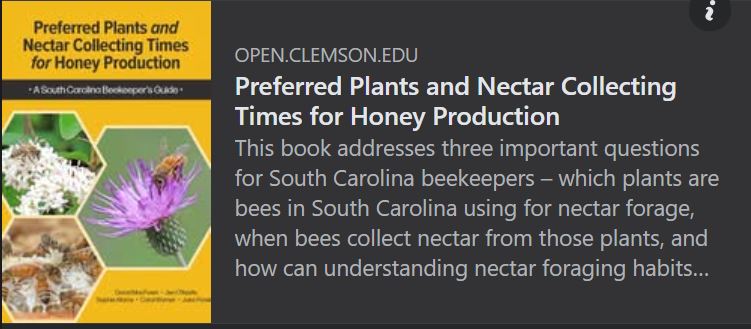
Download the full text of the Pollen Study here: https://open.clemson.edu/extension_pubs/1/

The South Carolina Statewide Honey Pollen Project, led by David MacFawn, Jennifer M.K. O’Keefe, Sophie Warny, Carol Wymer, and June Rampy Ponder, was the first in the U.S. in over fifty years to conduct a statewide melissopalynological (honey pollen) analysis. Funded by the South Carolina Department of Agriculture and the USDA Specialty Crop Block Program funds, and supported by the South Carolina Beekeepers Association (SCBA), it ran from Fall 2021 to September 2024.


Significance
This project is a preeminent reference for SC beekeepers, offering actionable insights for premium honey production and ecological monitoring. It also sets a precedent for similar statewide melissopalynological studies in other regions.


Purpose and Objectives
The project aimed to answer three key questions for beekeepers and the scientific community:

Which plants are nectar sources for honeybees by region across South Carolina, using pollen analysis of collected honey.

When these plants bloom across the state, based on weekly honey sample collection during nectar flows and nectar checks during dearth.

Whether maple (Acer) bloom (end of January/early February) is both a pollen source and a nectar source.
The results provide a baseline for regional nectar ecosystems, helping beekeepers plan honey production, choose when to install supers, and move hives for specific nectar flows. The data also serve as a scientific record to monitor impacts of climate change and urban sprawl.


Methodology
19 apiaries across SC’s Type III ecoregions participated.
Honey was collected weekly during nectar flow periods and checked for nectar during dearth.
Pollen was analyzed at multiple universities; melissopalynologists identified plant species from the pollen. Data were compiled by ecoregion to show regional differences in forage use.


Key Findings and Outputs
Identified preferred nectar plants and their seasonal bloom timing by region.
Revealed that some early-season plants (including maples) are both pollen and nectar sources, contrary to prior assumptions.


Provided weekly nectar flow dynamics for each ecoregion, enabling precise timing for honey production.


Published in Bee Culture (Sept. 2024) and Palynology, and compiled into a Clemson Extension Publishing book (2025).


Download the full text of the Pollen Study here: https://open.clemson.edu/extension_pubs/1/

Feel free to share this on:

  • Share on Facebook (Opens in new window) Facebook
  • Share on X (Opens in new window) X
  • Share on Pinterest (Opens in new window) Pinterest
  • Email a link to a friend (Opens in new window) Email
  • Share on LinkedIn (Opens in new window) LinkedIn
  • Share on Reddit (Opens in new window) Reddit
  • Share on Tumblr (Opens in new window) Tumblr
  • Print (Opens in new window) Print
  • Share on Telegram (Opens in new window) Telegram
  • Share on WhatsApp (Opens in new window) WhatsApp
Like Loading...
Follow Beekeeping365 on WordPress.com

Enter your email address to follow this blog and receive notifications of new posts by email.

Calendar

October 2026
S M T W T F S
 123
45678910
11121314151617
18192021222324
25262728293031
« Sep    

Posts by Month:

  • October 2026 (21)
  • September 2026 (32)
  • August 2026 (6)
  • July 2026 (1)
  • May 2026 (2)
  • January 2026 (3)
  • July 2025 (1)
  • April 2024 (1)
  • July 2022 (1)
  • March 2022 (13)
  • February 2022 (17)
  • January 2022 (4)
  • December 2021 (4)
  • November 2021 (4)
  • August 2021 (11)
  • July 2021 (18)
  • June 2021 (5)
  • May 2021 (2)
  • April 2021 (9)
  • March 2021 (2)
  • February 2021 (5)
  • January 2021 (16)
  • December 2020 (15)
  • November 2020 (5)
  • October 2020 (2)
  • July 2020 (1)
  • February 2020 (1)
  • March 2019 (2)
  • February 2019 (4)
  • January 2019 (1)
  • December 2018 (10)
  • November 2018 (8)
  • October 2018 (13)
  • September 2018 (18)
  • August 2018 (3)
  • July 2018 (11)
  • June 2018 (27)
  • May 2018 (33)
  • April 2018 (20)
  • March 2018 (20)
  • February 2018 (12)
  • January 2018 (22)
  • December 2017 (18)
  • November 2017 (15)
  • October 2017 (19)
  • September 2017 (17)
  • August 2017 (21)
  • July 2017 (29)
  • June 2017 (28)
  • May 2017 (19)
  • April 2017 (17)
  • March 2017 (19)
  • February 2017 (12)
  • January 2017 (13)
  • December 2016 (5)

Posts by Categories:

  • absconding (1)
  • africanized honey bees (1)
  • apitherapy (1)
  • bee health (7)
  • bee law (2)
  • bee lining (2)
  • bee removals (2)
  • beekeeper (5)
  • beekeeper education (17)
  • beekeeping (609)
    • South Carolina (3)
  • beekeeping author (10)
  • beekeeping books (12)
  • beekeeping calendar (7)
  • beekeeping chores (10)
  • beekeeping equipment (23)
  • beekeeping history (48)
  • beekeeping management (38)
  • beekeeping pest management (9)
  • beekeeping seasons (27)
  • beekeeping vocabulary (15)
  • beeswax (11)
  • biography (5)
  • biology (13)
  • birthday (37)
  • birthdays (31)
  • book review (16)
  • breakfast (1)
  • calendar (6)
  • CCD (1)
  • chores (6)
  • comb (6)
  • comb honey (10)
  • commercial beekeeping (1)
  • cutouts (2)
  • dearth (4)
  • defensiveness (1)
  • diseases (9)
  • drawn comb (5)
  • ecology (4)
  • education (30)
  • equipment (21)
  • extracting (1)
  • fall nectar flow (1)
  • famous beekeepers (25)
  • feeding bees (8)
  • first blog entry (1)
  • folklore (1)
  • food (7)
  • forage (4)
  • hacks (3)
  • hive inspections (6)
  • hive placement (2)
  • hive products (6)
  • honey (85)
  • honey as food (22)
  • honey bee anatomy (3)
  • honey bee behavior (23)
  • honey bee biology (43)
  • honey bee genetics (4)
  • honey bee losses (1)
  • honey bee nutrition (1)
  • honey bee photos (6)
  • Honey Bee Research (1)
  • honey bee vocabulary (11)
  • honey bees (14)
  • honey judging (3)
  • honey recipe (65)
  • humor (13)
  • inspections (9)
  • journal (1)
  • log book (1)
  • making increase (3)
  • management (84)
  • mentoring (2)
  • mites (4)
  • national pollinator week (2)
  • nectar flow (6)
  • nomenclature (1)
  • opinion (5)
  • out yards (1)
  • outyards (2)
  • package bees (2)
  • pears (1)
  • pests (17)
  • plants for bees (3)
  • polish (1)
  • pollen (4)
  • pollination (11)
  • pollinators (7)
  • product review (1)
  • production (1)
  • products (3)
  • propolis (2)
  • queens (17)
  • raw honey (6)
  • recipe (88)
  • removals (1)
  • safety (3)
  • sales (2)
  • season (2)
  • seasons (22)
  • sideliner (1)
  • small hive beetles (1)
  • spring buildup (4)
  • state fair (2)
  • sustainable (8)
  • swarms (27)
  • ursurpation (1)
  • usurpation (1)
  • varroa (20)
  • varroa destructor (11)
  • varroa mites (23)
  • Winter (6)
  • winter solstice (2)
  • woodenware (3)
  • yellow jackets (2)

Sassafras Bee Farm on Facebook

Sassafras Bee Farm on Facebook

Sassafras Bee Farm

Sassafras Bee Farm

Recent Posts

  • South Carolina Statewide Honey Pollen Project (2021–2024)
  • Beekeeping Vocabulary – “R” is for…
  • Happy Birthday Johann Ludwig Christ
  • Let’s Talk about Moisture in the Bee Hive
  • The Fall Four

Beekeeping365 on Facebook

Beekeeping365 on Facebook

Top Posts & Pages

  • The Russian Scion
    The Russian Scion
  • Contact
    Contact
  • Book Review: The Incomparable Honeybee by Dr. Reese Halter
    Book Review: The Incomparable Honeybee by Dr. Reese Halter

Blog Stats

  • 145,840 hits

Website Built with WordPress.com.

  • Subscribe Subscribed
    Beekeeping365
    Join 417 other subscribers

    Have a WordPress.com account? Log in now.

  • Beekeeping365
    View site in Reader
    Manage subscriptionsSign upLog in
    Report this content
    Collapse this bar
Loading Comments...
%d