Source: The Boom in Beekeeping

It’s the middle of the night, you’ve driven miles outside of town. You’re a nomad, traveling around the country, staying out of the public eye. Out of sight, out of mind. This is how Dan Wyns (a faculty research assistant and ex-commercial beekeeper) describes the reality of beekeeping: a merging of agriculture and science. “Part farmer, part carpenter, part biologist, part machine operator.” He explains. This image sparks the imagination, but this is not what many people think of when they think beekeeper. This idea is not what has caused an undeniable spike in hobbyist beekeepers in recent years.
Within the last decade, media has latched onto bees, creating a story about the extinction of bees. One fascination is Colony Collapse Disorder, or CCD, which was spotted around 2006, and quickly made the news. These sudden reports put bees in the spotlight, and this spotlight inspired average people; there’s nothing like a sob story to get people to take interest in an issue, and this interest soon became a trend. Bill Catherall is just one example of someone who was captivated by the news, which was one of the motivations for him to begin beekeeping in 2012. Catherall is now the president of the Portland Urban Beekeepers, an organization that aims to support both honeybees and native bees in the Portland, Oregon area. Catherall is only one of many that can confirm the sudden spike in beekeepers, “Portland beekeeping is exploding, our club almost doubles in size every year. A lot more people are in it to save the bee.” This is where many beekeepers begin: by joining local clubs, and caring for a single hive, of up to 80,000 bees [7].

There are three types of beekeeper: the hobbyist beekeeper, the semi-commercial beekeeper and the commercial beekeeper. Beekeepers are sorted by size and agenda, not skill level. In fact, there is a wide range of skill levels across all types of beekeeping. Commercial beekeepers keep bees as a job, this is how they make their living. According to Wyns, commercial beekeepers are also the smallest group there are only 2,000 commercial beekeepers, but, they keep thousands of hives and are responsible for about one-third of food production. The hobbyist beekeeper, or the small-scale beekeeper, keep bees as pets in their backyard. They have a small number of hives for personal enjoyment, and nothing else. This is the most common group, and the group that was inspired by the media to take up beekeeping. Semi-commercial or sideliners, fall into the middle and keep several hundred hives. At this level beekeeping is more than just a hobby, often semi-commercial beekeepers do make some money off of their bees, but they do not depend on it.
So, news teams caught wind of the struggles that were being faced primarily by commercial beekeeping [7], the public read these stories and became worried. This prompted individuals to begin keeping bees, and the pendulum swung upwards. But the media may have deceived us all. Dr. Michael Burgett, professor emeritus and published entomologist disagrees with the media’s claims, pointing out that “The death of large numbers of bees in an area didn’t start in 2006, there have been lots of instances in the past where large numbers of bees have died.” Dr. Burgett also pointed out that Aristotle wrote about the subject of bee die-outs and diseases 2,000 years ago, bringing to light that this is neither a new, nor surprising phenomenon, in his opinion. Bees have always bee important enough to pay attention to, and now is no different.

The Basics
Overtime beekeeping has become an essential part of human life, even if you do not keep bees yourself, the pollination industry is a $15 billion industry (in 2000) in America alone [7] it is responsible for 35% of the food that we consume daily [2]. According to Burgett, it’s not a beekeeping industry, its industries: the pollination industry, and the hobbyist industry. Because of the importance, and size of the pollination industry, this is where the news is focusing, but the media does not understand how this industry works. Pollination is done on a contract basis. Farmers hire hives from commercial beekeepers all around the country. Each hive cost about $50, and stays in the crop from 3 weeks to 2 months, depending on the need of the crop. Every year the bees begin their journey in the almonds in California. In late January, about 2 million beehives are shipped from all over America to California for almond pollination. All commercial hives are fed syrup and protein pellets to give them the energy that they need to begin pollination after the winter. After the almonds, bees are driven around the country on palettes to pollinate tree fruits, then blueberries, then vegetable crops, and so on until September, when there is nothing else to pollinate. At this point, the bees are fed more syrup and protein pellets, the hives are inspected, and treated if needed. This is to prepare to the bees for winter, the hives will sit until they are needed for pollination again, and the bees will stay inside the hive to keep warm, and eat reserves.

Because of the reality of commercial pollinators trucking their bees around the country, feeding them syrup, and keeping them from sickness with the use of chemicals, it is easy to see how one could blame the pollination industry for the sudden decline in bees. But this is not the case. While commercial beekeepers are losing more hives by sheer numbers, hobbyist beekeepers lose more hives by percentage. Burgett emphasized how the success of a beekeeper depends on their experience. “Commercial beekeepers cannot afford to lose hives, so they have a higher learning curve.” He says, “I have no worry whatsoever about the extinction of honeybees. I have no worry whatsoever about the extinction of commercial beekeeping. Simply because the need is so great.”
There is a misconception that you can stick a beehive in your backyard, and have honey “on tap.” This is what Catherall first thought when he had the initial idea to begin beekeeping. Then he began doing research, during this time he was fascinated by bee biology, saying, “The honeybee biology is really exciting and interesting, because they are such a weird insect, they behave in ways that we don’t find normal, or natural.” Honey bees are eusocial, meaning that they have a complex social structure. Only a handful of animals share this type of complex hierarchy in their daily lives.

The honey bee hive is run entirely by female bees, which are sorted into subcategories: the queen, and the workers. Each worker has their own role, some collect pollen, some care for the brood (the larval stage in the bee life cycle), some make honey, and so on. Every worker in the hive is controlled by the queen, who emits pheromones which allows the hive to work as a single unit. Her pheromones control the workers mood, and makes the workers unable to reproduce. The queen has one other job: to lay eggs. Without a queen, the hive will slowly die off because the workers have a lifecycle of 2 to 8 weeks, while a queen can live for years. Every bee in the colony is a daughter of the queen bee, and every bee is related to her. Genetic diversity in the hive, and in bees is entirely related to queen bees.
Genetic Diversity
In 1621 the European honey bee was brought to the colonies in Virginia by settlers to aid with food production. In Europe the honey bee was already an important part of the economy [5]. This was the beginning of the genetic diversity bottleneck. Because the European honey bee is not native, and the only means of getting honey bees to the New World was by boat, not many hives were brought over. By 1856 bees were in every part of the United States [6]. Soon after, the importation of honey bees into America was banned. The millions of beehives that are in America today are products of the hives initially brought over from Europe.
When a queen bee is created she must go and breed with male bees or drones in order to birth workers. The queen leaves the hive once in her life, and mates with many drones as she can store the sperm for later use [7]. After, she returns to the hive and begins to lay eggs. Unfortunately, most queen bees are only at their prime for the first year or two, then they begin to lay less eggs; for this reason, many commercial beekeepers will “re-queen” the hive yearly. To do this, they buy a new, already mated queen from a supplier, and squish the old queen. This may sound harsh, but a hive cannot have two queens, because the bees are loyal to their queen, they will kill any new queen that enters. Next, the new queen is added to the hive in a cage, and the bees get used to her scent, and will accept her. They will only accept her if the old queen is gone, the new queen is then released into the hive to live her life for the next year.

Commercial beekeepers rarely breed queens, this is often done by an outside company. There are several problems with queen breeding that is leading to a problem in genetic diversity. Firstly, in the wild, a queen bee will lay 2 to 3 eggs that will become queens, but a breeder will create up to 5,000 queens from one mother bee. Catherall puts the largest problem best, “The genetics that are found in the breeders are very tight, there are about four or five different mothers, and that’s all. But in the wild, feral populations, there is a lot more diversity, in fact the genetics in the wild populations are different than the ones in the commercial population; showing that they are not interbreeding.” Because all of the genetics in bees are so close, commercial beekeepers could easily run into problems. Should a disease come to your hive, your bees genetics are so similar, that one thing could easily wipe out your business.Genetic diversity is the key to the survival of the species, and more genetics lead to stronger, healthier hives now and in the future [5]. Genetically diverse colonies are stronger foragers, thus creating more food storage for the winter, and the ability to grow their populations, and swarm faster and more easily [4]. Genetic diversity also leads to a boost in fitness, and thus higher survival rates for over-wintering. The more people keep bees, the more opportunity there is for genetic diversity, luckily, bees can be kept in almost every space imaginable.
Urban Beekeeping
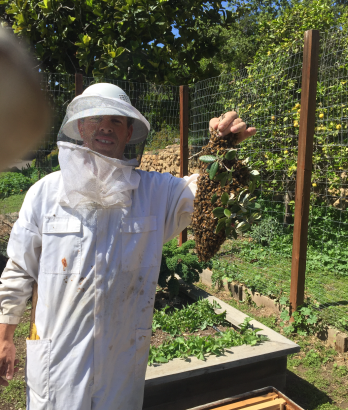
In 2014, about 1,500 people kept bees in the city of London. Camilla Goddard was one of the first, she began beekeeping in the city around 2005. The beginning was rocky, as she struggled to find place where her bees would not be disturbed. But when beekeeping became fashionable, the city of London was just one city that embraced the trend, and began keeping bees within it’s walls [1]. Wyns says, “It is definitely possible, in a lot of ways urban bees potentially can do a lot better than bees in agriculture. Because of the diversity, everybody has their flowers and vegetables, even in real true urban areas, inevitably there are flowers and trees in city parks, and people have their verandas with a couple plants on it.” Because bees can fly several miles away from the hive, they will find the flowers. Not only are there many of diverse forage opportunities, but there are also less pesticides used in urban areas due to the close proximity to humans, and the lack of a monoculture.
“It’s in that vein of self-sustainability, grow your own food. It all fits together.” Says Wyns, who believes that monocultures, and big agricultural farming is a big cause of the current struggles that honey bees are facing. The pollination of urban areas is the opposite of monoculture.
Beekeepers agree that the current public interest in bees is a good thing. The more people who keep bees, the greater the opportunity that bees will outlive these problems [2]. Hobbyists become very attached and protective of their bees, which is one way that this will help the bee population [2]. Even if you’re not a beekeeper yourself, education and awareness is the key. People who begin beekeeping pay attention to the bees by planting more bee friendly flowers, and avoiding pesticides in their own gardens. There is no argument that European honey bees are facing more challenges than ever, but with the spotlight on bees, “the future looks rosy to tell the truth” says Burgett. There is more research, more interest, and more information about bees than ever before.
Wyns paints a picture of the future, saying, “It’s pretty cool to be standing on the rooftop of some giant building in the middle of a metropolitan area looking at the skyline playing with bees. I think that there’s potential there.”
Sources:
1. ”Honey monsters; Urban beekeeping.” The Economist 12 Apr. 2014: 27(US). Academic OneFile. Web. 21 May 2016.
2. Chadwick, Kristi. “McFarland, Rob & Chelsea McFarland. Save the Bees with Natural Backyard Hives: The Easy and Treatment-Free Way To Attract and Keep Healthy Bees.” Library Journal 1 Jan. 2016: 123. Academic OneFile. Web. 2 May 2016.
3. Genersch, Elke. “Honey Bee Pathology: Current Threats to Honey Bees and Beekeeping.” Applied Microbiology and Biotechnology 87 (2010): 87-97. Web.
4. Mattila, Heather R., and Thomas D. Seeley. “Genetic Diversity in Honey Bee Colonies Enhances Productivity and Fitness.” Science 317.3836 (2007): 362-64.
5. Sammataro, Diana, and Jay Yoder. Honey Bee Colony Health: Challenges and Sustainable Solutions. Boca Raton, FL: CRC, 2012. Print.
6. Shimanuki, H. “Beekeeping.” Dictionary of American History. Ed. Stanley I. Kutler. 3rd ed. Vol. 1. New York: Charles Scribner’s Sons, 2003. 436. Gale Virtual Reference Library. Web. 1 May 2016.
7. Wilson-Rich, Noah, Kelly Allin, Andrea Quigley, and Norman L. Carreck. The Bee: A Natural History. Lewes: Ivy, 2014. Print.
Interviews
Catherall, Bill. Interview. 14 May. 2016.
Burgett, Dr. Michael. Phone Interview. 18 May. 2016.
Wyns, Dan. Interview. 20 May. 2016.
Source: The Boom in Beekeeping

