• Sassafras Bee Farm
  • About
  • Contact

Beekeeping365

~ The more I studied beekeeping, the less I knew, until, finally, I knew nothing. But, even though I knew nothing, I still had plenty to unlearn. Charles Martin Simon

Beekeeping365

Daily Archives: November 28, 2017

Called Hive Inspection

28 Tuesday Nov 2017

Posted by Beekeeping365 in beekeeping, hive inspections, inspections

≈ 6 Comments

Tags

beekeeping

IMAG2301

Hive Assessment

Assessment: Called to look at a hive that had experienced a sudden (less than one week) drop in population and an increase in dead bees accompanied by “sawdust” like material.

Location: Swansea, SC Weather: Mid 60’s overcast. Light wind.

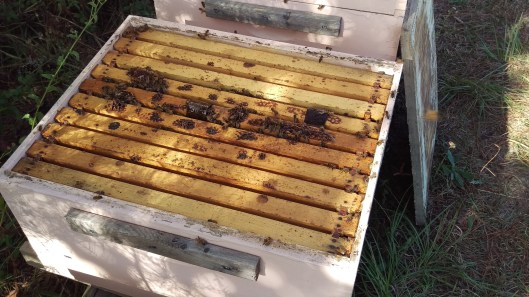
Hive is a 10 frame Langstroth, three hive bodies tall (two deeps, one medium).

By history, this is a new hive installed this season from a package (H&R). Hive has been doing well until a couple days ago. Owner inspected hive last week and reports “full boxes of bees”. Became concerned this weekend with increase in dead bees on ground in front of hive and “sawdust” like material in front.

On arrival I noticed an open feeder located a couple feet to the side of the hive. Noticing more bees coming and going at the feeder than the front entrance of the hive I watched and saw bees coming to the feeder and on departing going elsewhere . Owner reports neighbor has multiple bee hives.

The hive had little activity at the entrance reducer which was set on about a two bee width setting. No fighting.

Owner showed me “sawdust” like material. Appeared to be animal scat largely composed of bee parts.

Hive opened and no bees noted on opening. Top medium all frames filled with capped honey.

Middle box deep had a cluster of bees approximately 200. No queen observed. Three emergency queen cells observed but these were away from cluster but on same frames. Appeared queenless. Approximately 20 capped brood cells. No open brood noted.

Bottom deep partially filled with open nectar. Apparently cured as passed the “shake” test.

Screened bottom board had about 20-30 dead bees.

Sticky board was under the SBB. Had been in place for unknown period of time. Had notable number of mites, a few SHB, minimal wax particles.

While I generally discourage viewing individual bees as an assessment of Varroa load, I did observe the bees on the top of the small cluster. Approximately 25 bees were on the top bars of the middle box gathered together at top of cluster. I counted 4 or 5 mites on the top surface of the bees’ thoraxes and abdomens.

Removal of pupae from capped brood. No mites observed. Pupae had been dead several days and starting to dehydrate and decompose.


Analysis of Assessment:

Upon seeing bees other than the bees from the owner’s hive I initially suspected an abscond due to robbing pressure. However I ruled this out after seeing 1) no fighting or increased activity at the front entrance of the hive; 2) No torn cappings or wax on SBB; 3) hive stores intact.

The scat like droppings containing bee parts led me to suspect harassment from a raccoon or other small animal. However, it is my understanding that raccoons will scratch on the hive box or entrance at night to get bees to come out so they may eat them. However, I saw no scratches on the box or landing board. Additionally, I understand that raising the hive off the ground is a method of discouraging raccoons because it causes them to expose their undersides which the bees sting. This hive was raised further discounting the raccoon harassment leading to an abscond. The scat remains a mystery however, it is possible the scat was from another animal, perhaps a snake regularly eating dead or dying bees off the ground in front of the hive. I have lizards at my home yard that eat the dying bees on the ground and are a benefit to yard hygiene.

Owner reports increased yellow jacket activity. Not noted on inspection. We have had a couple recent freezes so that may account for lack of activity today. It is, however, noted as another pest pressure on this hive.

Varroa on bees. Counting 5 per 20 bees is a 25% Varroa load and well beyond economic threshold for treatment. It is generally considered that a functioning hive cannot withstand a mite population greater than 3000 total and is considered doomed. I suspect this hive had a mite load sufficient to cause death / absconding.

Plan:

Reconfigure hive

Remove capped honey

Safely store comb for next season

Provide educational tips

Implementation:

Box with small cluster placed on hive stand. Owner advised that they are hopelessly queenless and doomed. However, as the owner had no other hive to work with and she did not wish to shake them out on the ground. Owner advised to recover and save comb after the bees die.

The hive bodies containing capped honey were removed for processing.

Combs with extracted honey will be placed outside for neighbor’s bees to clean up for 24 hours prior to being stored. Owner instructed in proper comb storage options.

Restart hive(s) in spring with packages placed on drawn comb.

Tips:

Do not open feed in close proximity to hive. Feeding close introduces your hive to the neighbor’s hive and during times of dearth weaker hives are identified. I do not think this was an issue in this instance however it can lead to a “stressor” on the hive to defend its stores. Additionally, open feeding promotes viral disease transmission via contact with other, possibly infected, colonies.

Treat for Varroa earlier in the year. Given that we now know there are multiple hives located in close proximity to the owner’s bee yard, I recommend treatments at the close of the nectar flow, and again in early fall. An assessment of Varroa counts in the spring as well would be advised.

Perform the final “deep” inspection a bit earlier in the fall. Do final total inspection in early fall to ensure the queen is where you want her (lower boxes) and to assess stores prior to any fall feeding. After early fall inspection let them get their house in order. Remember, while we are trying to help the bees, we are not perceived by them as helping. To them, we are another pest in their hive.

Feel free to share this on:

  • Share on Facebook (Opens in new window) Facebook
  • Share on X (Opens in new window) X
  • Share on Pinterest (Opens in new window) Pinterest
  • Email a link to a friend (Opens in new window) Email
  • Share on LinkedIn (Opens in new window) LinkedIn
  • Share on Reddit (Opens in new window) Reddit
  • Share on Tumblr (Opens in new window) Tumblr
  • Print (Opens in new window) Print
  • Share on Telegram (Opens in new window) Telegram
  • Share on WhatsApp (Opens in new window) WhatsApp
Like Loading...
Follow Beekeeping365 on WordPress.com

Enter your email address to follow this blog and receive notifications of new posts by email.

Calendar

November 2017
S M T W T F S
 1234
567891011
12131415161718
19202122232425
2627282930  
« Oct   Dec »

Posts by Month:

  • August 2026 (4)
  • July 2026 (1)
  • May 2026 (2)
  • January 2026 (3)
  • July 2025 (1)
  • April 2024 (1)
  • September 2022 (1)
  • July 2022 (1)
  • March 2022 (13)
  • February 2022 (17)
  • January 2022 (4)
  • December 2021 (4)
  • November 2021 (7)
  • October 2021 (1)
  • September 2021 (3)
  • August 2021 (11)
  • July 2021 (18)
  • June 2021 (5)
  • May 2021 (2)
  • April 2021 (9)
  • March 2021 (2)
  • February 2021 (5)
  • January 2021 (16)
  • December 2020 (15)
  • November 2020 (15)
  • October 2020 (11)
  • July 2020 (1)
  • February 2020 (1)
  • March 2019 (2)
  • February 2019 (4)
  • January 2019 (1)
  • December 2018 (10)
  • November 2018 (8)
  • October 2018 (15)
  • September 2018 (25)
  • August 2018 (3)
  • July 2018 (11)
  • June 2018 (27)
  • May 2018 (33)
  • April 2018 (20)
  • March 2018 (20)
  • February 2018 (12)
  • January 2018 (22)
  • December 2017 (18)
  • November 2017 (17)
  • October 2017 (25)
  • September 2017 (27)
  • August 2017 (21)
  • July 2017 (29)
  • June 2017 (28)
  • May 2017 (19)
  • April 2017 (17)
  • March 2017 (19)
  • February 2017 (12)
  • January 2017 (13)
  • December 2016 (5)

Posts by Categories:

  • absconding (1)
  • africanized honey bees (1)
  • apitherapy (1)
  • bee health (6)
  • bee law (2)
  • bee lining (2)
  • bee removals (2)
  • beekeeper (5)
  • beekeeper education (16)
  • beekeeping (612)
    • South Carolina (2)
  • beekeeping author (10)
  • beekeeping books (14)
  • beekeeping calendar (4)
  • beekeeping chores (8)
  • beekeeping equipment (26)
  • beekeeping history (49)
  • beekeeping management (37)
  • beekeeping pest management (8)
  • beekeeping seasons (23)
  • beekeeping vocabulary (16)
  • beeswax (13)
  • biography (4)
  • biology (14)
  • birthday (40)
  • birthdays (34)
  • book review (16)
  • breakfast (1)
  • calendar (4)
  • CCD (1)
  • chores (6)
  • comb (7)
  • comb honey (10)
  • commercial beekeeping (2)
  • cutouts (2)
  • dearth (3)
  • defensiveness (2)
  • diseases (9)
  • drawn comb (6)
  • ecology (4)
  • education (28)
  • equipment (25)
  • extracting (1)
  • fall nectar flow (1)
  • famous beekeepers (27)
  • feeding bees (7)
  • first blog entry (1)
  • folklore (1)
  • food (7)
  • forage (4)
  • hacks (3)
  • hive inspections (8)
  • hive placement (2)
  • hive products (6)
  • honey (90)
  • honey as food (22)
  • honey bee anatomy (3)
  • honey bee behavior (25)
  • honey bee biology (43)
  • honey bee genetics (4)
  • honey bee nutrition (1)
  • honey bee photos (6)
  • Honey Bee Research (1)
  • honey bee vocabulary (12)
  • honey bees (14)
  • honey judging (4)
  • honey recipe (65)
  • humor (13)
  • inspections (10)
  • journal (1)
  • log book (1)
  • making increase (3)
  • management (82)
  • mentoring (2)
  • mites (3)
  • national pollinator week (2)
  • nectar flow (6)
  • nomenclature (1)
  • opinion (8)
  • out yards (1)
  • outyards (1)
  • package bees (1)
  • pears (1)
  • pests (17)
  • plants for bees (3)
  • polish (1)
  • pollen (4)
  • pollination (11)
  • pollinators (7)
  • product review (1)
  • production (1)
  • products (3)
  • propolis (2)
  • queens (17)
  • raw honey (6)
  • recipe (88)
  • removals (1)
  • safety (3)
  • sales (2)
  • season (1)
  • seasons (21)
  • sideliner (1)
  • small hive beetles (1)
  • spring buildup (4)
  • state fair (2)
  • sustainable (7)
  • swarms (27)
  • ursurpation (1)
  • usurpation (1)
  • varroa (21)
  • varroa destructor (12)
  • varroa mites (24)
  • Winter (5)
  • winter solstice (2)
  • woodenware (3)
  • yellow jackets (2)

Sassafras Bee Farm on Facebook

Sassafras Bee Farm on Facebook

Sassafras Bee Farm

Sassafras Bee Farm

Recent Posts

  • Meeting Reality vs What Seems Deserved
  • Everything Starts with a Tasty Meal: The Science Behind a Beekeeper’s Best Pest-Management Insight
  • Pest Control
  • State Fair Wax Preparation
  • Sherlock Holmes and Beekeeping: A Unique Connection

Beekeeping365 on Facebook

Beekeeping365 on Facebook

Top Posts & Pages

  • Types of bees by Fat Daddy’s Apiary
    Types of bees by Fat Daddy’s Apiary
  • Meeting Reality vs What Seems Deserved
    Meeting Reality vs What Seems Deserved
  • Early Spring? Or not...
    Early Spring? Or not...

Blog Stats

  • 141,317 hits

Website Built with WordPress.com.

  • Subscribe Subscribed
    • Beekeeping365
    • Join 426 other subscribers
    • Already have a WordPress.com account? Log in now.
    • Beekeeping365
    • Subscribe Subscribed
    • Sign up
    • Log in
    • Report this content
    • View site in Reader
    • Manage subscriptions
    • Collapse this bar
Loading Comments...
%d