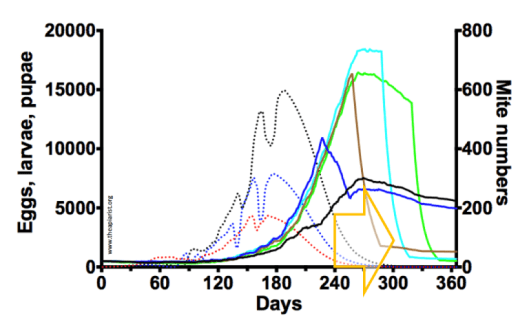
Below is an excellent article by David the Apiarist on understanding the varroa mite population cycle as relates to management of Varroa mites. Understanding the pest is key to maximizing the impact of the treatement. I’ve chosen to crosspost it on this date to benefit my readers in the Midlands of South Carolina as we enter the period of time when the presence of brood is at it’s yearly low. References to the Eagles and Don Henley are entertaining as well.
Why bother treating colonies in midwinter to reduce Varroa infestation? After all, you probably treated them with Apiguard or Apivar (or possibly even Apistan) in late summer or early autumn.
Is there any need to treat again in midwinter?
Yes. To cut a long story short, there are basically two reasons why a midwinter mite treatment almost always makes sense:
- Mites will be present. In addition, they’ll be present at a level higher than the minimum level achievable, particularly if you last treated your colonies in late summer, rather than early autumn.
- The majority of mites will be phoretic, rather than hiding away in sealed brood. They’re therefore easy to target.
I’ll deal with these in reverse order …
Read the full article at: Kick ’em when they’re down — The Apiarist
 The other day I received an automated congratulations from WordPress. It was the anniversary of this blog. A little over a year ago this blog was created with the goal of capturing one complete year of beekeeping – trying to follow the seasons with corresponding articles, pictures, and posts – some original and many shared. My thanks to all of the contributors who allowed me to re-blog their articles along the way.
