Tags
Born June 28, 1815
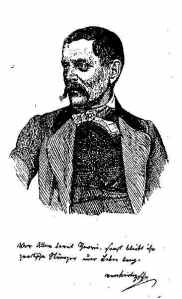
Baron August von Berlepsch a dedicated apiarist dedicated himself to study and built upon the works of other prominent beekeepers of his time. Probably most importantly Johann Dzierzon’s discovery of the exact space which we now refer to as bee space. “In 1848 Dzierzon introduced grooves into the hive’s side walls, replacing the strips of wood for moving top bars. The grooves were 8 × 8 mm—the exact average between ¼ and ⅜ inch, which is the range called the ‘bee space.’ On the basis of the aforementioned measurements, August Adolph von Berlepsch (May 1852) in Thuringia and L.L. Langstroth (October 1852) in the United States designed their frame-movable hives.” (Wikipedia)
Thus Berlepsch edged out Langstroth by 5 months on the invention of a removable frame hive utilizing bee space to the benefit of the beekeeper.
The following text is an extract – introduction from his work published (3rd edition 1873). The technical part would go beyond the scope of a homepage. The book may be borrowed from well-assorted public libraries.
The Honey Bee and its Breeding in Movable Honeycombs in Regions without Late Summer Yield.
http://www.v.berlepsch.de/_private/bienen-august-engl.htm
My Life as an Apiarist
- The beginning of my passion for bees dates back to the early days of childhood, and the only thing I still remember is that when I was a very little boy, I liked nothing better than running away from my nurse to the bees of our neighbour Gottlob Richter. When the lovely maiden came to take me back, I was standing right amidst the buzzing bees, crying mockingly: “try and get me, try and get me!” On 28 June 1822 , my 7th birthday, my father bought me first beehive from the most renowned beekeeper of my native region, the peasant Jacob Schulze, who was living in the neighbouring town of Langensalza . From then on, that man gave me training, and when I was 10 and my education was committed to the learned parson Wenck in the nearby village of Heroldshausen, I already owned 4 hives. 2 accompanied me to Heroldshausen, 2 were left at my father’s manor Seebach (Note: expropriated by the Russians in 1945, and once more expropriated by the Federal Republic of Germany in 1997) so that I would not miss the bees on Sundays, which I used to spend at home. At Easter 1828, I was transferred to the flourishing Gotha grammar school with the famous Latinist and Horaz interpreter Döring.
- My grandfather who was still alive at that time, Baron Gottlob von Berlepsch, was a grammar school and university fellow student of Döring and insisted on presenting me to his former pal. It happened that Döring was as enthusiastic beekeeper as a philologist, and when grandfather told him that “bees meant everything to his little grandson and that he was very skilled in handling them,” the amiable 72 year old man insisted on my bees being moved to Gotha and on being accommodated in his beehouses also. So 6 hives immigrated to Gotha and I became Döring’s “bee catcher”, as the kind man used to call me even at school because I climbed up the highest trees to collect the swarms for him. I spent many wonderful hour with good old Mr. Döring in his apiary, and it was in place where he explained to me the complete 4th book of Virgil’s Georgica sermone latino, although better under linguistic than under apiarian aspects.
- As a student of philology and law at the universities of Halle, Bonn and Leipzig, I always had several beehives standing in front of my windows, and in Greifswald, the professor of botany, Hornschuh, put me in charge of his small beehouse which he maintained in the botanic garden. And it was here where I saw a queen bee on her return flight, bearing the copulation mark; certainly, neither I nor Hornschuh to whom I talked about my discovery, knew what it was. We both believed that the queen had been injured through an adversary event, and were worrying about the hive, which naturally continued to enjoy excellent health.
- From 1836 to 1838 I worked as a post-graduate judicial service trainee at the regional and local court of Mühlhausen in Thuringia while I owned a small beehouse in said place and a larger one at my father’s estate nearby.Soon I became absolutely fed up with juridical practice because of its dull formalism; I quitted and went to the ‘German Athens’, the splendid city of Munich. Living at Theresienstrasse, I let the bees fly out from the bedroom windows. But when despite all my attentiveness, a hive was swarming in June 1840 and the swarm moved to Ludwigstrasse landing on a hackney cab, the police ordered me under penalty of punishment to remove my hives at once.
(Note: After leaving judicial service, he studied catholic theology in Munich, took the simple vow and published then the esteemed work Anthropologiae Christianae Dogmata in 1842, in which he is dealing about Maria not being incriminated with the original sin. Furthermore he was a recognized and valued Pomologe and owned a very efficient and versatile large fruitplants-nursery in Seebach.) - My father died on 5 September 1841 , and already at the end of October, 100 straw hives were standing at Seebach manor. I had already read every book about bees which I could get hold of and learnt a great many things in particular from Spitzner, Baron von Ehrenfels and Klopffleisch-Kürschner, but I yet owe most of my knowledge to the above-mentioned Jakob Schulze, a very intelligent man who definitely knew a lot more than I learnt from the books which I had read already. From then until his death on 12 December 1854 , I had very close and frequent contacts with this man. In the 13 years between 1841 and 1854, nearly no week passed without “Bienenschulze” coming to Seebach or the “Bee Baron” (which I am generally nicknamed in my native region) going to Langensalza.
Being 26 years old (1841) and owner of 100 hives, I practised beekeeping on a large scale, anything devisable was undertaken and tried out without sparing cost and effort. Journeys, also far away and to all four points of the compass, were undertaken for the benefit of apiculture. - So the year 1845 began when Dzierzon made his first appearance in public and the bee journal (i.e. (Nördlinger) Eichstädter Bienen-Zeitung, which is the first substantial beekeepers’ journal in the world edited from 1845 to 1899) was founded by Barth and Schmid. This simultaneously occurring double event meant a turning point in beekeeping. Old times had ended, a new time had begun. Dzierzon and Schmid (Barth had always only been lending his name as editor) are the two men to whom we owe the tremendous progress which the knowledge about bees and their keeping has experienced during the past 23 years. Dzierzon invented the hive with movable honeycombs and supported by an extremely rare talent for observation and combination, was in a position to unveil the sexual relationships and other circumstances of the life and behaviour of bees, which had been covered by darkness during thousands of years. Schmid opened a free platform in his journal where intellect and scholarship could romp about.
- In 1845, when Dzierzon appeared and the bee journal was published for the first time, I probably was the one who had made the most experiments among all living beekeepers, but I had neither come to know the hive with movable honeycombs and I am lacking Dzierzon’s immense astuteness and amazing talent for observation. Motivated by this new incentive, I doubled the efforts which I spent on observations and tests, mainly to verify Dzierzon’s theorems in all directions. But regrettably enough, I was so unfortunate as to own such miserable hives with movable honeycombs that my work was often delayed, hindered or totally frustrated, but yet so fortunate to recruit a 15 year old boy, Wilhelm Günther, the youngest son of my gardener, in 1848 as my assistant who was in no way inferior to Huber’s famous assistant Burnens in terms of inquisitiveness, perseverance, talent for observation, and astuteness. He has been by my side with great loyalty in all matters, and I feel obliged to express my thanks to him in public, as I did in the 1st edition, now also in the 2nd edition. Without him, a good many things in that work would certainly not be as they are.
- Finally, after seven years of silent studiousness, I came before the public in the bee journal in the issues of the years 1853 and 1854 with my Apiarian Letters which should become so famous and in which I, now standing on firm ground, presented Dzierzon’s fundamental theses in systematic sequence and in astute and clear form, furnishing experimental evidence on all points. As if on military command, a triumph was achieved for Dzierzon’s new theory. Many agreed openly, others at least kept quiet, whereas Dzierzon himself had in vain been struggling for recognition of his theory since 1845 in numerous articles in the bee journal and in special publications.
- The first to swear the oath of allegiance with Dzierzon was Kleine. In the 1854 bee journal, page 4, he wrote: “Von Berlepsch has published a series of apiarian letters in the bee journal which must be welcomed as an event of greatest importance by all those of its readers who take a higher interest also in the scientific aspect of beekeeping. A new system which poured an unexpected light over the secret obscurity of apian life was established and struggled for recognition. Although it may have found such recognition in many places, this yet happened in the quiet. No one supported it openly and frankly. So many prejudices had to be overcome, the choruses of apiarian scientists rose up against it so uncompromisingly, and the deeper insight into natural science among beekeepers was such a pia vis (lit. pious force) that it needed the firm confidence of conviction, the skilled tactics and the resolute courage of Dzierzon to fight his case in a seven years’ struggle, however, with successful result. Nevertheless, the truth of what he claimed was still only based on his own testimony credence to which was not given from all sides, and his scientifically founded principles were granted only the significance of hypotheses. At that moment, von Berlepsch, with his unsuspicious testimony, sided with the single-handed fighter. As a second Oedipus, he resolutely went into action against fatal Sphinx, solved its most intricate riddles with admirable astuteness, taking from us the ultimate doubt which we might have had against the new teachings.”
But Kleine was not only the first after me to acknowledge the new teachings, he also was particularly helpful by examining it as physiologist from the viewpoint of exact natural sciences and contributing excellent further evidence. He was the one who first raised apiculture above the level of mere empirics. For at that time, Dzierzon knew little about physiology, I myself nothing, and the same absolute physiological darkness was prevailing among all other beekeepers. - Already before my presentation in the bee journal, the famous Carl Theodor Ernst von Siebold, Professor for zoology and comparative anatomy in Breslau (Wroclaw), at that time stationed in Munich, had contacted Dzierzon in 1851, “partly” as he wrote to me later, “to get instructed himself about the life of bees by the greatest authority on bees nowadays, partly to come to the beekeeper’s assistance with his microscope and exact science.” Also, von Siebold had condescended to take the chair of vice-president at the 3rd migratory meeting of German Beekeepers in Brieg in 1855. This encouraged me to send quite a lengthy letter to von Siebold in which I proved the only still hypothetic point in Dzierzon’s theory, the reproduction of the male bee through parthenogenesis, by empirical arguments, while loudly calling for the help of von Siebold and all natural scientists. My voice should no longer be crying in the wilderness. For already in May 1855, the no less famous Professor Leuckart from Gießen came with his big microscope to visit me in Seebach and so did Siebold in August the same year. And the latter was successful in supplying the scientific-microscopic evidence proving the correctness of Dzierzon’s hypothesis in my garden salon and thus shaking the foundations of the whole theory of procreation. More details are contained in Chapter VIII of the book.
- In the years 1852 and 1853, I had considerably perfected the movable hive with movable honeycombs by the appropriate construction of the bee pavilions and by inventing the frames, thus having prepared a beehouse of more than 100 beehives with movable honeycombs of the type that may probably have been seen in larger size, but definitely not better populated and with better internal structures. In this context, I will only quote what von Siebold has written in the Parthenogenesis, p. 110: “I was really astonished at the bee material which was presented to me in Seebach; the mass of bee colonies as well as the utterly suitable equipment which was most appropriate for observations of any kind, surpassed all my expectations. I found 104 Dzierzon hives intended for hibernating and packed with honey and bees, distributed in different forms over a spacious orchard in 8 places, from which the pavilion with its 28 colonies, which had often been discussed in the bee journal, was a particular surprise to me.” Crowds of beekeepers from all over Europe, even Russia, France, Sweden and Denmark, went on a pilgrimage to Seebach. Several persons stayed for months in order to learn apiculture thoroughly, among them e.g. the present bee master of Rhineland-Westphalia Teckaus.
- Theory and practice were developed in the bee journal with more and more thoroughness, and a continually growing number of excellent men bought the journal, let me only mention Dönhoff, Vogel and Count Stosch in that period.
- Despite all my involvement with bees and science, especially with national economy and the other social doctrines that are governing the world of today, I got so sick of living in a small village deprived of any scientific communication, that I left my large bee establishment to Günther and moved to Gotha in 1858. In cooperation with my old friend Kalb, I built up a new beehouse which almost reached up to the one in Seebach, continued my research work untiringly and became aware that eventually the time had come to collect all the material published in the bee journal and otherwise existing in bits and pieces, and combine it to a comprehensive didactic book.
August Baron von Berlepsch married on 8 Januar 1867 the renowned widowed author Karoline (Lina) Künstle, nèe Welebil, and died 17.9.1877 in Munich.
Source: http://www.v.berlepsch.de/_private/bienen-august-engl.htm
Died: September 17, 1877
 Beekeeping365