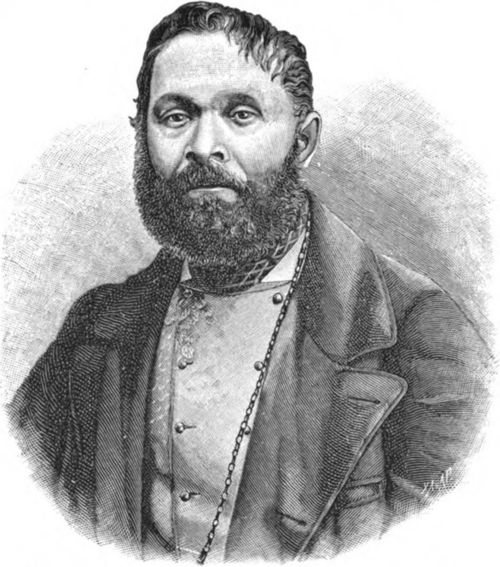
Johannes Mehring (* 24. Juni 1816 in Kleinniedesheim; † 24. November 1878 in Frankenthal)
Johannes Mehring first made comb foundation in 1857.
Straight combs were assured when Johannes Mehring, a carpenter from Germany designed wax foundation with octagonal indentations (5 per inch) for use in Langstroth’s frames.
Below Source: Chest of Books
When Langstroth invented the loose-hanging frame and the top-opening hive, he paved the way for a substantial industry in the production of honey, but two other important inventions were necessary before rapid progress was possible. Until the invention of the extractor and comb foundation, beekeeping was far from easy.
Prior to the invention of foundation, the beekeeper found great difficulty in obtaining straight combs and in controlling the building of drone cells. In his personal recollections which appeared in Gleanings in 1893, Langstroth mentioned the difficulty of inducing the bees to confine each comb to a separate frame. He recounted the experience of Della Rocca a hundred years previous in supporting small pieces of worker comb on the bars which he used with his hives. Huber made some improvement of this arrangement, but fell short of “Golding’s simple plan of dipping the upper part of his guides in melted wax. “
Because of the difficulties mentioned above, Langstroth spent much time in the development of a comb guide which would insure straight combs. The result was a triangular guide at top of frames to take the place of the guide combs. This sharp edge below the top bar provided an attractive place for the bees to start the combs and proved of some help. Langstroth applied for a patent, feeling that it was essential to the success of his hives. Much delay ensued and similar applications from others finally resulted in the refusal of the commissioner to issue a patent to anyone.
Charles Dadant later told the story in the bee magazines of the effort which he made to secure worker comb during the early years of his experience, before foundation came into use. He sent his son about the country in early spring to buy the combs from all colonies which had died during the winter. Every piece was carefully saved and many small bits pieced together to the best advantage.
Johannes Mehring first made comb foundation in 1857.
Later when Langstroth discovered that the triangular guide had been anticipated by John Hunter in 1793, and long before that by Della Rocca, he expressed great satisfaction because no patent had been issued to him. He had incurred many vexations, loss of time, and much expense, but he regarded these as trifling in comparison to the pain which comes to an honest inventor “when apparent success gives way to bitter mortification of finding the patent absolutely worthless. ” Hunter had written that, by the use of a salient angle, bees could be induced to build their combs in any direction desired and Della Rocca had described the triangular device for the same purpose.
Later a patent was issued to another claimant and Langstroth was sued for infringement. By this time, having the necessary information at hand, it was easy to defend the suit, but not without some annoyance and expense.
To get a hive filled with good, straight combs required close attention on the part of the beekeeper. It was a common practice to place an empty frame between two well-built combs. In this way, the bees would find it quite natural to build the new one in the desired manner.

Root developed his first foundation mill in 1876, and announced it as “a complete success. “
The invention of foundation must be credited to a German, Johannes Mehring, who first succeeded in producing a crude product in 1857. He invented a press to impress wax wafers with the indentations common to the bottoms of the cells. There were no projections for ceil walls, and the bees consequently were less inclined to build only worker comb. Much drone comb was built on such foundation but it did provide a means of securing straight combs. A Swiss apiarist.
Peter Jacob, improved the Mehring press, and some of his foundation was imported to America in 1865.
Samuel Wagner appears to have made some attempts to manufacture foundation, adding shallow sidewalls and, in 1861, secured a patent on the manufacture of artificial honey comb foundation by whatever process made. He was not successful and later dropped the matter. In the meantime his patent probably kept others from experimenting and probably delayed the perfection of the process.
In 1876 Gleanings published directions by F. Cheshire for making a plaster of Paris mould on which foundation could be made. In the same issue, the editor comments at length on this and on the foundation made in this country by a man named Long and by F. Weiss, a German.
A. I. Root, with his characteristic enthusiasm, took up the improvement of the manufacture of foundation, which in its crude form had demonstrated its value to the beekeeper. He employed a man named A. Washburn to develop metal rollers with the proper impressions. Although Washburn actually did the work, he was working under Root’s direction, at Root’s expense, and it was Root who took the risk of failure. In the March, 1876, issue of Gleanings, the announcement is made under date of February 26, “we are happy to state that the metal rollers are a complete success. ” The impressions were cut out by hand with metal punches.
This idea of the metal rollers solved at once the problem of making foundation. Apparently, other workers had thought only of making it on a flat surface in some kind of press. In a letter from Wagner, published in Gleanings in 1876, he indicates that he was using a hexagonal type from which he made stereotype or electrotype plates on which the foundation was impressed.
Wagner found his cast foundation very fragile and experimented with paper as a base with the idea that, with a wax covering, it would serve the purpose more successfully. Never has the idea that a paper center foundation would be ideal been permitted to die. Even yet, at frequent intervals, the thing is revived by someone who thinks he has made a new discovery. Wagner reported in the American Bee Journal, in 1867, that light and beautiful foundation could be made of gutta percha but that it soon became so friable that the material could not be used.

