Tags
artificial insemination, Dr. Lloyd R Watson, famous beekeepers, instrumental insemination, queen honey bee
Dr. Lloyd Raymond Watson (1876–1948)
Birth: 7 September 1876 — Cuba, Allegany County, New York, USA Death: 24 February 1948 (aged 71) — North Hornell, Steuben County, New York, USA Burial: Alfred Rural Cemetery, Alfred, Allegany County, New York, USA
Dr. Lloyd Raymond Watson was the first person to demonstrate a workable method for instrumentally inseminating a queen honey bee — and the man who gave the procedure its name.
The problem he solved
For most of the history of beekeeping, the queen’s mating flight was a closed door. A virgin queen leaves her hive, mates in the air with a dozen or more drones from colonies miles away, and returns carrying a lifetime supply of semen. The beekeeper sees none of it and controls none of it. Every other domesticated animal — cattle, horses, poultry, dogs — had been improved by controlling who bred with whom. The honey bee alone resisted, because half of every pairing was invisible.
Francis Huber had described the essentials of queen mating in the 1790s. Johann Dzierzon worked out in 1845 that drones develop from unfertilized eggs. But knowing how bees mate did not mean anyone could direct it. Through the nineteenth century, beekeepers tried isolated mating yards, island apiaries, screened flight cages — and a handful, including Nelson W. McLain working for the U.S. Department of Agriculture in the 1880s, tried to inseminate queens by hand. The attempts failed or produced results too erratic to build on, and by the time Watson took up the question the earlier work had largely been forgotten.
The breakthrough
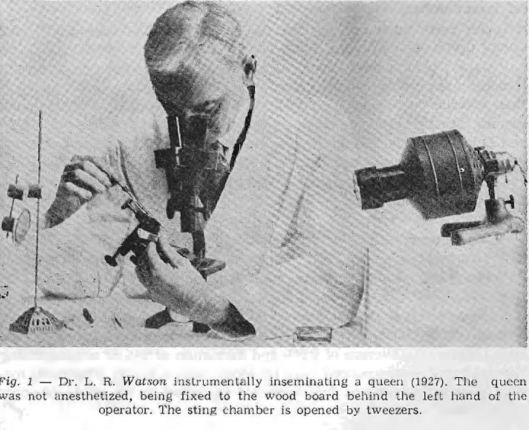
Watson attacked the problem as his doctoral research at Cornell University, completing the Ph.D. in 1926. His apparatus was, by modern standards, startlingly simple: a stereomicroscope, a light source, hand-held forceps to open and hold the queen’s sting chamber, and a capillary syringe charged with drone semen. There were no micromanipulators, no CO₂ narcosis protocol, no purpose-built queen holder — only steady hands, good optics, and an anatomist’s understanding of where the semen had to go.
His success rate was inconsistent, and he knew it. But inconsistent success is a categorically different thing from failure. Watson’s queens could be inseminated, could be returned to colonies, and could lay fertilized eggs that produced workers. He had demonstrated to a skeptical beekeeping community that the thing was possible at all — and once it was possible, it became an engineering problem rather than a mystery.
He also named it. Watson deliberately chose “instrumental insemination” over the more common “artificial insemination,” arguing that nothing about the process was artificial — the semen and the queen were entirely real, and what distinguished the technique was its dependence on instruments. The term stuck, and it remains, so far as the literature suggests, unique to honey bees.
He published the work for the wider scientific world as “Controlled Mating in Honeybees” in The Quarterly Review of Biology (Vol. 3, No. 3, September 1928, pp. 377–390), and wrote extensively for the beekeeping press in the American Bee Journal, the Journal of Economic Entomology, and Bee World.
Career
Watson was an Allegany County man for most of his life. He took his A.B. from Alfred College in 1905 and his A.M. there in 1914, and eventually returned as a professor at Alfred University. In between he worked as an instructor in chemistry, as an extension apiculturist, as an assistant apiculturist with the U.S. Bureau of Entomology, and as a state apiarist — a career that moved back and forth between the laboratory, the classroom, and the bee yard.
In 1936 the John Simon Guggenheim Memorial Foundation awarded him a fellowship “for research toward the development of new and improved types of honeybees,” with a tenure of six months beginning 1 April 1936 and a further six months beginning 1 April 1937. It was recognition that his technique was not an end in itself but a tool — the first tool that made deliberate honey bee breeding conceivable.
Legacy
Watson opened the door; others widened it. Over the following two decades, W. J. Nolan, Harry H. Laidlaw Jr., Otto Mackensen, and William Roberts refined the procedure into something reliable and teachable. Laidlaw’s careful anatomical work on the queen’s valve fold — published in 1944 — explained why so many early inseminations failed and how to place semen so that it reached the spermatheca. Purpose-built instruments, CO₂ treatment to induce egg laying, and standardized technique followed.
Today instrumental insemination is the foundation of serious honey bee stock improvement worldwide. Every closed-population breeding program, every Varroa-resistance selection line, every effort to conserve a regional subspecies rests on the ability to know exactly who a queen mated with. That ability begins in a laboratory in western New York, with a man, a microscope, a pair of forceps, and a great deal of patience.
 Beekeeping365