• Sassafras Bee Farm
  • About
  • Contact

Beekeeping365

~ The more I studied beekeeping, the less I knew, until, finally, I knew nothing. But, even though I knew nothing, I still had plenty to unlearn. Charles Martin Simon

Beekeeping365

Daily Archives: December 14, 2020

Raw Honey FAQ

14 Monday Dec 2020

Posted by Beekeeping365 in beekeeping

≈ Leave a comment

Tags

beekeeping, raw honey

11407203_1604162183199559_5682916072016194813_n

I know this but after an evening answering questions at a local famer’s market I decided I needed as refresher on Raw Honey myself – just in case I was omitting some points. I found the following on a blog called Honey Traveler.

Raw honey is honey that is unheated and minimally processed. It is pure honey where nothing has been added or removed. To be raw, honey should not be heated above temperatures one would normal find in a hive (approximately 95 degrees F). Additionally it should not be ultra-finely filtered to the point of removing pollen and organic materials that are an intrinsic constituent of honey.

Unheated, “raw” honey contains all the vital ingredients that give it its healthful properties and wonderful aroma. Most commercial honey you see in supermarkets is not raw honey. This mass produced honey is often heated to temperatures far above the normal temperatures of the bee hive. Heating past the maximum hive temperature of 95 degrees Fahrenheit changes honey’s essential composition and degrades its quality. It partially destroys honey’s beneficial enzymes and ‘boils off’ volatile compounds that account for the unique, delicate floral aroma of the honey. This is done to make it easier to extract from the honey comb, to filter it, to package it, to ‘pasteurize’ it to kill benign yeast and prevent fermentation and to delay crystallization.

Micro-filtering also degrades the healthful properties of honey by removing beneficial pollen residue. Much commercial honey is micro-filtered, often using a diatomaceous earth (DE) process to eliminate even micron-sized particles. Why go to these lengths when a relatively coarse strain would result in a clear, visually beautiful product and not remove healthful pollen? The reason is to slow down the naturally occurring crystallization of honey. Tiny particles act as ‘seeds’ for the crystallization process, by removing them with micro-filtering, crystallization is delayed.

But crystallization is not a problem to be solved. Almost all honeys crystallize after time. It is actually a good sign the honey is raw. To re-liquify, simply heat the honey jar in warm water (104 F, 40 C) until it returns to the liquid state, stir occasionally to transfer heat, and replace the hot water if needed. Note some honeys will not crystallize easily because of low glucose levels and in these cases, this is not a sign of heating or micro-filtering (ex. honeydews, black locust-acacia, tupelo, sourwood, sunflower, sage).

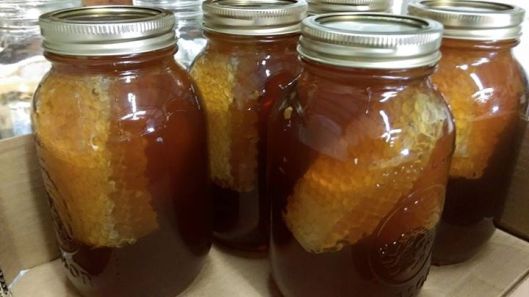
A good trick to ensure you are getting raw, unprocessed honey is to purchase it in the comb.

Health Benefits of Honey Negatively Affected by Heating

Many of the healthful organic compounds and substances in honey are destroyed or inhibited by heat.

Antibacterial, Antimicrobial Properties from Enzymes in Raw Honey:
The main enzymes in honey are invertase (saccharase) diastase (amylase) which break down sugars and help digestion. The enzyme glucose oxidase produces the antibacterial, antimicrobial hydrogen peroxide, a well-known disinfectant.

Antioxidant Properties in Raw Honey:
Dependent upon enzymes and a wide range of compounds in honey, antioxidants are substances that can retard or inhibit oxidation and/or neutralize the effects of damaging “free radicals”. Increasing the body’s antioxidant content may help protect against cellular damage and the development of chronic diseases.

From the Journal of Agricultural and Food Chemistry 2002, Vol. 50, No. 21, pp.5870-5877:
“…Antioxidant analysis of the different honey fractions suggested that the water-soluble fraction contained most of the antioxidant components, including protein; gluconic acid; ascorbic acid; hydroxymethylfuraldehyde; and the combined activities of the enzymes glucose oxidase, catalase and peroxidase. Of these components, a significant correlation could be established only between protein content and oxygen radical absorbance capacity ORAC activity (R(2) = 0.674, p = 0.024). These results suggest that the antioxidant capacity of honey is a product of the combined activity of a wide range of compounds including phenolics, peptides, organic acids, enzymes, Maillard reaction products, and possibly other minor components…”

Other antioxidants include polyphenols, flanonoids and phenolic acid in Raw Honey. Polyphenols in foods are thought to play important roles in human health such as cancer preventative, and anti-inflammatory, radical scavenging and antioxidative activities. The most important classes of antioxidant polyphenols are the flavonoids and phenolic acids. It is these substances in honey, wine, fruits and vegetables that are most responsible for the antioxidant characteristics, and thus the healthy image of these foods.

Darker honeys like Buckwheat honey are stronger antioxidants compared to lighter honeys.

Source: http://www.honeytraveler.com/types-of-honey/raw-honey/

Feel free to share this on:

  • Share on Facebook (Opens in new window) Facebook
  • Share on X (Opens in new window) X
  • Share on Pinterest (Opens in new window) Pinterest
  • Email a link to a friend (Opens in new window) Email
  • Share on LinkedIn (Opens in new window) LinkedIn
  • Share on Reddit (Opens in new window) Reddit
  • Share on Tumblr (Opens in new window) Tumblr
  • Print (Opens in new window) Print
  • Share on Telegram (Opens in new window) Telegram
  • Share on WhatsApp (Opens in new window) WhatsApp
Like Loading...
Follow Beekeeping365 on WordPress.com

Enter your email address to follow this blog and receive notifications of new posts by email.

Calendar

December 2020
S M T W T F S
 12345
6789101112
13141516171819
20212223242526
2728293031  
« Nov   Jan »

Posts by Month:

  • August 2026 (4)
  • July 2026 (1)
  • May 2026 (2)
  • January 2026 (3)
  • July 2025 (1)
  • April 2024 (1)
  • September 2022 (1)
  • July 2022 (1)
  • March 2022 (13)
  • February 2022 (17)
  • January 2022 (4)
  • December 2021 (4)
  • November 2021 (7)
  • October 2021 (1)
  • September 2021 (3)
  • August 2021 (11)
  • July 2021 (18)
  • June 2021 (5)
  • May 2021 (2)
  • April 2021 (9)
  • March 2021 (2)
  • February 2021 (5)
  • January 2021 (16)
  • December 2020 (15)
  • November 2020 (15)
  • October 2020 (11)
  • July 2020 (1)
  • February 2020 (1)
  • March 2019 (2)
  • February 2019 (4)
  • January 2019 (1)
  • December 2018 (10)
  • November 2018 (8)
  • October 2018 (15)
  • September 2018 (25)
  • August 2018 (3)
  • July 2018 (11)
  • June 2018 (27)
  • May 2018 (33)
  • April 2018 (20)
  • March 2018 (20)
  • February 2018 (12)
  • January 2018 (22)
  • December 2017 (18)
  • November 2017 (17)
  • October 2017 (25)
  • September 2017 (27)
  • August 2017 (21)
  • July 2017 (29)
  • June 2017 (28)
  • May 2017 (19)
  • April 2017 (17)
  • March 2017 (19)
  • February 2017 (12)
  • January 2017 (13)
  • December 2016 (5)

Posts by Categories:

  • absconding (1)
  • africanized honey bees (1)
  • apitherapy (1)
  • bee health (6)
  • bee law (2)
  • bee lining (2)
  • bee removals (2)
  • beekeeper (5)
  • beekeeper education (16)
  • beekeeping (612)
    • South Carolina (2)
  • beekeeping author (10)
  • beekeeping books (14)
  • beekeeping calendar (4)
  • beekeeping chores (8)
  • beekeeping equipment (26)
  • beekeeping history (49)
  • beekeeping management (37)
  • beekeeping pest management (8)
  • beekeeping seasons (23)
  • beekeeping vocabulary (16)
  • beeswax (13)
  • biography (4)
  • biology (14)
  • birthday (40)
  • birthdays (34)
  • book review (16)
  • breakfast (1)
  • calendar (4)
  • CCD (1)
  • chores (6)
  • comb (7)
  • comb honey (10)
  • commercial beekeeping (2)
  • cutouts (2)
  • dearth (3)
  • defensiveness (2)
  • diseases (9)
  • drawn comb (6)
  • ecology (4)
  • education (28)
  • equipment (25)
  • extracting (1)
  • fall nectar flow (1)
  • famous beekeepers (27)
  • feeding bees (7)
  • first blog entry (1)
  • folklore (1)
  • food (7)
  • forage (4)
  • hacks (3)
  • hive inspections (8)
  • hive placement (2)
  • hive products (6)
  • honey (90)
  • honey as food (22)
  • honey bee anatomy (3)
  • honey bee behavior (25)
  • honey bee biology (43)
  • honey bee genetics (4)
  • honey bee nutrition (1)
  • honey bee photos (6)
  • Honey Bee Research (1)
  • honey bee vocabulary (12)
  • honey bees (14)
  • honey judging (4)
  • honey recipe (65)
  • humor (13)
  • inspections (10)
  • journal (1)
  • log book (1)
  • making increase (3)
  • management (82)
  • mentoring (2)
  • mites (3)
  • national pollinator week (2)
  • nectar flow (6)
  • nomenclature (1)
  • opinion (8)
  • out yards (1)
  • outyards (1)
  • package bees (1)
  • pears (1)
  • pests (17)
  • plants for bees (3)
  • polish (1)
  • pollen (4)
  • pollination (11)
  • pollinators (7)
  • product review (1)
  • production (1)
  • products (3)
  • propolis (2)
  • queens (17)
  • raw honey (6)
  • recipe (88)
  • removals (1)
  • safety (3)
  • sales (2)
  • season (1)
  • seasons (21)
  • sideliner (1)
  • small hive beetles (1)
  • spring buildup (4)
  • state fair (2)
  • sustainable (7)
  • swarms (27)
  • ursurpation (1)
  • usurpation (1)
  • varroa (21)
  • varroa destructor (12)
  • varroa mites (24)
  • Winter (5)
  • winter solstice (2)
  • woodenware (3)
  • yellow jackets (2)

Sassafras Bee Farm on Facebook

Sassafras Bee Farm on Facebook

Sassafras Bee Farm

Sassafras Bee Farm

Recent Posts

  • Meeting Reality vs What Seems Deserved
  • Everything Starts with a Tasty Meal: The Science Behind a Beekeeper’s Best Pest-Management Insight
  • Pest Control
  • State Fair Wax Preparation
  • Sherlock Holmes and Beekeeping: A Unique Connection

Beekeeping365 on Facebook

Beekeeping365 on Facebook

Top Posts & Pages

  • Types of bees by Fat Daddy’s Apiary
    Types of bees by Fat Daddy’s Apiary
  • Meeting Reality vs What Seems Deserved
    Meeting Reality vs What Seems Deserved
  • Early Spring? Or not...
    Early Spring? Or not...

Blog Stats

  • 141,317 hits

Website Built with WordPress.com.

  • Subscribe Subscribed
    • Beekeeping365
    • Join 426 other subscribers
    • Already have a WordPress.com account? Log in now.
    • Beekeeping365
    • Subscribe Subscribed
    • Sign up
    • Log in
    • Report this content
    • View site in Reader
    • Manage subscriptions
    • Collapse this bar
Loading Comments...
%d