Tags
The story starts years ago when I noticed that the bees flew with more enthusiasm and worked harder in the days following a varroa mite treatment (oxalic acid vaporization). I asked others if they too saw this behavior change. Some said they never took notice; others said it was obvious. Years later I measured the coming and going on the landing board using one of those click counters. It was true; the bees were energized after a treatment. But I didn’t have the answer as to why. Last summer I spoke to someone more knowledgeable than I in entomology and he used the analogy, “Have you ever noticed how good a dog feels the day after a flea dip?” A great reply that satisfied me for a while. But I thought, putting a dent in a 3% mite load — not even eliminating the mites — couldn’t increase the entire colony’s enthusiasm as evidenced by the increase in activity on the landing board. Could it? Or was something else going on? But I’m getting ahead of myself.
Oxalic Acid as a Disinfectant
Back in 2021, I started doing some research and learned that the EPA first approved oxalic acid (OA) in 1957 as a disinfectant in bathrooms, swimming pools, and sewage and drainage systems, among other uses.1 It’s still used today in cleaning solutions for industrial food-production machines, not to mention good old Bar Keeper’s Friend. If you’re not sure of the definition of disinfectant, look it up — it’s different from a sanitizer, cleaner, or antibacterial. The EPA’s own regulatory definition of “disinfectant” does include destroying or inactivating viruses, not just bacteria.2 But here’s a wrinkle I didn’t appreciate until I went back and checked: a product can’t legally claim virus-killing power just because it’s registered as a disinfectant in general. EPA requires specific test data before a virucidal claim goes on a label, and oxalic acid’s original 1957 registration only carries data for bacteria and general germs — not viruses.3 So the “disinfectant” label tells me OA belongs to the right broad category of chemical, but it doesn’t, by itself, prove OA is killing viruses in my hives. That’s still my hypothesis to prove, not a fact I get to borrow from the EPA paperwork. Was OA also acting as a chemical scrubbing of the internal surfaces of the hive and the bees themselves? Was I killing bacteria and viruses as well as mites? I didn’t know, but I wanted to try a few things.
Starting the Routine Schedule
Over two years ago, in January 2022, I started treating my bee hives routinely with OA vapor — “routine schedule” meaning a set date each month on my calendar, similar to taking a blood pressure medication on a routine schedule, or a medicine for a chronic condition like diabetes or reflux. I think of it as an IPM treatment for mites and their accompanying viruses.
This isn’t as far a stretch as it might sound. In nursing, we’re taught to administer medications only after verifying the five rights: right patient, right medication, right dose, right route, right time. Applying that framework to pesticide administration isn’t a stretch either — both involve delivering a chemical substance to a living organism in hopes of a beneficial outcome. Physicians sometimes order medications on schedules that fall outside the manufacturer’s standard recommendation, tailored to a particular patient’s situation, and as treatment has advanced, we’ve moved toward managing chronic illness before it becomes acute — we don’t wait for the stroke or the diabetic coma before we intervene, and then discharge without ongoing management. We manage the disease continuously. I think we currently let our bees stay sick much of the time, performing sub-par, and only step in when they’re approaching the acute, terminal stage. I fully support not overusing pesticides in the hive — the reasons economic thresholds exist are good ones, and an overused pesticide breeds tolerance and becomes useless. But I think there’s a version of “right schedule, right rotation” that lets us manage the chronic illness of our bees without letting them get sick first.
My goals were to 1) decrease the number of yearly OA treatments and 2) reduce the likelihood of resistance to OA developing. Really, all I was changing was one aspect of treatment — the dosing schedule — from one that targeted the mites’ reproductive cycle to one that disinfected the colony’s environment on a regular interval. Any varroa mites killed in the process would be a value-added outcome.
That year I had no colony losses during the spring, and I made more honey than usual. I did have some colony failures (~10%) after the nectar flow during our dearth period, as is typical — multiple stressors (small hive beetle, harvest, and climbing mite-to-bee ratios) take their toll during that window as mite load climbs and viral load along with it. I intervened with a single series of OA treatments and the losses stopped, which pointed me toward mite/viral load as the most critical stressor. After that series, I resumed my scheduled monthly treatments and had no winter losses.
In January 2023, I continued the routine schedule and again had no losses during the nectar flow. This year I made a change for the post-nectar-flow period: a treatment every two weeks (the 1st and 15th) from June through October, adding about five extra treatments for the year — pushing me toward the edge of my own goal to limit total treatments. In November I went back to the monthly schedule. The result: no colony losses in spring, summer, fall, or winter of 2023. Honey production ran about 65 lbs. per hive, roughly 50% above what’s typical in the SC Midlands. Keeping bees healthy through the nectar flow keeps them working harder, rather than the more common pattern of letting their health decline over the season until they collapse just ahead of a “salvation” treatment.
That brings me to 2024. No mite or virus-related losses so far. Coming out of winter I saw the occasional weak colony needing a new queen or help with small hive beetles, but buildup was fast in the pre-season. I did my tax accounting and used less sugar last year, having left more honey on the hive thanks to their productivity (and my reluctance to pay for sugar). They’re healthy and handling stressors well.
What Research Actually Says
I spent some time this year researching organic acids as disinfectants and antimicrobials, and there’s real science here — organic acids can be antivirals, and it’s dose- and pH-dependent to a degree. A 3% oxalic acid solution, the concentration most beekeepers mix, lands somewhere around pH 2, though the exact number moves with concentration — straight crystals run closer to pH 1.5, and a well-diluted solution can sit up near pH 4.4 There are some unidentified factors at play too. A 2024 study in the journal Tropical Medicine and Health tested acetic, oxalic, and citric acid head-to-head against influenza, SARS-CoV-2, and feline calicivirus at matched pH levels, and found that acetic acid could inactivate the flu virus at a milder pH than oxalic or citric acid needed to do the same job — meaning virucidal effect isn’t simply a function of how acidic the acid is.5 That’s a nice confirmation of something I’d suspected but couldn’t fully source: the reason organic acids kill viruses, and which ones do it best against which viruses, is still something of an open question in the literature.
Where I have to be honest with myself: that research is about organic acids and viruses in a petri dish, not specifically about oxalic acid and bee viruses in a hive. I went looking for a study that would confirm OA directly suppressing bee viruses the way I’m proposing, and I didn’t find one that backs it cleanly — one field trial I came across actually measured viral loads (Deformed Wing Virus and Acute Bee Paralysis Virus) rising after an oxalic acid trickle treatment, right alongside a rise in the untreated control group.6 So this part of my theory stays a hypothesis, not a demonstrated fact, and I want to be upfront about that rather than dress it up as settled science.
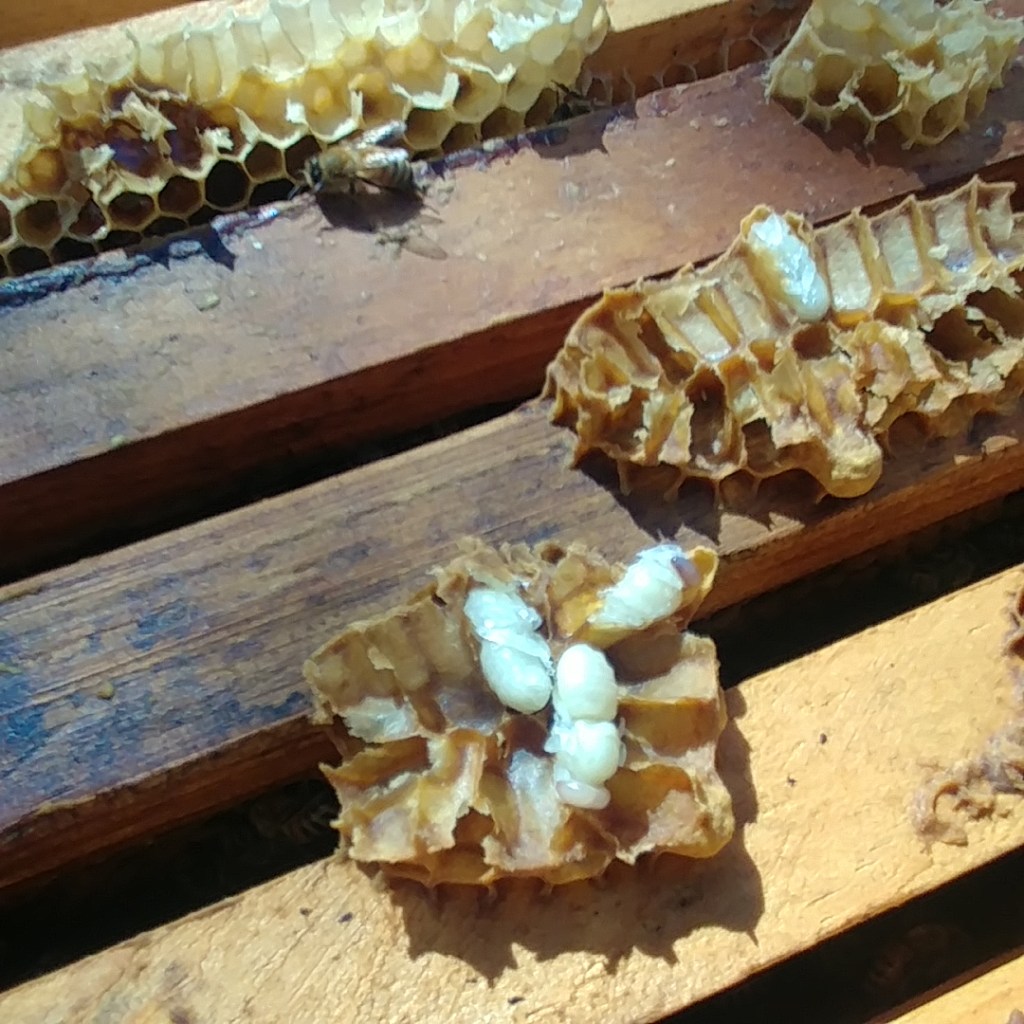
Why is this interesting anyway? First, because it shouldn’t be working — one would think my colonies would be mite-ridden and failing, since this schedule gives mites more time between treatments than a reactive approach would. But I haven’t seen a case of deformed wing in years, and skewering drone pupae shows the mites are under control. Second, because mite levels are now out of the treatment-decision loop, I’ve stopped watching my bees decline before they trip whatever this season’s action threshold happens to be. Third, I honestly wouldn’t mind if my mite counts were high — it would confirm something other than mite-killing is doing the work. Fourth, I’m exposing my bees to the same amount of OA, or less, than a standard reactive schedule would use. Fifth, more time between treatments means less chance of building resistance — and it’s worth saying plainly that as of now there are no confirmed reports of varroa developing resistance to oxalic acid anywhere, which is a genuinely good track record compared to the synthetic acaricides.7 That said, extension entomologists still recommend rotating treatments as a hedge rather than relying on any one product indefinitely, so I’m not treating “no resistance yet” as a guarantee it’ll stay that way.8 Sixth, it simplifies a process that overwhelms a lot of new beekeepers — mite assessment, seasonal thresholds, choosing the right miticide for the month and temperature. Seventh, my bees stay healthy and productive all year, without the yo-yo of cleaning them up only to let them slide back toward collapse before the next rescue series. That yo-yo isn’t healthy living. We don’t let diabetics go into a coma before treating them, or let HIV patients run high viral loads before we intervene — we manage the illness rather than wait for the crisis. Our colonies don’t die from the mites; they die from the high viral loads the mites bring with them.
How is this working? My supposition is that I’m killing viruses, or a subset of them, directly — bypassing the need to fight the mite as a vector. Another possibility is that I’m interrupting the mite-virus relationship to the mite’s detriment. I don’t know which, if either, is right. It could be something else entirely that I haven’t considered.
The Breakthrough Thought — and Where I’ve Had to Pull Back
One thing that’s plagued me is that noticeable change in demeanor within a day or two of treatment — more energy, more intent, more enthusiasm on the landing board. It never made sense that killing some fraction of a 3% mite load would produce a colony-wide mood shift. My working theory for a while was that removing even a few mites reduced viral load enough to matter, since bees pass food and pheromone constantly through trophallaxis — if one bee carries virus, the whole colony is soon exposed through contact, grooming, and shared food.
I’d been citing a 2015 source that described oxalic acid as an antibacterial compound and framed mite reduction as a side effect of that antibacterial action. Going back to properly source that for this rewrite, I couldn’t relocate or verify the site, so I’m setting that particular citation aside until I can pin down where it actually came from — I don’t want to build an argument on a quote I can’t stand behind.
Here’s where I land instead: it’s reasonable to think that a monthly dose of OA is doing some general sanitizing of the hive’s internal surfaces and the bees themselves, similar to how a household disinfectant works on a countertop — and, notably, cleaning products with proven antiviral action against human pathogens are common and unremarkable. What makes OA unusual is that it can be safely delivered directly onto a living colony, which most disinfectants can’t claim. If the bees were living in an environment thick with viruses and passed constantly through trophallaxis, they’d plausibly feel run-down most of the time, the way we do with a low-grade infection — and a monthly disinfecting dose might give them room to recover between exposures. That’s a coherent hypothesis. It just isn’t a proven one yet, and I want to say that plainly rather than lean on the “disinfectant equals antiviral equals proven” logic I was using before — that chain has a real gap in it once you look closely at what the label was actually tested for.
One more correction I owe myself: I’d been saying bees don’t really have an immune system the way we do, and that most of their defense runs through the propolis envelope and nutrition. That’s an overstatement. Bees do have an individual innate immune system — immune cells in the hemolymph, defense proteins like phenoloxidase — it’s just a scaled-down one compared to solitary insects, carrying roughly a third of the immune-related genes some other insects have.9 What they’ve evolved instead is social immunity: propolis, grooming, hygienic behavior, all working alongside the individual system rather than replacing it. So “the colony’s immune system leans hard on propolis and nutrition” is fair; “bees don’t have one” isn’t.
On the mite-killing side, we still don’t fully know the mechanism — the EPA’s own label for oxalic acid says as much, listing the mode of action as unknown.10 We do know mite knockdown peaks within the first two to three days post-treatment, tapering afterwards.11 One open question I keep turning over: could OA be disrupting a symbiotic relationship between the mite and some other microbe, say in its gut, causing a slower die-off over those first few days rather than a direct kill? I don’t have an answer.
Using OA once a month shouldn’t promote tolerance, given it breaks down in the hive faster than the synthetic acaricides and there’s no confirmed resistance on record. I suspect it could be used more frequently than monthly, but once a month is the more sustainable choice for most beekeepers. If I were pitching this to a pharmaceutical company’s R&D team, the next questions would be the obvious ones: best dosage, best frequency, best route. My best guess is that vaporization is the right route, since it coats the entire interior with OA crystals; the right dosage is still undetermined and could turn out to be higher or lower than current guidance. It’s also worth noting the guidance itself has kept moving in a direction that makes this easier: the EPA cleared OA for use with honey supers on the hive back in 2021, reversing the old restriction,12 and more recently raised the allowed vaporizer dose from 1 gram to 4 grams per brood chamber based on research showing the higher dose is effective without harming the bees.13 Both changes make a routine, honey-season-friendly schedule more practical than it would have been when I started this in 2022.
One more thing worth naming: this experiment might produce colonies with higher mite counts that never get sick, which means future mite counts alone may not be the right barometer of success. Who cares if my mite counts run higher, as long as the bees stay healthy and productive?
Takeaways: Oxalic acid is unusual among disinfectants in that it’s safe to administer directly within a living hive. The benefit I’m chasing isn’t a lower mite count — it’s year-round, consistent colony health and productivity, instead of the current default of cycling between “sick” and “well” periods.
This honey season is off to a great start. All supers are already deployed, and I’m wondering how I’m going to keep up with giving the bees enough space now that they’ve gone gangbusters. Cheers!
Brief update, 7/20/2025: I’m just back from my state beekeepers’ association’s summer conference. Talk of mites always triggers a little guilt that I haven’t updated this in a while, so the effort continues. I’ve tried to maintain the routine monthly schedule, with some disruption during a personal health event. The healthy-bees, minimal-losses pattern has held — a near-perfect survival rate in the middle of record national losses across the US is rewarding to see. I don’t make it to as many conferences as I used to, but among the people I’ve shared this with, there’s a shared read that I may simply be keeping the viral threshold below the point where illness develops. Randy Oliver has written about colonies hitting a tipping point at a certain mite count, beyond which they’re doomed to failure — a framing that lines up with the broader consensus that varroa itself rarely kills a colony outright; it’s the virus the mite carries that does. I think that’s a reasonable read of what I’m seeing too — that the viral threshold is being held in check, by a little or by a lot, I still can’t say for certain.
Notes
U.S. EPA, Pesticides — Fact Sheet for Oxalic Acid (PC-009601): oxalic acid was first registered as a pesticide in 1957 for bathroom disinfectant use, swimming pool water systems, drainage and sewage systems, and eating establishments. epa.gov (archived reregistration fact sheet, www3.epa.gov/pesticides/chem_search/reg_actions/reregistration/fs_PC-009601_1-Dec-92.pdf) ↩
U.S. EPA, “Selected EPA-Registered Disinfectants”: a disinfectant is defined as a substance that destroys or irreversibly inactivates bacteria, fungi, and viruses on hard surfaces. epa.gov/pesticide-registration/selected-epa-registered-disinfectants ↩
U.S. EPA, Interim Guidance for the Evaluation of Products for Claims Against Viruses (Oct. 2024): registered products may not carry pathogen-specific efficacy claims, including virucidal claims, unless EPA has reviewed supporting data and approved the label language. epa.gov/system/files/documents/2024-10/11108-02_interim_virucidal_claim_guidance_2024_10_10.pdf ↩
pH figures for oxalic acid at various concentrations, per whatistheph.com/substance/Oxalic_Acid and completeera.com’s oxalic acid pH overview — undiluted crystals run roughly pH 1.5–2, with pH rising as the solution is diluted. ↩
Ogura, T. et al., “pH-dependent virucidal effects of weak acids against pathogenic viruses,” Tropical Medicine and Health (2024). Acetic acid inactivated influenza virus at approximately pH 4, while citric and oxalic acid required a lower pH for the same effect. pmc.ncbi.nlm.nih.gov/articles/PMC10785384/ ↩
Field trial comparing oxalic acid trickle treatment to lithium citrate found Acute Bee Paralysis Virus and Deformed Wing Virus loads increased significantly in the oxalic-acid group post-treatment (loads also rose in the untreated control). PMC, ncbi.nlm.nih.gov/pmc/articles/PMC9510912/ ↩
Washington State University Extension, “Oxalic Acid Options for Controlling Varroa destructor“: no reports of miticide resistance to oxalic acid to date. pubs.extension.wsu.edu/product/oxalic-acid-options-for-controlling-varroa-destructor/ ↩
NC State Extension, “Oxalic Acid for the Control of Varroa Mites”: recommends rotating treatments rather than relying on oxalic acid alone, even though resistance hasn’t yet been documented. content.ces.ncsu.edu/oxalic-acid-for-the-control-of-varroa-mites ↩
Honey bees innate and social immunity: bees possess hemolymph immune cells and defense proteins such as phenoloxidase but carry comparatively fewer immune-related genes than many other insects, relying heavily on social immunity (propolis, grooming, hygienic behavior) to compensate. See overviews at imanagement.ch (apisavoir.ch, “Social Immunity in Honey Bees”) and the review in Revista Mexicana de Ciencias Pecuarias, scielo.org.mx/pdf/rmcp/v10n3/2448-6698-rmcp-10-03-705-en.pdf ↩
U.S. EPA oxalic acid product label (EPA Reg. No. 091266-00001): resistance management section states oxalic acid’s mechanism of action is unknown. www3.epa.gov/pesticides/chem_search/ppls/091266-00001-20210430.pdf ↩
Honey Bee Suite, “Using Oxalic Acid Vaporization When Brood Is Present”: peak mite drops typically occur within the first two to three days of treatment. honeybeesuite.com/using-oxalic-acid-vaporization-when-brood-is-present/ ↩
EPA label amendment, effective 4/30/21, permitting oxalic acid use with honey supers on the hive. Reported via OxaVap, oxavap.com/information/, and MiteCalculator.com’s coverage of the label change. ↩
University of Florida IFAS, “Using research to change regulation: Honey bee research impacts EPA labeling” (2025): EPA raised the allowed oxalic acid vaporizer dose from 1 gram to 4 grams per brood chamber following UF/IFAS research. blogs.ifas.ufl.edu/news/2025/09/17/using-research-to-change-regulation-honey-bee-research-impacts-epa-labeling/ ↩
 Beekeeping365