• Sassafras Bee Farm
  • About
  • Contact

Beekeeping365

~ The more I studied beekeeping, the less I knew, until, finally, I knew nothing. But, even though I knew nothing, I still had plenty to unlearn. Charles Martin Simon

Beekeeping365

Tag Archives: nucleus hives

Nuc and Swarm Trap Building

04 Sunday Jan 2026

Posted by Beekeeping365 in swarms

≈ Leave a comment

Tags

nucleus hives, swarm bait hives, swarm traps

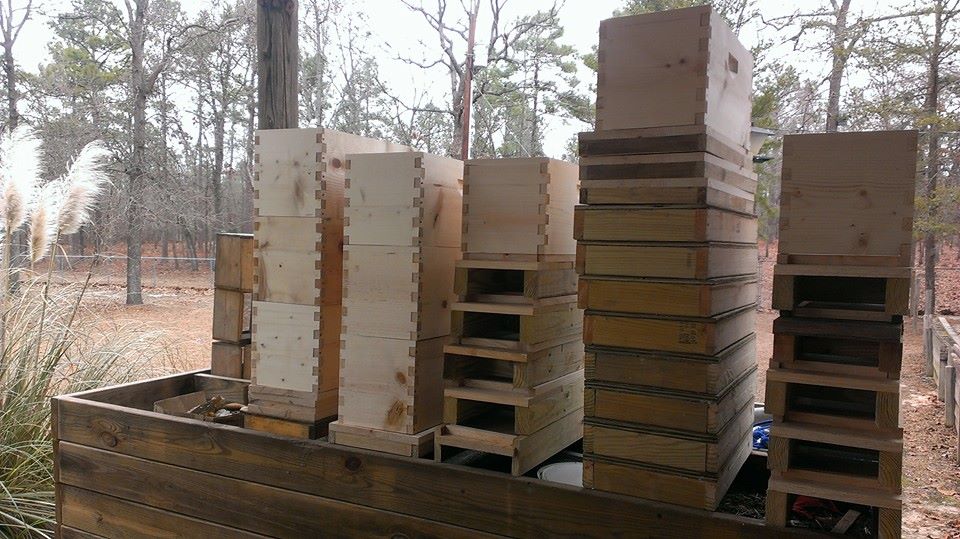
Been on a nuc and swarm trap building binge. Now for some paint.

Feel free to share this on:

  • Share on Facebook (Opens in new window) Facebook
  • Share on X (Opens in new window) X
  • Share on Pinterest (Opens in new window) Pinterest
  • Email a link to a friend (Opens in new window) Email
  • Share on LinkedIn (Opens in new window) LinkedIn
  • Share on Reddit (Opens in new window) Reddit
  • Share on Tumblr (Opens in new window) Tumblr
  • Print (Opens in new window) Print
  • Share on Telegram (Opens in new window) Telegram
  • Share on WhatsApp (Opens in new window) WhatsApp
Like Loading...

Sustainable Beekeeping thru Nucleus Colonies

01 Monday Mar 2021

Posted by Beekeeping365 in beekeeping, beekeeping management, beekeeping seasons, education, management, seasons

≈ Leave a comment

Tags

beekeeping, education, nucleus hives, seasons, spring management

Something for the second-year beekeeper or anyone who has overwintered hives. If you are still relatively new to beekeeping, perhaps having successfully overwintered a colony or colonies, the concept of two and a half hives is a good next step. Having and managing a nucleus hive is a great learning opportunity as well as a valuable resource should one of your production colonies develops problems. And it’s just fun. Nucleus hives are a pleasure to work and help you develop your assessment and inspection techniques. And finally, it’s your next step to never buying bees again!
 
Some time ago I listened to a local beekeeper give a lecture about flexibility in beekeeping. One of the points of his lecture was going with the natural rhythm of the bees and nature. Experienced beekeepers, having kept bees over many seasons, know these things. Spring is the time of increase, a time of plenty, growth, and expansion. It is a time of natural increase. Summer follows here in the South Carolina Midlands with dearth and a time for the bees to tighten the belt on resources. Fall and Winter are times when the bees depend on stored resources. This is also when the stress on the hive is greatest due to the climate, pest pressures, viruses, and lack of food stores all of which sometimes leads to colony failure.
 
Going with the flux described above means making increase when the bees want to make increase. The beekeeper goes with the flow and capitalizes on the ease with which nature and the bees expand during times of plenty. The idea being to capitalize during times of plenty so you too, the beekeeper, have resources during the harder times of seasons ahead.
 
Dr. Dewey Caron of Oregon State, “Two and a Half Hives”
 
Dr. Larry Connor, “Two and a Half Hives”
 
Joe Lewis on “Sustainable Beekeeping thru Nucleus Colonies”
 

Feel free to share this on:

  • Share on Facebook (Opens in new window) Facebook
  • Share on X (Opens in new window) X
  • Share on Pinterest (Opens in new window) Pinterest
  • Email a link to a friend (Opens in new window) Email
  • Share on LinkedIn (Opens in new window) LinkedIn
  • Share on Reddit (Opens in new window) Reddit
  • Share on Tumblr (Opens in new window) Tumblr
  • Print (Opens in new window) Print
  • Share on Telegram (Opens in new window) Telegram
  • Share on WhatsApp (Opens in new window) WhatsApp
Like Loading...

Coming Soon, Spring Splits!

11 Friday Dec 2020

Posted by Beekeeping365 in beekeeping, beekeeping management, management

≈ Leave a comment

Tags

beekeeping, making increase, nucleus hives, splits, spring splits, sustainable beekeeping

img_7163%20400x266

Picture from Coweta Sustainable Beekeeping article.

I have raised 5 frame nucleus hives since 2016 from Spring splits and allowed them to grow out to double boxes (ten frames). Last year, and this coming, I’ll graft queens and be using the Coweta mindset and method (below) to make increase or to sustainably maintain a hive after the sale of a nucleus hive or queen.  I always retain 5 frames with at least one frame of young larvae and notch the cells to raise a new queen as detailed in the following article.

Source: Coweta Sustainable Beekeeping Method by Steven Page

Coweta Sustainable Beekeeping

Click here to download a pdf file of this article.

Most beekeepers are not sustainable; they purchase nucs or packages each spring to replace winter losses.  This is expensive and prevents the creation of local, sustainable honey bee genetics.  The true cost of a package or nuc can escalate when some die during the winter before producing any honey.  If only half of these young colonies survive until next spring the cost per a nuc or package doubles.

A beekeeper with only a few hives may experience the disheartening loss of all their colonies.  No honey will be harvested for a year and they must start over purchasing nucs or packages if they can find them.

The current or traditional methods that the beekeeping books teach do not account for the difficulties we experience.  A book may teach Varroa mite control but not how to thrive in spite of Varroa.  Most are teaching beekeeping from a time before the combined effects of:

·         Varroa Mites

·         Numerous diseases

·         Colony Collapse Disorder (CCD)

·         Small hive beetle

·         Short lived queens

·         High pesticide use

There has to be a better way.

If you have bees you can make more bees or more accurately, colonies can be used to make more colonies.  All beekeepers have the resources in their colonies to become sustainable.

In the south, winter losses average one-third.  During the summer make enough splits to begin winter with one and a half times the number of colonies required for honey production in the spring.  If six colonies are required for spring honey production, begin winter with ten.  For example, begin the winter with six production hives and four nucs. After losing two production hives and two nucs during the winter, a 40 percent loss, the two remaining nucs are used to replace the dead colonies restoring production hives to six.  There is no need to buy colonies because of winter losses.  In May, splits can be started to replace the nucs bringing the total number of colonies up to ten again.

Overwinter Nucs

“Almost every emergency of management can be met by putting something into or taking something out of a nucleus, while nuclei themselves seldom present emergencies.” E. B. Wedmore, A Manual of Beekeeping

Continued…

To read  the complete article visit: Coweta Sustainable Beekeeping Method

Feel free to share this on:

  • Share on Facebook (Opens in new window) Facebook
  • Share on X (Opens in new window) X
  • Share on Pinterest (Opens in new window) Pinterest
  • Email a link to a friend (Opens in new window) Email
  • Share on LinkedIn (Opens in new window) LinkedIn
  • Share on Reddit (Opens in new window) Reddit
  • Share on Tumblr (Opens in new window) Tumblr
  • Print (Opens in new window) Print
  • Share on Telegram (Opens in new window) Telegram
  • Share on WhatsApp (Opens in new window) WhatsApp
Like Loading...

Overwintering Nuclei Colonies by Larry Connor

07 Monday Dec 2020

Posted by Beekeeping365 in beekeeping, beekeeping seasons, seasons

≈ 2 Comments

Tags

beekeeping, beekeeping equipment, Larry Connor, nucleus hives, overwintering

Some northern beekeepers have success overwintering nuclei-sized colonies. This may be based on a particular stock or genetic trait, and should be tested carefully. More beekeepers are able to overwinter a single, deep hive body by packing the hive out with honey or sugar syrup in the Fall. In addition to food reserves, make sure such colonies are protected from the harsh winds of Winter.

Read the complete article here: Overwintering Nuclei Colonies — BEEKeeping: Your First Three Years

Feel free to share this on:

  • Share on Facebook (Opens in new window) Facebook
  • Share on X (Opens in new window) X
  • Share on Pinterest (Opens in new window) Pinterest
  • Email a link to a friend (Opens in new window) Email
  • Share on LinkedIn (Opens in new window) LinkedIn
  • Share on Reddit (Opens in new window) Reddit
  • Share on Tumblr (Opens in new window) Tumblr
  • Print (Opens in new window) Print
  • Share on Telegram (Opens in new window) Telegram
  • Share on WhatsApp (Opens in new window) WhatsApp
Like Loading...

Installing Your New Bees by Prime Bees – College Station Bee & Honey Farm

11 Monday Feb 2019

Posted by Beekeeping365 in beekeeping, beekeeping management, management

≈ Leave a comment

Tags

beekeeping, honey bees, installing bees, new bee hive, nucleus hives, package bees

We’ve got short instructions on installing your Package Bees or Nucleus Colony below – feel free to reach out with questions or clarification!

Package bees are just boxes specially built to carry bees securely and safely. They are sold according to the weight of the bees with maybe 4000 to 5000 per pound. They mostly have the queen bee not unless the buyer has instructed otherwise. They are relatively cheaper compared to nucleus colony.

To install the package bees, you will need to remove the center frames of the colony you’re moving the bees into. Remove the cage containing the queen bee first, then place the container on its side over the place you have removed the frames. Put the queen’s cage on top of a frame and gently turn the package inside out to assist the bees to fall into the hive.  Prepare two frames where you shall place the queen cage and use pressure to hold it in place if you have existing comb – otherwise you can tie the cage with string or tape to secure her – you don’t want her to fall to the bottom of the hive. Once all the bees are out of the package, you can remove the package and set it in front of the hive (or on top).

Read the fully article here:  Installing Your New Bees — Prime Bees – College Station Bee & Honey Farm

Feel free to share this on:

  • Share on Facebook (Opens in new window) Facebook
  • Share on X (Opens in new window) X
  • Share on Pinterest (Opens in new window) Pinterest
  • Email a link to a friend (Opens in new window) Email
  • Share on LinkedIn (Opens in new window) LinkedIn
  • Share on Reddit (Opens in new window) Reddit
  • Share on Tumblr (Opens in new window) Tumblr
  • Print (Opens in new window) Print
  • Share on Telegram (Opens in new window) Telegram
  • Share on WhatsApp (Opens in new window) WhatsApp
Like Loading...

Quote

Over Wintering Nucs- A Better Way by Michael Palmer

03 Tuesday Jul 2018

Posted by Beekeeping365 in beekeeping, beekeeping management, management, Winter

≈ 2 Comments

Tags

beekeeping, nucleus hives, winter beekeeing, winter management

I used to buy bees, lots and lots of bees; singles from South Carolina, nuclei from Florida and frames of brood from New York. I used to buy queens, lots and lots of queens; queens from Georgia, queens from Texas and queens from California. Every year it was the same. Pick up the pieces of my apiary in the Spring, send a big check to southern queen breeders, split up my best colonies, and hope I made enough of a honey crop to pay the bills. Some years I did, some years I did not.

Read full article here: Over Wintering Nucs- A Better Way — BEEKeeping: Your First Three Years

Feel free to share this on:

  • Share on Facebook (Opens in new window) Facebook
  • Share on X (Opens in new window) X
  • Share on Pinterest (Opens in new window) Pinterest
  • Email a link to a friend (Opens in new window) Email
  • Share on LinkedIn (Opens in new window) LinkedIn
  • Share on Reddit (Opens in new window) Reddit
  • Share on Tumblr (Opens in new window) Tumblr
  • Print (Opens in new window) Print
  • Share on Telegram (Opens in new window) Telegram
  • Share on WhatsApp (Opens in new window) WhatsApp
Like Loading...
Follow Beekeeping365 on WordPress.com

Enter your email address to follow this blog and receive notifications of new posts by email.

Calendar

August 2026
S M T W T F S
 1
2345678
9101112131415
16171819202122
23242526272829
3031  
« Jul    

Posts by Month:

  • August 2026 (4)
  • July 2026 (1)
  • May 2026 (2)
  • January 2026 (3)
  • July 2025 (1)
  • April 2024 (1)
  • September 2022 (1)
  • July 2022 (1)
  • March 2022 (13)
  • February 2022 (17)
  • January 2022 (4)
  • December 2021 (4)
  • November 2021 (7)
  • October 2021 (1)
  • September 2021 (3)
  • August 2021 (11)
  • July 2021 (18)
  • June 2021 (5)
  • May 2021 (2)
  • April 2021 (9)
  • March 2021 (2)
  • February 2021 (5)
  • January 2021 (16)
  • December 2020 (15)
  • November 2020 (15)
  • October 2020 (11)
  • July 2020 (1)
  • February 2020 (1)
  • March 2019 (2)
  • February 2019 (4)
  • January 2019 (1)
  • December 2018 (10)
  • November 2018 (8)
  • October 2018 (15)
  • September 2018 (25)
  • August 2018 (3)
  • July 2018 (11)
  • June 2018 (27)
  • May 2018 (33)
  • April 2018 (20)
  • March 2018 (20)
  • February 2018 (12)
  • January 2018 (22)
  • December 2017 (18)
  • November 2017 (17)
  • October 2017 (25)
  • September 2017 (27)
  • August 2017 (21)
  • July 2017 (29)
  • June 2017 (28)
  • May 2017 (19)
  • April 2017 (17)
  • March 2017 (19)
  • February 2017 (12)
  • January 2017 (13)
  • December 2016 (5)

Posts by Categories:

  • absconding (1)
  • africanized honey bees (1)
  • apitherapy (1)
  • bee health (6)
  • bee law (2)
  • bee lining (2)
  • bee removals (2)
  • beekeeper (5)
  • beekeeper education (16)
  • beekeeping (612)
    • South Carolina (2)
  • beekeeping author (10)
  • beekeeping books (14)
  • beekeeping calendar (4)
  • beekeeping chores (8)
  • beekeeping equipment (26)
  • beekeeping history (49)
  • beekeeping management (37)
  • beekeeping pest management (8)
  • beekeeping seasons (23)
  • beekeeping vocabulary (16)
  • beeswax (13)
  • biography (4)
  • biology (14)
  • birthday (40)
  • birthdays (34)
  • book review (16)
  • breakfast (1)
  • calendar (4)
  • CCD (1)
  • chores (6)
  • comb (7)
  • comb honey (10)
  • commercial beekeeping (2)
  • cutouts (2)
  • dearth (3)
  • defensiveness (2)
  • diseases (9)
  • drawn comb (6)
  • ecology (4)
  • education (28)
  • equipment (25)
  • extracting (1)
  • fall nectar flow (1)
  • famous beekeepers (27)
  • feeding bees (7)
  • first blog entry (1)
  • folklore (1)
  • food (7)
  • forage (4)
  • hacks (3)
  • hive inspections (8)
  • hive placement (2)
  • hive products (6)
  • honey (90)
  • honey as food (22)
  • honey bee anatomy (3)
  • honey bee behavior (25)
  • honey bee biology (43)
  • honey bee genetics (4)
  • honey bee nutrition (1)
  • honey bee photos (6)
  • Honey Bee Research (1)
  • honey bee vocabulary (12)
  • honey bees (14)
  • honey judging (4)
  • honey recipe (65)
  • humor (13)
  • inspections (10)
  • journal (1)
  • log book (1)
  • making increase (3)
  • management (82)
  • mentoring (2)
  • mites (3)
  • national pollinator week (2)
  • nectar flow (6)
  • nomenclature (1)
  • opinion (8)
  • out yards (1)
  • outyards (1)
  • package bees (1)
  • pears (1)
  • pests (17)
  • plants for bees (3)
  • polish (1)
  • pollen (4)
  • pollination (11)
  • pollinators (7)
  • product review (1)
  • production (1)
  • products (3)
  • propolis (2)
  • queens (17)
  • raw honey (6)
  • recipe (88)
  • removals (1)
  • safety (3)
  • sales (2)
  • season (1)
  • seasons (21)
  • sideliner (1)
  • small hive beetles (1)
  • spring buildup (4)
  • state fair (2)
  • sustainable (7)
  • swarms (27)
  • ursurpation (1)
  • usurpation (1)
  • varroa (21)
  • varroa destructor (12)
  • varroa mites (24)
  • Winter (5)
  • winter solstice (2)
  • woodenware (3)
  • yellow jackets (2)

Sassafras Bee Farm on Facebook

Sassafras Bee Farm on Facebook

Sassafras Bee Farm

Sassafras Bee Farm

Recent Posts

  • Meeting Reality vs What Seems Deserved
  • Everything Starts with a Tasty Meal: The Science Behind a Beekeeper’s Best Pest-Management Insight
  • Pest Control
  • State Fair Wax Preparation
  • Sherlock Holmes and Beekeeping: A Unique Connection

Beekeeping365 on Facebook

Beekeeping365 on Facebook

Top Posts & Pages

  • Types of bees by Fat Daddy’s Apiary
    Types of bees by Fat Daddy’s Apiary
  • Meeting Reality vs What Seems Deserved
    Meeting Reality vs What Seems Deserved
  • Old-fashioned Honey Wafer Recipe by A Hundred Years Ago
    Old-fashioned Honey Wafer Recipe by A Hundred Years Ago

Blog Stats

  • 141,302 hits

Website Built with WordPress.com.

  • Subscribe Subscribed
    • Beekeeping365
    • Join 426 other subscribers
    • Already have a WordPress.com account? Log in now.
    • Beekeeping365
    • Subscribe Subscribed
    • Sign up
    • Log in
    • Report this content
    • View site in Reader
    • Manage subscriptions
    • Collapse this bar
Loading Comments...
%d