• Sassafras Bee Farm
  • About
  • Contact

Beekeeping365

~ The more I studied beekeeping, the less I knew, until, finally, I knew nothing. But, even though I knew nothing, I still had plenty to unlearn. Charles Martin Simon

Beekeeping365

Tag Archives: bee smoker

The Smoke Between Us: What’s Really Happening When You Smoke the Colony

09 Wednesday Sep 2026

Posted by Beekeeping365 in beekeeping

≈ Leave a comment

Tags

bee smoker, smoking the hive

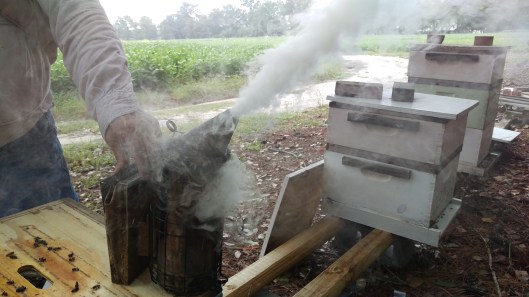
You crack the outer cover before you’ve even lit the smoker — just a peek, you tell yourself. Bad idea. A guard bee lifts off the top bars and bumps your veil, and you can already hear the pitch of the hive climbing half a step. You set the lid back down, take a breath, and get your smoker going properly this time. A few cool puffs at the entrance. A few more under the lid once it’s cracked again. Wait just a bit.


And just like that, the hive exhales. The hum drops. Bees that were staring you a minute ago are now walking calmly across the frame you’re holding, going about their business like you’re not even there. You pull the frame, look it over, and not a single bee so much as flinches toward you.

It feels a little bit like magic. It isn’t. It’s chemistry, instinct, and a survival response so old it predates you, me, and every beekeeper who ever lived — and it’s worth understanding exactly what you’re doing to that colony every time you squeeze the bellows.


The Alarm They Never Get to Sound
Here’s what almost happened before you grabbed the smoker. That guard bee in front of your veil was seconds from raising her abdomen and releasing a chemical signal from a gland near her sting shaft — a compound called isopentyl acetate, along with dozens of other volatile chemicals riding along with it. It smells like bananas to some people, which is exactly why old-timers will tell you not to eat one near the hive. To a bee, that smell means one thing: intruder, mobilize, attack here.


Under normal circumstances, that message travels fast. Nearby bees pick it up through their antennae, and within seconds you’ve got a small squad converging on the exact spot where the first bee raised the alarm. It’s an efficient, ruthless bit of biology — a single sting recruits reinforcements to the scene of the crime.


Smoke breaks that chain of communication. It doesn’t destroy the pheromone or somehow calm the bee down emotionally — it overwhelms her sense of smell. Researchers who measured this directly found that after smoke exposure, a bee’s antennae simply stop registering the alarm signal the way they normally would. She’s not less alarmed. She just can’t smell the message anymore, and neither can her sisters. That fog lifts on its own, too — bees typically regain full sensitivity within about ten to twenty minutes, which is exactly why a long inspection calls for more than one round with the smoker.


A Bellyful of Honey and a Fire That Isn’t Coming
While all that’s happening at the entrance, something else is going on deeper in the hive — and it might matter even more.


Smoke, to a bee, doesn’t read as “a person is bothering us.” It reads as fire. And a colony facing fire has exactly one move: pack up and go. So workers throughout the hive start doing something that looks almost frantic if you watch closely — they push their heads into open cells and drink down honey as fast as they can, filling their crops the way you’d grab you’d wallet and photos on the way out the door. It’s not panic for panic’s sake. Honey is expensive to make — it takes roughly eight pounds of nectar-turned-honey to produce a single pound of the wax they’d need to start over somewhere new. If the home is about to burn, that honey is coming with them.


Here’s the part that actually helps you: a bee with a full crop is a different animal. Distended and heavy, she has a much harder time curling her abdomen around to drive a stinger home. She gets sluggish — genuinely lethargic, in the same unglamorous way you get lethargic after a holiday dinner you didn’t need to finish. Multiply that across ten thousand bees and you get a hive that’s chemically confused about a fire, physically stuffed on its own honey, and — for a little while — remarkably easy to work.


This is also why a smart beekeeper doesn’t smoke and immediately rip the lid off. Give it a minute. That’s the time it takes for the “we might need to evacuate” instinct to actually kick in.


An Old, Old Trick
None of this is new information to bees, and it turns out it isn’t new information to us, either. Tomb paintings from ancient Egypt show beekeepers blowing smoke over clay hives thousands of years before anyone understood a single molecule of pheromone chemistry. Some Native American beekeepers burned puffball fungus to the same effect. Even today, honey hunters in remote parts of Nepal climb rope ladders up sheer cliff faces to reach wild colonies, carrying nothing more sophisticated than a smoldering torch to do exactly what your smoker does.


The tool in your hand only got its modern shape in 1873, when a New York beekeeper named Moses Quinby built the first bellows smoker — a tin firebox with a hand pump, not so different from the one hanging by your hive today. True to his Quaker upbringing, Quinby never patented it. He just gave it to every beekeeper who came after him, which is most of the reason it’s sitting in your hand right now instead of some more complicated, proprietary contraption.


Doing It Well, Not Just Doing It
Smoke is a tool you can absolutely overuse. The goal is a light reminder, not a siege — a few cool, gentle puffs at the entrance, a short wait, a few more under the cover before you lift it. Thick, hot, billowing smoke stresses a colony more than it calms one, and it can leave your equipment and honey smelling like a campfire for longer than you’d like. Light and patient beats heavy and rushed, every time.


Back at the Hive
So the next time the hum drops and the bees on your frame go about their business like you’re invisible, you’ll know what actually happened. You didn’t trick them, exactly — you borrowed an instinct that’s been wired into them since long before there were hive tools or bee suits, one that ancient Egyptians and Nepalese cliff-climbers and a Quaker beekeeper in the Mohawk Valley all discovered the same way you just did: light some smoke, and for a few quiet minutes, the bees will let you in.

Feel free to share this on:

  • Share on Facebook (Opens in new window) Facebook
  • Share on X (Opens in new window) X
  • Share on Pinterest (Opens in new window) Pinterest
  • Email a link to a friend (Opens in new window) Email
  • Share on LinkedIn (Opens in new window) LinkedIn
  • Share on Reddit (Opens in new window) Reddit
  • Share on Tumblr (Opens in new window) Tumblr
  • Print (Opens in new window) Print
  • Share on Telegram (Opens in new window) Telegram
  • Share on WhatsApp (Opens in new window) WhatsApp
Like Loading...

My Favorite Smoker Fuel by Local Honey from Happy Bees

09 Wednesday May 2018

Posted by Beekeeping365 in beekeeping, beekeeping management

≈ Leave a comment

Tags

bee smoker, burlap

Mine too! ~ SassafrasBeeFarm

As a beekeeper you have many choices when it comes to smoker fuel. Some of it is free and widely available and some of it can be ordered with several bee supply houses. During my first two years of beekeeping I was testing several fuel sources. The free fuel I found around the house ranged from dry grass to pine needles. I also purchased some smoker fuel from Brushy Mountain and picked up some small burlap bags at the local farmer store. Good news is – everything works! However, my favorite by far is burlap.

Read full article here: My Favorite Smoker Fuel — Local Honey from Happy Bees

Feel free to share this on:

  • Share on Facebook (Opens in new window) Facebook
  • Share on X (Opens in new window) X
  • Share on Pinterest (Opens in new window) Pinterest
  • Email a link to a friend (Opens in new window) Email
  • Share on LinkedIn (Opens in new window) LinkedIn
  • Share on Reddit (Opens in new window) Reddit
  • Share on Tumblr (Opens in new window) Tumblr
  • Print (Opens in new window) Print
  • Share on Telegram (Opens in new window) Telegram
  • Share on WhatsApp (Opens in new window) WhatsApp
Like Loading...

Smoking The Bees

21 Wednesday Mar 2018

Posted by Beekeeping365 in beekeeping, beekeeping management

≈ Leave a comment

Tags

bee smoker, beekeeping, beekeeping equipment

Source: World of Beekeeping – Smoking the Bees

April 6, 2012

When I first started beekeeping I never smoked my hives.  Somehow, somewhere I had learned that it was terribly difficult to smoke your hives correctly without burning the bees or some other weird idea.  I had some strange fear that it would be a little like operating a hand held dragon.  I’m not sure how that got into my head but it caused a ton of issues for me and thankfully I eventually started smoking my hives when doing inspections.

While you certainly can operate without smoking your hives it means putting new boxes, lids and other items onto the hives very slowly, pushing each little bee out of the way.  If you don’t you’ll squish a lot of bees and while unlikely, one of those could be the queen.

Eventually I fired up the smoker and realized that it really isn’t difficult to use.  The trick?  Let the fire die down before you start pumping the bellows.  You don’t want burning dragon fire coming from your smoker but it’s easy enough to avoid.

That’s really all there is to it.  If you’re at all paranoid you can simply blow the smoke over your bare hand… if it only feels mildly warm to you it’ll be just fine.

But why do we smoke our bees?

There are several thoughts as to what a smoker causes bees to do.  First many think that bees respond to smoke as they would a forest fire, gorging themselves on honey so they can fly off to a new home should they need to flee the hive.  Second the smoke is said to mask the warning pheromones given off by guard bees, keeping the troops from hearing the battle cry.

So how do you best use the smoke in your hives?

Well first you can use smoke to push bees where you want them to go.  When I first used the smoker this was really helpful when it came to adding new boxes to the tops of my hives… pushing them away from the top of the box meant very few if any were squished when I put on the new box.  The same idea holds true when it comes time to put on the inner cover.

But don’t smoke them too much!

Pushing them around a bit is fine but if you use too much smoke it won’t work for you.  Why?  Because if they are surrounded by smoke they won’t be able to “move away” from the smoke but will instead simply walk around disoriented.  Not what you were hoping for when you lit up the smoker!  So use smoke sparingly and both you and the bees will be happy.

Final thought.  If your beehives aren’t at your home (or even if they are) you have a burning thing you need to transport and/or store.  Make sure the fire is out before you put it anywhere and as an extra added precaution get a metal box with a lid if you need to put your smoker in your car.  We don’t want to see you on the news with a smoking car!

Source: World of Beekeeping – Smoking the Bees

Feel free to share this on:

  • Share on Facebook (Opens in new window) Facebook
  • Share on X (Opens in new window) X
  • Share on Pinterest (Opens in new window) Pinterest
  • Email a link to a friend (Opens in new window) Email
  • Share on LinkedIn (Opens in new window) LinkedIn
  • Share on Reddit (Opens in new window) Reddit
  • Share on Tumblr (Opens in new window) Tumblr
  • Print (Opens in new window) Print
  • Share on Telegram (Opens in new window) Telegram
  • Share on WhatsApp (Opens in new window) WhatsApp
Like Loading...
Follow Beekeeping365 on WordPress.com

Enter your email address to follow this blog and receive notifications of new posts by email.

Calendar

October 2026
S M T W T F S
 123
45678910
11121314151617
18192021222324
25262728293031
« Sep    

Posts by Month:

  • October 2026 (15)
  • September 2026 (32)
  • August 2026 (6)
  • July 2026 (1)
  • May 2026 (2)
  • January 2026 (3)
  • July 2025 (1)
  • April 2024 (1)
  • July 2022 (1)
  • March 2022 (13)
  • February 2022 (17)
  • January 2022 (4)
  • December 2021 (4)
  • November 2021 (4)
  • August 2021 (11)
  • July 2021 (18)
  • June 2021 (5)
  • May 2021 (2)
  • April 2021 (9)
  • March 2021 (2)
  • February 2021 (5)
  • January 2021 (16)
  • December 2020 (15)
  • November 2020 (5)
  • October 2020 (2)
  • July 2020 (1)
  • February 2020 (1)
  • March 2019 (2)
  • February 2019 (4)
  • January 2019 (1)
  • December 2018 (10)
  • November 2018 (8)
  • October 2018 (13)
  • September 2018 (18)
  • August 2018 (3)
  • July 2018 (11)
  • June 2018 (27)
  • May 2018 (33)
  • April 2018 (20)
  • March 2018 (20)
  • February 2018 (12)
  • January 2018 (22)
  • December 2017 (18)
  • November 2017 (15)
  • October 2017 (19)
  • September 2017 (17)
  • August 2017 (21)
  • July 2017 (29)
  • June 2017 (28)
  • May 2017 (19)
  • April 2017 (17)
  • March 2017 (19)
  • February 2017 (12)
  • January 2017 (13)
  • December 2016 (5)

Posts by Categories:

  • absconding (1)
  • africanized honey bees (1)
  • apitherapy (1)
  • bee health (7)
  • bee law (2)
  • bee lining (2)
  • bee removals (2)
  • beekeeper (5)
  • beekeeper education (17)
  • beekeeping (604)
    • South Carolina (3)
  • beekeeping author (10)
  • beekeeping books (12)
  • beekeeping calendar (6)
  • beekeeping chores (9)
  • beekeeping equipment (23)
  • beekeeping history (48)
  • beekeeping management (35)
  • beekeeping pest management (8)
  • beekeeping seasons (26)
  • beekeeping vocabulary (15)
  • beeswax (11)
  • biography (5)
  • biology (12)
  • birthday (37)
  • birthdays (31)
  • book review (16)
  • breakfast (1)
  • calendar (6)
  • CCD (1)
  • chores (6)
  • comb (6)
  • comb honey (10)
  • commercial beekeeping (1)
  • cutouts (2)
  • dearth (4)
  • defensiveness (1)
  • diseases (9)
  • drawn comb (5)
  • ecology (4)
  • education (30)
  • equipment (21)
  • extracting (1)
  • fall nectar flow (1)
  • famous beekeepers (25)
  • feeding bees (8)
  • first blog entry (1)
  • folklore (1)
  • food (7)
  • forage (4)
  • hacks (3)
  • hive inspections (6)
  • hive placement (2)
  • hive products (6)
  • honey (85)
  • honey as food (22)
  • honey bee anatomy (3)
  • honey bee behavior (23)
  • honey bee biology (42)
  • honey bee genetics (4)
  • honey bee losses (1)
  • honey bee nutrition (1)
  • honey bee photos (6)
  • Honey Bee Research (1)
  • honey bee vocabulary (11)
  • honey bees (14)
  • honey judging (3)
  • honey recipe (65)
  • humor (13)
  • inspections (9)
  • journal (1)
  • log book (1)
  • making increase (3)
  • management (82)
  • mentoring (2)
  • mites (4)
  • national pollinator week (2)
  • nectar flow (6)
  • nomenclature (1)
  • opinion (5)
  • out yards (1)
  • outyards (2)
  • package bees (2)
  • pears (1)
  • pests (17)
  • plants for bees (3)
  • polish (1)
  • pollen (4)
  • pollination (11)
  • pollinators (7)
  • product review (1)
  • production (1)
  • products (3)
  • propolis (2)
  • queens (17)
  • raw honey (6)
  • recipe (88)
  • removals (1)
  • safety (3)
  • sales (2)
  • season (1)
  • seasons (21)
  • sideliner (1)
  • small hive beetles (1)
  • spring buildup (4)
  • state fair (2)
  • sustainable (8)
  • swarms (27)
  • ursurpation (1)
  • usurpation (1)
  • varroa (20)
  • varroa destructor (11)
  • varroa mites (23)
  • Winter (6)
  • winter solstice (2)
  • woodenware (3)
  • yellow jackets (2)

Sassafras Bee Farm on Facebook

Sassafras Bee Farm on Facebook

Posts I Like

  • What happens to beekeepers if… on Bad Beekeeping Blog
  • Honey Bee Hormones and Metamor… on The Beelistener
  • The “reverse outline”: a usefu… on Scientist Sees Squirrel

Sassafras Bee Farm

Sassafras Bee Farm

Recent Posts

  • It Always Starts with Assessment
  • Happy Birthday Jay J. Smith
  • Miracles by Walt Whitman
  • What Do You Know?
  • Fall Nectar Flow

Beekeeping365 on Facebook

Beekeeping365 on Facebook

Top Posts & Pages

  • Swarms
    Swarms
  • Waxing frame foundation - one of many winter tasks
    Waxing frame foundation - one of many winter tasks
  • The Importance of Swarm Control
    The Importance of Swarm Control

Blog Stats

  • 145,463 hits

Website Built with WordPress.com.

  • Subscribe Subscribed
    Beekeeping365
    Join 417 other subscribers

    Have a WordPress.com account? Log in now.

  • Beekeeping365
    View site in Reader
    Manage subscriptionsSign upLog in
    Report this content
    Collapse this bar
Loading Comments...
%d