The story starts years ago when I noticed that the bees flew with more enthusiasm and worked harder in the days following a varroa mite treatment (oxalic acid vaporization). I asked others if they too saw this behavior change. Some said they never took notice; others said it was obvious. Years later I measured the coming and going on the landing board using one of those click counters. It was true; the bees were energized after a treatment. But I didn’t have the answer as to why. Last summer I spoke to someone more knowledgeable than I in entomology and he used the analogy, “Have you ever noticed how good a dog feels the day after a flea dip?” A great reply that satisfied me for awhile. But I thought, putting a dent in a 3% mite load (not even eliminating the mites) couldn’t increase the entire colony’s enthusiasm as evidenced with the increase in activity on the landing board. Could it? Or was something else going on? But I’m getting ahead of myself.
Back in 2021, I started doing some research and learned that the EPA first approved oxalic acid (OA) in 1957 as a disinfectant in bathrooms and septic systems among other uses. It’s still used today in cleaning solutions for industry food production machines, not to mention good old Bar Keeper’s Friend. If you’re not sure of the definition of disinfectant look it up. It’s different than sanitizer, cleaner, or antibacterial. So, is OA also acting in that manner in the hive? Is it giving the internal surfaces of the hive and the bees a chemical scrubbing? Am I killing bacteria and viruses as well as mites? I didn’t know but I wanted to try a few things.
Over two years ago (January 2022) I started treating my bee hives routinely with OA vapor. That’s “routine schedule” as meaning a set date each month to treat on my calendar. Similar to you taking an antibiotic on a routine schedule, or a medicine for a chronic condition like hypertension, diabetes, or reflux. Consider it an IPM treatment for treating mites and accompaning viruses. Also included in my goals were to 1) decrease the number of yearly OA treatments and 2) reduce the likelihood of resistance to OA. But simply put, all I was actually doing was going to be changing one aspect of treatment – the dosing schedule from one that targeted the mites’ reproductive schedule, to one that disinfected the colony’s environment regularly. Of course, any varroa mites killed would be a value-added outcome.
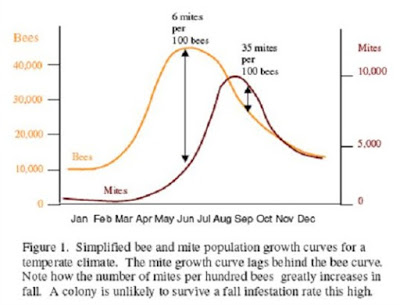
That year I did not suffer any colony losses during the spring, and I made more honey than usual. However, I did have some colony failures (~ 10%), as is typical, after the nectar flow during our dearth period. Multiple stressors (SHB, harvest, and climbing mite to bee ratios) take their toll during this period as the mite load climbs, increasing the viral load. I intervened with a single series of OA treatments and the losses stopped, leading me to believe the stressor most critical is mite/viral load. After completing the single series of treatments, I resumed my scheduled monthly treatments as before and had no winter losses. After the first year, I tried to make sense of that year’s interventions and outcomes and develop a plan for next year.
In January 2023, I continued my routine treatment schedule and, as experienced the previous year, I had no losses during the nectar flow. But this year I decided to make a change to the dosing schedule during the post nectar flow time period. I changed to a once every two-week treatment schedule (actually on the 1st and 15th) and continued this schedule until fall – so that would be twice monthly treatments June – October. This added about 5 additional treatments to the year which pushed me to the edge on my goal to limit the number of treatments per year. In November, I resumed the routine monthly schedule. This scheduling model resulted in no colony losses in the spring, fall, summer, or winter of 2023. My honey production was about 65 lbs. per hive which is about 50% higher than expected in the SC Midlands. Keeping bees healthy during the nectar flow keeps them working harder rather than our current method of allowing the bees’ health to decline over the season and often collapse just prior to treatment salvation.
All this brings me to this year (2024). So far, I have not sustained any mite/virus related losses. Coming out of winter I saw the occasional weak colony, needing a new queen, or help with SHBs. But my hives built up quickly in the pre-season. I just did my accounting for taxes and used less sugar last year having left more honey due to their productivity (and my reluctance to pay for sugar). My point is they are healthy and handling stressors.
Recently I spent some time researching organic acids as disinfectants, antimicrobials, etc. There are some studies on this with viruses. Yes, organic acids can be antivirals. It is dose and pH dependent to some extent. OA is around 2 on the pH scale so it’s potent. But there are some unidentified factors as well. For instance, acetic acid sometimes is more effective with certain viruses than acids with lower pH. So, the reason organic acids (and which) kill viruses still is somewhat a mystery.
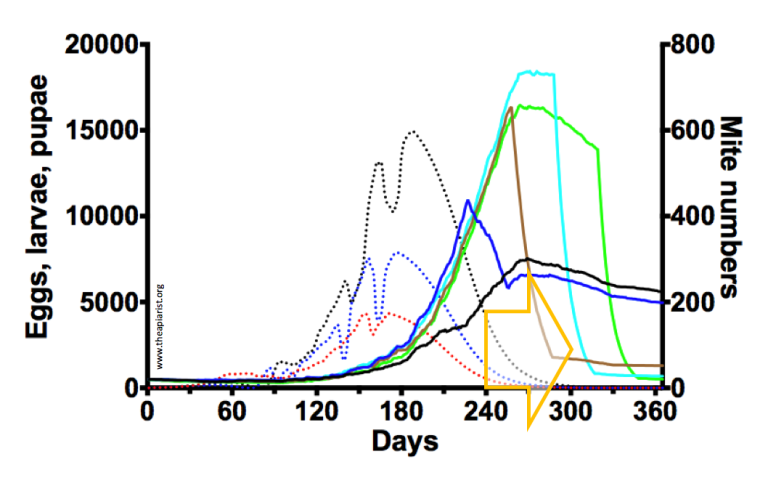
Why is this interesting? First, because it shouldn’t be working. One would think my colonies would be mite ridden and failing. This OA dosing schedule should be allowing the mites too much freedom to reproduce. However, I haven’t seen a case of deformed wing in years and my skewering of drone pupae shows me the mites are under control. Second, because varroa mite levels are out of the treatment consideration loop, I no longer concern myself with watching my bees become increasingly ill before tipping this season’s / year’s suggested EIL level. Third, I could care less even if my mite levels were high. In fact, I would be happy to find they were as it would confirm what I’m doing is working by a mechanism other than killing mites. Fourth, I’m exposing my bees to the same or less OA than I would if I was using currently acceptable OA vapor treatment schedules. Fifth, I’m allowing more time between treatments which lessens the possibility of miticide or antiviral resistance. Sixth, after seeing many new beekeepers struggle with the myriads of options for mite assessment, the complexity of understanding mite counts during different seasons, and the best choice of miticide for each time of year and temperature, what a gift it would be to simplify this process. Seventh, my bees stay healthy and productive all year. Gone is the yo-yo of cleaning them up only to let them fall to approaching colony collapse before a lifesaving series of treatments. That yo-yo isn’t healthy living. We don’t allow diabetics to go into diabetic coma before treating them nor do we allow HIV patients to live with high viral loads. No, we manage these illnesses rather than wait for a crisis to develop. We should keep in mind that our colonies don’t die from the mites they die from high viral loads.
How is this working? My supposition is that I am killing viruses (or a subset of the many virus types) directly, thus bypassing the need for vector (mite) control. Another possibility is I am interrupting the relationship between the virus and the mite – to the mite’s detriment. But to be honest, I don’t know. It could be something entirely different that I haven’t considered. I’ll continue the effort and will start to compile the research and data I have collected.
This honey season is off to a great start. All supers are already deployed and I’m wondering how I’m going to deal with keeping the bees with enough space now that they’ve gone gangbusters. Cheers!
Brief Update 7/20/2025: I’m just back from my state beekeepers assocation’s summer conference. The talk of mites always triggers some guilt that I have not updated this blog entry in some time. So, the effort continues. I have tried to maintained routine monthly treatments although there was some disruption during a personal health event. The success of healthy bees continues with minimal losses. It is rewarding to have a near perfect survival rate in the midst of record national losses in the US. I don’t get to as many conferences as I used to but with those I have shared this effort with, the idea that there is a possibility that I am simply keeping the viral threshold below the point of illness development. Randy Oliver wrote some time back that at a certain mite count within a colony they enter tipping point after which they are doomed to colony failure. I think this is a valid explanation – that the viral threshold is possibly being held in check. By a little or a lot is unknown. If you have ideas let me know. larrycoble@bellsouth.net