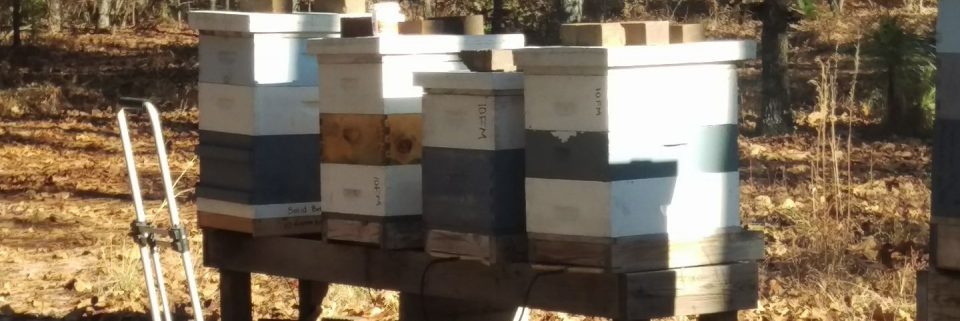
A mouse gets into a hive in October, drawn in by the warmth and the stores the way anything with sense would be, and the bees kill it — stinging it to death is well within their means, guarding an entrance a mouse fits through easily enough. What they can’t do is remove it. A field mouse dead in the bottom of a Langstroth deep is a problem with no exit: too heavy to carry off the way a dead bee gets carried off, one worker to a corpse, out over the landing board and dropped in the grass. So, the bees do the other thing available to them. They coat it. Propolis first — that dark, resinous, faintly bitter substance foragers pull off poplar and pine buds not because it feeds anyone but because it plugs gaps — and then wax over that, layer after layer, until the mouse is entombed inside the hive it broke into, mummified, sealed against the rot and disease a decomposing body would otherwise seed into the colony’s air. The intruder doesn’t leave. It becomes part of the wall.
Marcus Aurelius wrote that the rational mind is like a fire: throw anything onto a strong enough one and it becomes fuel, material the fire uses for its own purposes rather than material that defeats it. He wasn’t writing about bees, and probably never watched a colony entomb a mouse — but the bees perform this without the philosophy, constitutionally, the way they do everything. They didn’t evolve a way to remove every threat that gets into a hive. They evolved a way to convert what they can’t remove into something that can’t hurt them anymore. The obstacle becomes the wall around the obstacle.
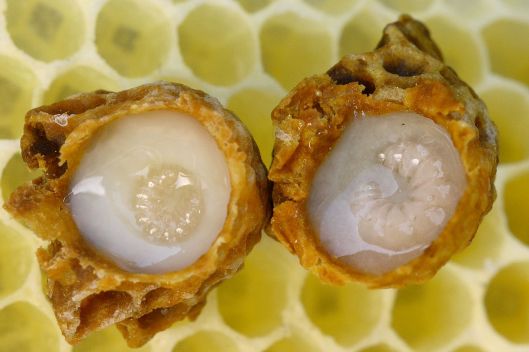
Epictetus said it more plainly, a couple of centuries before Marcus wrote his private fire metaphor down: every situation has two handles, one by which it can be carried and one by which it can’t. A dead queen is the clean beekeeping version of this. Open a hive in May and find no eggs, no queen, workers running the comb in that aimless way that tells you before you’ve confirmed it — and the colony has exactly the two options Epictetus described. If there’s no young larva anywhere in the box, the colony is carrying the situation by the handle that breaks: it dwindles for a few weeks, laying workers start dropping unfertilized eggs into cells built for one, and it’s over by summer, no rescue available once that clock runs out. But if there’s larva under three days old anywhere in the box, the same crisis has the other handle. Workers select several of those larvae, flood the cells with royal jelly, and in sixteen days there’s a virgin queen ready to fly out, mate, and requeen the colony that supposedly just lost its queen. Identical event. A dead queen either kills the colony or restarts it, and the difference isn’t luck — it’s which handle got grabbed, which in this case just means whether the beekeeper caught it in time to know there was a choice at all.
A swarm teaches the same lesson from the other direction, and it stings more because it looks like the beekeeper’s failure rather than the bees’ success. You miss a week in April — busy, or it rained, or you told yourself the colony wasn’t strong enough yet to need checking — and you come back to find half the bees gone, a fistful of capped queen cells left in the box, a virgin due to emerge any day. Carried by the first handle, that’s just a loss: half a colony’s population and most of a season’s honey crop, gone into somebody’s tree or somebody’s chimney. Carried by the other handle, it’s the most honest inspection report you’ll get all year. The colony just told you, without ambiguity, exactly what your spring management missed — that you supered too late, or didn’t check for swarm cells in the roughly 5 and a half day period between egg and capped queen cell, or left a queen in her second year past the point her pheromones still suppresses the urge. Take that seriously and the fix isn’t complicated: earlier supering next April, a swarm-cell check built into the calendar instead of left to memory, a requeening schedule that gets ahead of the colony’s own plans instead of reacting to them. The swarm cost you bees. It also handed you, for free, the one piece of information that prevents the next one.
That’s the whole operation, really, run across every setback a season produces. A queen that turns out to be a drone layer isn’t just a dud — it’s a question about where she was sourced, and whether that apiary had the drone saturation to guarantee a solid mating flight, worth asking before the next order goes in. A hive robbed out isn’t just a dead-out — it’s a lesson in how fast an entrance needs reducing once a flow closes, learned once, at the cost of one colony, so it doesn’t have to be learned twice at the cost of three. Wax moth damage in a stack of stored supers isn’t wasted equipment — it’s rendered down, the good comb salvaged, the moths themselves an argument for tighter storage next winter that costs nothing to implement once you’ve seen what loose storage costs. Every one of these is the same shape: something happens that you didn’t want, and underneath the loss there’s a piece of information, a skill you now have that you didn’t, a change worth making to how the yard runs, an old arrangement worth renegotiating, some steadiness you didn’t have in March that you have by August. None of that undoes the loss. The dead-out is still dead. But it stops being only a loss the moment you go looking for what it left behind.
None of this is a trick for feeling better about a bad season, and the bees aren’t doing it to feel better either — they don’t feel better or worse about a mouse in the hive, they just seal it and move on to the next frame. That’s the part worth taking from them literally: not the acceptance, which comes cheap, but the conversion, which takes actual work — prying the lid back off a box that disappointed you and asking what it’s made of now instead of just what it cost. The mouse is still in there. It just isn’t a threat anymore. It’s wall.

