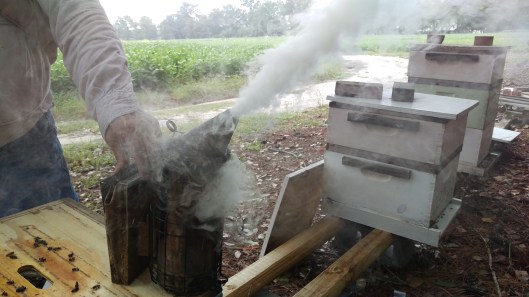
You crack the outer cover before you’ve even lit the smoker — just a peek, you tell yourself. Bad idea. A guard bee lifts off the top bars and bumps your veil, and you can already hear the pitch of the hive climbing half a step. You set the lid back down, take a breath, and get your smoker going properly this time. A few cool puffs at the entrance. A few more under the lid once it’s cracked again. Wait just a bit.
And just like that, the hive exhales. The hum drops. Bees that were staring you a minute ago are now walking calmly across the frame you’re holding, going about their business like you’re not even there. You pull the frame, look it over, and not a single bee so much as flinches toward you.
It feels a little bit like magic. It isn’t. It’s chemistry, instinct, and a survival response so old it predates you, me, and every beekeeper who ever lived — and it’s worth understanding exactly what you’re doing to that colony every time you squeeze the bellows.
The Alarm They Never Get to Sound
Here’s what almost happened before you grabbed the smoker. That guard bee in front of your veil was seconds from raising her abdomen and releasing a chemical signal from a gland near her sting shaft — a compound called isopentyl acetate, along with dozens of other volatile chemicals riding along with it. It smells like bananas to some people, which is exactly why old-timers will tell you not to eat one near the hive. To a bee, that smell means one thing: intruder, mobilize, attack here.
Under normal circumstances, that message travels fast. Nearby bees pick it up through their antennae, and within seconds you’ve got a small squad converging on the exact spot where the first bee raised the alarm. It’s an efficient, ruthless bit of biology — a single sting recruits reinforcements to the scene of the crime.
Smoke breaks that chain of communication. It doesn’t destroy the pheromone or somehow calm the bee down emotionally — it overwhelms her sense of smell. Researchers who measured this directly found that after smoke exposure, a bee’s antennae simply stop registering the alarm signal the way they normally would. She’s not less alarmed. She just can’t smell the message anymore, and neither can her sisters. That fog lifts on its own, too — bees typically regain full sensitivity within about ten to twenty minutes, which is exactly why a long inspection calls for more than one round with the smoker.
A Bellyful of Honey and a Fire That Isn’t Coming
While all that’s happening at the entrance, something else is going on deeper in the hive — and it might matter even more.
Smoke, to a bee, doesn’t read as “a person is bothering us.” It reads as fire. And a colony facing fire has exactly one move: pack up and go. So workers throughout the hive start doing something that looks almost frantic if you watch closely — they push their heads into open cells and drink down honey as fast as they can, filling their crops the way you’d grab you’d wallet and photos on the way out the door. It’s not panic for panic’s sake. Honey is expensive to make — it takes roughly eight pounds of nectar-turned-honey to produce a single pound of the wax they’d need to start over somewhere new. If the home is about to burn, that honey is coming with them.
Here’s the part that actually helps you: a bee with a full crop is a different animal. Distended and heavy, she has a much harder time curling her abdomen around to drive a stinger home. She gets sluggish — genuinely lethargic, in the same unglamorous way you get lethargic after a holiday dinner you didn’t need to finish. Multiply that across ten thousand bees and you get a hive that’s chemically confused about a fire, physically stuffed on its own honey, and — for a little while — remarkably easy to work.
This is also why a smart beekeeper doesn’t smoke and immediately rip the lid off. Give it a minute. That’s the time it takes for the “we might need to evacuate” instinct to actually kick in.
An Old, Old Trick
None of this is new information to bees, and it turns out it isn’t new information to us, either. Tomb paintings from ancient Egypt show beekeepers blowing smoke over clay hives thousands of years before anyone understood a single molecule of pheromone chemistry. Some Native American beekeepers burned puffball fungus to the same effect. Even today, honey hunters in remote parts of Nepal climb rope ladders up sheer cliff faces to reach wild colonies, carrying nothing more sophisticated than a smoldering torch to do exactly what your smoker does.
The tool in your hand only got its modern shape in 1873, when a New York beekeeper named Moses Quinby built the first bellows smoker — a tin firebox with a hand pump, not so different from the one hanging by your hive today. True to his Quaker upbringing, Quinby never patented it. He just gave it to every beekeeper who came after him, which is most of the reason it’s sitting in your hand right now instead of some more complicated, proprietary contraption.
Doing It Well, Not Just Doing It
Smoke is a tool you can absolutely overuse. The goal is a light reminder, not a siege — a few cool, gentle puffs at the entrance, a short wait, a few more under the cover before you lift it. Thick, hot, billowing smoke stresses a colony more than it calms one, and it can leave your equipment and honey smelling like a campfire for longer than you’d like. Light and patient beats heavy and rushed, every time.
Back at the Hive
So the next time the hum drops and the bees on your frame go about their business like you’re invisible, you’ll know what actually happened. You didn’t trick them, exactly — you borrowed an instinct that’s been wired into them since long before there were hive tools or bee suits, one that ancient Egyptians and Nepalese cliff-climbers and a Quaker beekeeper in the Mohawk Valley all discovered the same way you just did: light some smoke, and for a few quiet minutes, the bees will let you in.

