• Sassafras Bee Farm
  • About
  • Contact

Beekeeping365

~ The more I studied beekeeping, the less I knew, until, finally, I knew nothing. But, even though I knew nothing, I still had plenty to unlearn. Charles Martin Simon

Beekeeping365

Tag Archives: honey bee genetics

Honey Bee Genetics by PerfectBee

12 Monday Nov 2018

Posted by Beekeeping365 in beekeeping, honey bee genetics

≈ 1 Comment

Tags

haplodiploidy, honey bee genetics

Most of us have heard of the importance of genes, how a mother and father each contribute their important element and so on. We accept, without question, that the mother contributes chromosomes from her egg and the father from his sperm. Much of the animal kingdom operates with these principles.

But that is not the case with honey bees.

Read the full article here: Honey Bee Genetics — PerfectBee

Feel free to share this on:

  • Share on Facebook (Opens in new window) Facebook
  • Share on X (Opens in new window) X
  • Share on Pinterest (Opens in new window) Pinterest
  • Email a link to a friend (Opens in new window) Email
  • Share on LinkedIn (Opens in new window) LinkedIn
  • Share on Reddit (Opens in new window) Reddit
  • Share on Tumblr (Opens in new window) Tumblr
  • Print (Opens in new window) Print
  • Share on Telegram (Opens in new window) Telegram
  • Share on WhatsApp (Opens in new window) WhatsApp
Like Loading...

Breeding a better bee: Three social immunity traits, one massive experiment by Alison McAfee | Honey Bee Hub

08 Friday Jun 2018

Posted by Beekeeping365 in beekeeping, diseases

≈ Leave a comment

Tags

art, beekeeping pests, breeding better bees, diseases, honey bee diseases, honey bee genetics, opinion

Living in a honey bee hive is like living in a house with 40,000  siblings. It’s a pathogen’s dream. Left unchecked, contagious diseases can bring a colony to its knees, but honey bees – as well as other social insects – have evolved a way to fight back. Over millions of years, they have developed a collection of behaviors called ‘social immunity traits’ that help combat disease and parasite outbreaks.

Read the full article here: Breeding a better bee: Three social immunity traits, one massive experiment — Alison McAfee | Honey Bee Hub

Feel free to share this on:

  • Share on Facebook (Opens in new window) Facebook
  • Share on X (Opens in new window) X
  • Share on Pinterest (Opens in new window) Pinterest
  • Email a link to a friend (Opens in new window) Email
  • Share on LinkedIn (Opens in new window) LinkedIn
  • Share on Reddit (Opens in new window) Reddit
  • Share on Tumblr (Opens in new window) Tumblr
  • Print (Opens in new window) Print
  • Share on Telegram (Opens in new window) Telegram
  • Share on WhatsApp (Opens in new window) WhatsApp
Like Loading...

Bee Preview #2: Brother Adam’s Bees by The Honey Op

04 Monday Jun 2018

Posted by Beekeeping365 in beekeeping, diseases, famous beekeepers, honey bee genetics

≈ Leave a comment

Tags

Brother Adam, Buckfast bees, honey bee breeding, honey bee genetics, trachael mites

More than a century ago, a young Benedictine monk at Buckfast Abbey in southern England starting helping out the older brothers in the abbey’s apiary. The monk, originally from Germany, was known as Brother Adam.

The bees kept at Buckfast at the time were either Italians or a native British strain, and soon after Brother Adam joined Team Bee, a massive die-off occurred. About 2/3 of the abbey’s hives were lost as the bees succumbed to a disease then known as acarine (today I believe it’s more commonly referred to as tracheal mite disease, which tells you all you need to know about it). All the native British bees died. Only the Italian bees made it.

Read the entire artice here: Bee Preview #2: Brother Adam’s Bees — The Honey Op

Feel free to share this on:

  • Share on Facebook (Opens in new window) Facebook
  • Share on X (Opens in new window) X
  • Share on Pinterest (Opens in new window) Pinterest
  • Email a link to a friend (Opens in new window) Email
  • Share on LinkedIn (Opens in new window) LinkedIn
  • Share on Reddit (Opens in new window) Reddit
  • Share on Tumblr (Opens in new window) Tumblr
  • Print (Opens in new window) Print
  • Share on Telegram (Opens in new window) Telegram
  • Share on WhatsApp (Opens in new window) WhatsApp
Like Loading...

Sex between species: what happens when invasive honey bees meet the locals? by Ros Gloag

19 Thursday Oct 2017

Posted by Beekeeping365 in beekeeping, biology, honey bee biology

≈ Leave a comment

Tags

apis cerana, apis melifera, biology, honey bee biology, honey bee genetics

Some social insects have proved to be adept invaders. Assisted by the international trade of the modern world, these species have spread far beyond the ocean and mountain barriers that once determined their distributions. In some cases, these range expansions have brought previously isolated sister species back into contact. What happens when such species try to mate?

We were interested in this question of interspecific mating in the case of two honey bees: the Western honey bee Apis mellifera and the Eastern honey (or hive) bee, Apis cerana. These species diverged from a common ancestor at least 6 million years ago, with A. mellifera native to Europe and Africa and A. cerana native to Asia and India. Western honey bees have of course since been transported, in association with agriculture, to every human-inhabited continent on earth. Eastern honey bees meanwhile, have been quietly expanding their range too in recent decades, invading both Papua New Guinea and Australia. Thus what were allopatric (or separate) ranges for millions of years have suddenly become partially sympatric.

Read entire article at:  Sex between species: what happens when invasive honey bees meet the locals? — insectessociaux

Feel free to share this on:

  • Share on Facebook (Opens in new window) Facebook
  • Share on X (Opens in new window) X
  • Share on Pinterest (Opens in new window) Pinterest
  • Email a link to a friend (Opens in new window) Email
  • Share on LinkedIn (Opens in new window) LinkedIn
  • Share on Reddit (Opens in new window) Reddit
  • Share on Tumblr (Opens in new window) Tumblr
  • Print (Opens in new window) Print
  • Share on Telegram (Opens in new window) Telegram
  • Share on WhatsApp (Opens in new window) WhatsApp
Like Loading...

Cross-kingdom regulation of honeybee caste development by dietary plant miRNAs by Save The Bees Concert

12 Thursday Oct 2017

Posted by Beekeeping365 in beekeeping, biology, honey bee biology

≈ Leave a comment

Tags

biology, honey bee biology, honey bee genetics, honey bees, queens

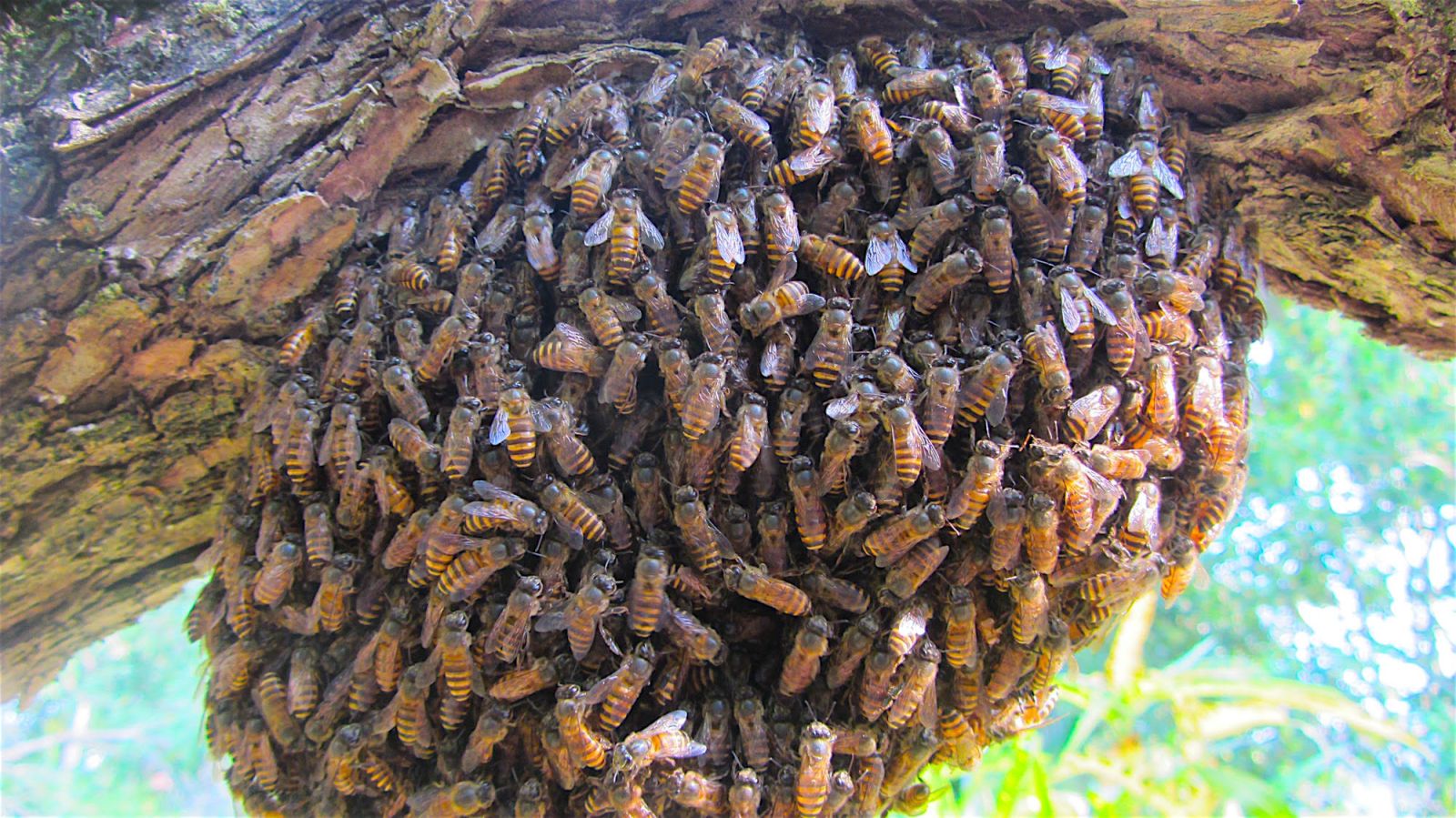
Honeybee larvae develop into workers but not queens, in part, because their diet of beebread/pollen is enriched in plant miRNAs. While miRNAs are generally negative regulators of gene expression in eukaryotes, they also negatively regulate larval development when honeybee larvae consume beebread/pollen and take up plant miRNAs. Xi Chen and Chen-Yu Zhang’s group in Nanjing University, report this finding on August 31, 2017 in PLOS Genetics.

How caste has formed in honeybees is an enduring puzzle. Although queens and workers are genetically identical, queens are reproductive and have a larger body size, develop faster and live longer than workers. Prevailing view is that differential larval feeding determines caste differentiation: royal jelly stimulates the differentiation of larvae into queen, whereas beebread and pollen consumed by the rest of the larvae lead to the worker bee fate. However, it is still not fully understood how alterations in diet modify so thoroughly the developmental trajectory of honeybees.

In previous studies, Chen-Yu Zhang’s group has reported a striking finding that plant miRNAs are ingested from plant diets and pass through the gastrointestinal tract, enter into the blood, accumulate in tissues and regulate endogenous gene expression in animals. Their findings suggest that ingested exogenous miRNAs can regulate endogenous gene expression and reshape animal phenotypes. Interestingly, since the components of beebread/pollen are mainly plant materials and royal jelly is a glandular secretion of nurse bees, the diets for worker- and queen-destined larvae are differentially derived from plant- and animal-sources. Therefore, Xi Chen, Chen-Yu Zhang and colleagues decide to investigate if miRNAs from different larval diets may have distinct impacts on honeybee development.

Here, they report that plant miRNAs are more enriched in beebread/pollen than in royal jelly. While plant miRNAs of beebread/pollen are fed to larvae, they cause developmental delay and reductions in body and ovary size in honeybees; in contrast, miRNAs in the royal jelly are not sufficient to reach a functional level, therefore queen-destined larvae evade this regulation. Mechanistic studies reveal that amTOR, a stimulatory gene in caste differentiation, is the direct target of miR162a. Interestingly, ingested plant miRNAs have a similar inhibitory effect on fruit fly development, even though fruit fly is not a social insect. In summary, this study uncovers a new mechanism that plant miRNAs in larval diet of worker bees delay caste differentiation and keep ovaries inactive, thereby inducing sterile worker bees.

The findings of this study are important for the following reasons:
Read full article at:  Cross-kingdom regulation of honeybee caste development by dietary plant miRNAs — Save The Bees Concert

Feel free to share this on:

  • Share on Facebook (Opens in new window) Facebook
  • Share on X (Opens in new window) X
  • Share on Pinterest (Opens in new window) Pinterest
  • Email a link to a friend (Opens in new window) Email
  • Share on LinkedIn (Opens in new window) LinkedIn
  • Share on Reddit (Opens in new window) Reddit
  • Share on Tumblr (Opens in new window) Tumblr
  • Print (Opens in new window) Print
  • Share on Telegram (Opens in new window) Telegram
  • Share on WhatsApp (Opens in new window) WhatsApp
Like Loading...

Honey Bee Genetics by deltavalleyapiary

03 Monday Jul 2017

Posted by Beekeeping365 in beekeeping, honey bee biology, honey bee genetics

≈ Leave a comment

Tags

beekeeping, honey bee biology, honey bee genetics

In my previous blog, I spoke about the Kinship theory. This theory states that the more relatedness there is between a group of individuals, the more likely to exhibit altruistic behavior the individuals are to be. Honeybee sisters share 75% of the same genetic material. This genetic similarity is what drives the honeybees to take […]

Read more here: Honey Bee Genetics — by deltavalleyapiary

Feel free to share this on:

  • Share on Facebook (Opens in new window) Facebook
  • Share on X (Opens in new window) X
  • Share on Pinterest (Opens in new window) Pinterest
  • Email a link to a friend (Opens in new window) Email
  • Share on LinkedIn (Opens in new window) LinkedIn
  • Share on Reddit (Opens in new window) Reddit
  • Share on Tumblr (Opens in new window) Tumblr
  • Print (Opens in new window) Print
  • Share on Telegram (Opens in new window) Telegram
  • Share on WhatsApp (Opens in new window) WhatsApp
Like Loading...
Follow Beekeeping365 on WordPress.com

Enter your email address to follow this blog and receive notifications of new posts by email.

Calendar

August 2026
S M T W T F S
 1
2345678
9101112131415
16171819202122
23242526272829
3031  
« Jul    

Posts by Month:

  • August 2026 (4)
  • July 2026 (1)
  • May 2026 (2)
  • January 2026 (3)
  • July 2025 (1)
  • April 2024 (1)
  • September 2022 (1)
  • July 2022 (1)
  • March 2022 (13)
  • February 2022 (17)
  • January 2022 (4)
  • December 2021 (4)
  • November 2021 (7)
  • October 2021 (1)
  • September 2021 (3)
  • August 2021 (11)
  • July 2021 (18)
  • June 2021 (5)
  • May 2021 (2)
  • April 2021 (9)
  • March 2021 (2)
  • February 2021 (5)
  • January 2021 (16)
  • December 2020 (15)
  • November 2020 (15)
  • October 2020 (11)
  • July 2020 (1)
  • February 2020 (1)
  • March 2019 (2)
  • February 2019 (4)
  • January 2019 (1)
  • December 2018 (10)
  • November 2018 (8)
  • October 2018 (15)
  • September 2018 (25)
  • August 2018 (3)
  • July 2018 (11)
  • June 2018 (27)
  • May 2018 (33)
  • April 2018 (20)
  • March 2018 (20)
  • February 2018 (12)
  • January 2018 (22)
  • December 2017 (18)
  • November 2017 (17)
  • October 2017 (25)
  • September 2017 (27)
  • August 2017 (21)
  • July 2017 (29)
  • June 2017 (28)
  • May 2017 (19)
  • April 2017 (17)
  • March 2017 (19)
  • February 2017 (12)
  • January 2017 (13)
  • December 2016 (5)

Posts by Categories:

  • absconding (1)
  • africanized honey bees (1)
  • apitherapy (1)
  • bee health (6)
  • bee law (2)
  • bee lining (2)
  • bee removals (2)
  • beekeeper (5)
  • beekeeper education (16)
  • beekeeping (612)
    • South Carolina (2)
  • beekeeping author (10)
  • beekeeping books (14)
  • beekeeping calendar (4)
  • beekeeping chores (8)
  • beekeeping equipment (26)
  • beekeeping history (49)
  • beekeeping management (37)
  • beekeeping pest management (8)
  • beekeeping seasons (23)
  • beekeeping vocabulary (16)
  • beeswax (13)
  • biography (4)
  • biology (14)
  • birthday (40)
  • birthdays (34)
  • book review (16)
  • breakfast (1)
  • calendar (4)
  • CCD (1)
  • chores (6)
  • comb (7)
  • comb honey (10)
  • commercial beekeeping (2)
  • cutouts (2)
  • dearth (3)
  • defensiveness (2)
  • diseases (9)
  • drawn comb (6)
  • ecology (4)
  • education (28)
  • equipment (25)
  • extracting (1)
  • fall nectar flow (1)
  • famous beekeepers (27)
  • feeding bees (7)
  • first blog entry (1)
  • folklore (1)
  • food (7)
  • forage (4)
  • hacks (3)
  • hive inspections (8)
  • hive placement (2)
  • hive products (6)
  • honey (90)
  • honey as food (22)
  • honey bee anatomy (3)
  • honey bee behavior (25)
  • honey bee biology (43)
  • honey bee genetics (4)
  • honey bee nutrition (1)
  • honey bee photos (6)
  • Honey Bee Research (1)
  • honey bee vocabulary (12)
  • honey bees (14)
  • honey judging (4)
  • honey recipe (65)
  • humor (13)
  • inspections (10)
  • journal (1)
  • log book (1)
  • making increase (3)
  • management (82)
  • mentoring (2)
  • mites (3)
  • national pollinator week (2)
  • nectar flow (6)
  • nomenclature (1)
  • opinion (8)
  • out yards (1)
  • outyards (1)
  • package bees (1)
  • pears (1)
  • pests (17)
  • plants for bees (3)
  • polish (1)
  • pollen (4)
  • pollination (11)
  • pollinators (7)
  • product review (1)
  • production (1)
  • products (3)
  • propolis (2)
  • queens (17)
  • raw honey (6)
  • recipe (88)
  • removals (1)
  • safety (3)
  • sales (2)
  • season (1)
  • seasons (21)
  • sideliner (1)
  • small hive beetles (1)
  • spring buildup (4)
  • state fair (2)
  • sustainable (7)
  • swarms (27)
  • ursurpation (1)
  • usurpation (1)
  • varroa (21)
  • varroa destructor (12)
  • varroa mites (24)
  • Winter (5)
  • winter solstice (2)
  • woodenware (3)
  • yellow jackets (2)

Sassafras Bee Farm on Facebook

Sassafras Bee Farm on Facebook

Sassafras Bee Farm

Sassafras Bee Farm

Recent Posts

  • Meeting Reality vs What Seems Deserved
  • Everything Starts with a Tasty Meal: The Science Behind a Beekeeper’s Best Pest-Management Insight
  • Pest Control
  • State Fair Wax Preparation
  • Sherlock Holmes and Beekeeping: A Unique Connection

Beekeeping365 on Facebook

Beekeeping365 on Facebook

Top Posts & Pages

  • Types of bees by Fat Daddy’s Apiary
    Types of bees by Fat Daddy’s Apiary
  • Meeting Reality vs What Seems Deserved
    Meeting Reality vs What Seems Deserved
  • Old-fashioned Honey Wafer Recipe by A Hundred Years Ago
    Old-fashioned Honey Wafer Recipe by A Hundred Years Ago

Blog Stats

  • 141,308 hits

Website Built with WordPress.com.

  • Subscribe Subscribed
    • Beekeeping365
    • Join 426 other subscribers
    • Already have a WordPress.com account? Log in now.
    • Beekeeping365
    • Subscribe Subscribed
    • Sign up
    • Log in
    • Report this content
    • View site in Reader
    • Manage subscriptions
    • Collapse this bar
%d