All beekeeping is local. These chores are for the Midlands of South Carolina. During May the nectar flow settles in, providing a steady influx of nectar keeping the bees busy. Robbing is minimal as food is plentiful. The bees are typically gentle and easy to work. Populations continue to grow. The beekeeper needs to be mindful of space management with both brood rearing at full tilt as well as incoming nectar or else swarming may occur due, in part, to limited space. Temperatures in the Midlands stabilize with few surprises and the bees continue to fly longer and longer hours each day.
New beekeepers, starting nucleus hives or packages, may find that during a strong nectar flow their bees will no longer take sugar syrup. By now they have developed a foraging force of their own and nature’s food is preferred over sugar syrup. Continue to encourage them to build comb at least until they complete the brood chamber hive body and food chamber hive body. After they have completed those boxes, it is your decision whether to continue to feed or hope to capture some real honey in the first honey super.
May:
1) Add space as needed during first part of month. There is still a month of nectar flow left to be gathered and your bees should be at maximum foraging force.
2) Manage space within the hive in population expanding situations as well as declining population situations. If a hive appears weak in population, or is not active, then investigate. Colony population should be growing this time of year. If the colony population appears declining, investigate. Do not allow too much unguarded space inside the hive if the colony weakens, swarms, or declines. If your queen is not performing well, you can either let them raise one on their own or purchase a bred queen or cell. Either way, eggs laid this month will not graduate to forager age until dearth begins.
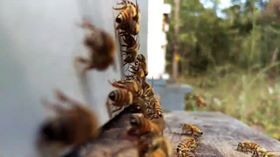
3) Plan on checks every week and no longer than every two weeks. If they are working hard and all seems well on the landing board a brief check to assess adequate space is all that’s needed. New beekeepers should take some time to begin understanding the workings of the brood nest.
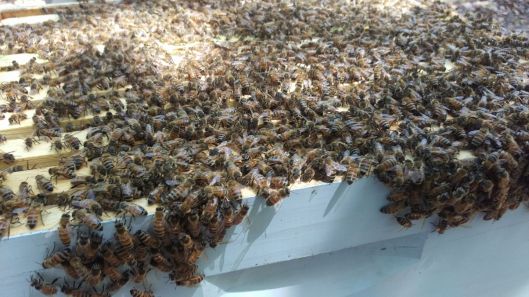
4) Swarm season continues but is lessened this month. The bees seem to be less intent on swarming and more intent on the work of gathering nectar. With both incoming nectar as well as increased brood rearing, space can quickly become an issue. Manage space accordingly and continue to watch for swarms.
5) The driver of swarming this time of year seems to shift to space issues. The bees are crowded and plentiful incoming nectar further complicates the issue. Continue to check for queen cells – make splits if swarm cells observed. Have an extra hive body, a five frame “nuc” box, or some other means to collect a swarm or to hive a split. This extra colony becomes a valuable resource hive and may save the day when the flow ends and the complexities of summer and fall approach.
6) Monitor for disease, pests, and parasites. Assess varroa mite levels this month. Talking about varroa is not why we started beekeeping but is necessary in order to keep our colonies alive and well. During the nectar flow, including the month of May, the bees are outbreeding varroa. Simply, the bee population is outpacing varroa. But there is danger ahead in the somewhat sudden onset of dearth. Dearth isn’t total zero nectar availability, it is nectar availability less than colony needs. The colony will respond to this by curtailing brood production. When this happens, the ratio of bees to mites will flip. Within a short period of time mite loads and viruses will reach levels which create sickness. Here’s the point: Make your plan for varroa management now. Waiting until they are sick is a recipe that does not work for honey bees.
7) Temperatures this month will allow the appearance of a new pest – wax moths. They can set up shop in weak hives – keep your hive volume: colony population ratio appropriate (this is what we refer to as “a strong hive.”) Also, increasingly, small hive beetles make their appearance or multiply.
8) Honey supers above the feed chamber that are filled and capped may be removed and extracted or left in place until the end of the nectar flow but no longer. Provide super space with drawn comb if available for bees to deposit nectar to ripen.
9) Notice Blackberries in bloom. Tulip poplar in bloom. Then Honeysuckle, Dandelion, Privet Hedge, Confederate Jasmine, Persimmon.
10) Add additional space conservatively toward the middle of May. Remove capped honey supers as nectar flow lessens to encourage the bees to fill the remaining open cells, remove moisture, and cap.
11) Now, or later this month, is a good time consider splitting large overwintered production colonies to: 1) make a resource hive, 2) re-queen, 3) provide a brood break for mite control, 4) make increase, 5) eliminate the chance of congestive swarming. Queen rearing isn’t difficult at this time as you have plenty of nurse bees, a nectar flow, and abundant drones. Using the On the Spot “OTS” method (similar to the Reverse Split) you can easily make colony increase and a new queen. As a bonus, due to a reduction in the number of larvae in the parent hive, you will also increase the amount of surplus honey your parent hive stores during these last weeks of the nectar flow.
12) Begin IPM program. Place beetle traps or other hive beetle management items. Your management method for wax moths is “a strong hive” with sufficient bees for the hive volume.
13) If you forgot to renew your local association membership this year do so now. Local associations operate on a shoestring budget. Only through this limited budget, and the volunteerism of club members, can they provide local beekeeping education, group purchases, beekeeping classes, community outreach, monthly meetings/fellowship, and more. Dues are minimal and your help is needed.
14) First and second year beekeepers should plan to take the written portion of the Certified Beekeeper test. Visit the South Carolina Beekeepers Association website to take the online test. Second year beekeepers should complete their journey to Certified by taking the practical portion of the test. Any South Carolina Journeyman level or above may administer the practical. You can usually complete this at a club “morning in the bee yard” event.
15) Start making plans to attend the South Carolina State Beekeepers Assocation’s Summer Conference in July. It’s a great learning experience with lectures and hands-on events. The Master Beekeeper Program usually conducts testing for all levels of the program at the Summer Conference.
16) Email your local club Secretary asking what you can do to help, or volunteer to lend a hand in your organization. Many hands make light work. If you’d like to see your local and state organizations maintain and grow your current level of member services, your help is needed.
The above are general guidelines for the average bee colony in the Midlands of South Carolina. We all have hives that may be outperforming the average. We also have colonies that underperform the average. Use your judgement in making changes suggested here. Beekeeping is an art as well as a science. Only you know the many, many particulars associated with your physical hives as well as the general health and population of your colonies.

