• Beekeeping Educational Files
  • About
  • Contact
  • Beekeeping365 Blog

Beekeeping365

~ The more I studied beekeeping, the less I knew, until, finally, I knew nothing. But, even though I knew nothing, I still had plenty to unlearn. Charles Martin Simon

Beekeeping365

Daily Archives: April 1, 2026

Midlands Beekeeping Calendar for April

01 Wednesday Apr 2026

Posted by Beekeeping365 in beekeeping, calendar, chores, honey bees, management, swarms

≈ 2 Comments

Tags

beekeeping, chores, feeding bees, honey bees, management, package bees, Swarm control, swarm prevention, swarm traps, swarms
bee_journal_html_dd42818

All beekeeping is local. These chores are for the Midlands of South Carolina.

April starts with the nectar flow in earnest and the beekeeper is busy with hive space management, swarm prevention, and swarm control. The bees will be in high gear growing populations, seeking opportunities to swarm, and storing excess nectar. Weather in the Midlands typically stabilizes with few surprises and the bees are actively flying longer and longer hours each day.

Beginning beekeepers get a “gentle” introduction to beekeeping as the bees are less defensive due to the availability of plentiful food. Also swarming behavior is not typical during a colony’s first season if space management is followed and the bees provided with proper space as the colony grows.

1) Monitor for queen cells – check suspect hives every five to seven days for swarm cells hanging on bottom bar in boxes above the brood chamber in hives with screen bottom boards and all boxes in hives with solid bottom boards. An easy, and time effective, short cut is to tip the uppermost brood box or, if no queen excluder is used, the first super, to quickly check for hanging queen cells.

2) Prevent swarms. Control swarming. Capture swarms.

3) Plan on checking every two weeks for hive body management i.e. space management.

4) If not yet added, place additional honey super(s) at the beginning of this month. On strong hives, install two honey supers if frames have drawn comb. Weaker colonies should receive less supers accordingly. If drawn comb is not available and foundation is used supers should be placed one at a time. Periodic checks should be made during the honey flow to see if additional supers are needed.

5) Install and feed any packages and nucleus hives purchased. Feed splits. Feed captured swarms.

6) Unite weak colonies with strong colonies unless suspect of disease. Replace weak queens when queens become available. 

7) Make splits if increasing total hives is a goal with mated queens or allow colonies to re-queen themselves. Splits can be used to curtail swarm behavior but will decrease honey production. If increase is desired, split any hives not previously split and re-queen any weak queens. Queens should now, or soon, be available if needed.

8) Actively manage your hives designated for honey. Stop any feeding if you are managing for honey. Manage brood space allowing the queen room to lay. Utilize other methods of swarm prevention. There is no longer time for a colony to re-queen itself in time to raise foraging bees in time for the nectar flow. If needed, add a purchased mated queen or combine colonies if not diseased if seeking honey production.

9) Begin IPM program. Place beetle traps or other hive beetle management items.

10) Watch for swarms daily and inspect for swarm cells no less than every 5 – 7 days. (Bee math alert: An egg laid in a queen cup is capped on day 9 at which point the colony may swarm. Bees will use a one day old larva to start a queen. That’s day four of sixteen and capping occurs on approximately day nine – do the math to understand why swarm cells can slip by you.) Keep a watchful eye on the landing board, a colony preparing to swarm will display lethargic bees gathered on the landing board as opposed to purposeful coming and going behavior.

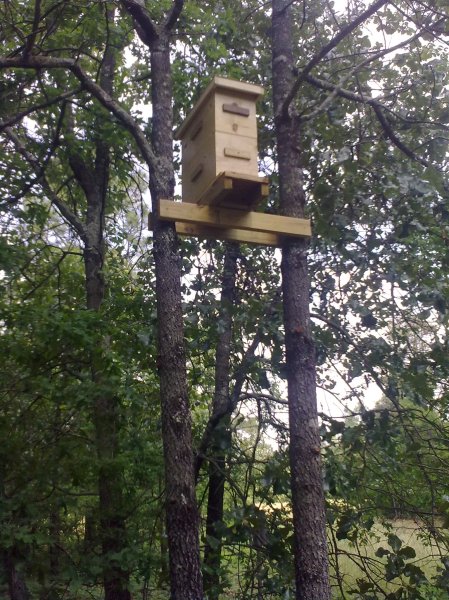
11) If not already done, bait hives should be in position at various points 360 degrees surrounding apiary. Place bait hives at 50 to 150 yards away from colonies, edges of open fields, close to “bee” aerial landmarks, scent lightly with lemongrass oil, and a 1 1/4″ circular entrance equals the 2 square inch recommendation.

12) Notice Dogwoods blooming and azaleas in earnest the first week. Sassafras, Tulip Poplar, and Tupelo blooming. Holly typically blooms in early April but is short. Also, notice the increasing greening up of many, many nectar producing trees.

13) Email your club Secretary asking what you can do to help, or volunteer to lend a hand in your organization. Many hands make light work. If you’d like to see your organization grow as well as offer and maintain your current level of member services your help is needed.

For your viewing pleasure this month Kirk Anderson shows us how to capture a swarm:

The above are general guidelines for the average bee colony in the Midlands of South Carolina. We all have hives that may be outperforming the average. We also have colonies that underperform the average. Use your judgement in making changes suggested here. Beekeeping is an art as well as a science. Only you know the many, many particulars associated with your physical hives as well as the general health and population of your colonies.

For your viewing pleasure here’s Greta Garbo in 1936 “Camille.”

Feel free to share this on:

  • Share on Facebook (Opens in new window) Facebook
  • Share on X (Opens in new window) X
  • Share on Pinterest (Opens in new window) Pinterest
  • Email a link to a friend (Opens in new window) Email
  • Share on LinkedIn (Opens in new window) LinkedIn
  • Share on Reddit (Opens in new window) Reddit
  • Share on Tumblr (Opens in new window) Tumblr
  • Print (Opens in new window) Print
  • Share on Telegram (Opens in new window) Telegram
  • Share on WhatsApp (Opens in new window) WhatsApp
Like Loading...
Follow Beekeeping365 on WordPress.com

Enter your email address to follow this blog and receive notifications of new posts by email.

Calendar

April 2026
S M T W T F S
 1234
567891011
12131415161718
19202122232425
2627282930  
« Mar   May »

Posts by Month:

  • October 2026 (26)
  • September 2026 (32)
  • August 2026 (7)
  • July 2026 (2)
  • June 2026 (1)
  • May 2026 (2)
  • April 2026 (2)
  • March 2026 (1)
  • February 2026 (2)
  • January 2026 (4)
  • July 2025 (1)
  • July 2022 (1)
  • March 2022 (13)
  • February 2022 (17)
  • January 2022 (4)
  • December 2021 (4)
  • November 2021 (4)
  • August 2021 (11)
  • July 2021 (18)
  • June 2021 (5)
  • May 2021 (2)
  • April 2021 (9)
  • March 2021 (2)
  • February 2021 (5)
  • January 2021 (16)
  • December 2020 (15)
  • November 2020 (5)
  • October 2020 (2)
  • July 2020 (1)
  • February 2020 (1)
  • March 2019 (2)
  • February 2019 (4)
  • January 2019 (1)
  • December 2018 (10)
  • November 2018 (8)
  • October 2018 (13)
  • September 2018 (18)
  • August 2018 (3)
  • July 2018 (11)
  • June 2018 (27)
  • May 2018 (33)
  • April 2018 (20)
  • March 2018 (20)
  • February 2018 (12)
  • January 2018 (22)
  • December 2017 (18)
  • November 2017 (15)
  • October 2017 (19)
  • September 2017 (17)
  • August 2017 (21)
  • July 2017 (29)
  • June 2017 (28)
  • May 2017 (19)
  • April 2017 (17)
  • March 2017 (19)
  • February 2017 (12)
  • January 2017 (13)
  • December 2016 (5)

Posts by Categories:

  • absconding (1)
  • africanized honey bees (1)
  • apitherapy (1)
  • bee health (7)
  • bee law (2)
  • bee lining (2)
  • bee removals (2)
  • beekeeper (5)
  • beekeeper education (18)
  • beekeeping (621)
    • South Carolina (4)
  • beekeeping author (10)
  • beekeeping books (12)
  • beekeeping calendar (14)
  • beekeeping chores (10)
  • beekeeping equipment (23)
  • beekeeping history (48)
  • beekeeping management (38)
  • beekeeping pest management (10)
  • beekeeping seasons (27)
  • beekeeping vocabulary (15)
  • beeswax (11)
  • biography (5)
  • biology (13)
  • birthday (37)
  • birthdays (31)
  • book review (16)
  • breakfast (1)
  • calendar (13)
  • CCD (1)
  • chores (13)
  • comb (6)
  • comb honey (10)
  • commercial beekeeping (1)
  • cutouts (2)
  • dearth (4)
  • defensiveness (1)
  • diseases (9)
  • drawn comb (5)
  • ecology (4)
  • education (31)
  • equipment (21)
  • extracting (1)
  • fall nectar flow (1)
  • famous beekeepers (26)
  • feeding bees (8)
  • first blog entry (1)
  • folklore (1)
  • food (7)
  • forage (4)
  • hacks (3)
  • hive inspections (6)
  • hive placement (2)
  • hive products (6)
  • honey (86)
  • honey as food (22)
  • honey bee anatomy (3)
  • honey bee behavior (23)
  • honey bee biology (43)
  • honey bee genetics (4)
  • honey bee losses (1)
  • honey bee nutrition (1)
  • honey bee photos (6)
  • Honey Bee Research (1)
  • honey bee vocabulary (11)
  • honey bees (15)
  • honey judging (3)
  • honey recipe (65)
  • humor (13)
  • inspections (9)
  • journal (1)
  • log book (1)
  • making increase (3)
  • management (91)
  • mentoring (2)
  • mites (4)
  • national pollinator week (2)
  • nectar flow (6)
  • nomenclature (1)
  • opinion (6)
  • out yards (1)
  • outyards (2)
  • package bees (2)
  • pears (1)
  • pests (17)
  • plants for bees (3)
  • polish (1)
  • pollen (4)
  • pollination (11)
  • pollinators (7)
  • product review (1)
  • production (1)
  • products (3)
  • propolis (2)
  • queens (17)
  • raw honey (6)
  • recipe (88)
  • removals (1)
  • safety (3)
  • sales (2)
  • season (2)
  • seasons (23)
  • sideliner (1)
  • small hive beetles (1)
  • spring buildup (4)
  • state fair (2)
  • sustainable (8)
  • swarms (28)
  • ursurpation (1)
  • usurpation (1)
  • varroa (20)
  • varroa destructor (11)
  • varroa mites (23)
  • Winter (6)
  • winter solstice (2)
  • woodenware (3)
  • yellow jackets (2)

Sassafras Bee Farm on Facebook

Sassafras Bee Farm on Facebook

Sassafras Bee Farm

Sassafras Bee Farm

Recent Posts

  • Happy Birthday Julius Hoffman
  • A pint is a pound the world around…
  • The Man Who Never Hurried
  • Journeyman Beekeeper Study Guide and Sample Test
  • Happy Birthday Juraj Fándly

Beekeeping365 on Facebook

Beekeeping365 on Facebook

Top Posts & Pages

  • The Russian Scion
    The Russian Scion
  • Autumn Absconding and Other Odd Events
    Autumn Absconding and Other Odd Events
  • An open invitation to my visitors
    An open invitation to my visitors

Blog Stats

  • 146,322 hits

Website Built with WordPress.com.

  • Subscribe Subscribed
    Beekeeping365
    Join 417 other subscribers

    Have a WordPress.com account? Log in now.

  • Beekeeping365
    View site in Reader
    Manage subscriptionsSign upLog in
    Report this content
    Collapse this bar
Loading Comments...
%d