John S. Harbison (1826–1912)
Born: September 29, 1826 — near Freedom, Beaver County, Pennsylvania Died: October 12, 1912 (aged 86) — San Diego, California
Timeline
- 1857 — Made the first successful shipment of bees into California, introducing commercial beekeeping to the state and laying the foundation for its honey industry.
- 1857 — Invented the section honey box.
- 1859 — Invented the Harbison, or California, hive; received a patent for the section box on January 4, 1859.
- 1860 — Authored An Improved System of Propagating the Honey Bee.
- 1860 — Helped organize the Pacific Apiarian Society, the first beekeepers’ association west of the Mississippi.
- 1861 — Authored The Beekeeper’s Directory, a 440-page work still regarded decades later as one of the most practical manuals of its kind.
- 1869 — Partnered with R. G. Clark to introduce beekeeping to San Diego County, shipping 110 colonies south by steamer.
- 1873 — The firm of Clark & Harbison shipped the first carload of honey to cross the continent from California.
- 1874 — Relocated permanently to San Diego with his family.
- 1876 — Awarded a medal and diploma for his San Diego County honey at the Centennial Exposition in Philadelphia.
- 1912 — Died in San Diego at age 86.
Frontier stock
Harbison came from people who had already done the hard work of settling a wilderness once. His grandparents, John and Massey Harbison, were among the first white settlers of western Pennsylvania, near Freeport on the Allegheny River, where his grandfather built and ran the region’s first grist mill — and where the family endured the raids and reprisals of the frontier wars along the Allegheny, Erie, and Ohio frontier. His grandfather fought in the punitive campaigns led by St. Clair and Wayne that eventually ended the fighting. On his mother’s side, his grandfather William Curry was a Continental Army armorer and one of Washington’s minutemen, present at the Delaware crossing and the surprise attack on the Hessian garrison at Trenton. It was a lineage built on showing up for hard, dangerous, foundational work — which is more or less what Harbison went on to do for an entire industry.
He grew up on a farm in Beaver County, and there is nothing in his early life to suggest beekeeping — the family trade, apparently, since his brothers William Curry Harbison and Andrew also became beekeepers and nurserymen.
Gold fever, then a nursery
In 1854, at 27, Harbison caught the same fever that pulled tens of thousands of young men toward California. He sailed from New York that October aboard the steamship Northern Light, crossed via the Nicaragua route, and connected on the Pacific side with the Sierra Nevada — filling in for the Yankee Blade, which had just wrecked off the California coast. He reached San Francisco on November 20, 1854, and went straight for the gold camp at Campo Seco in Amador County.
Mining, it turned out, was not for him. After a few discouraging weeks of hard labor and thin returns, he gave it up, moved to Sacramento, and took work at the Sutterville sawmill to get by while he figured out what he actually wanted to do. What he wanted to do was work with plants: he sent to Pennsylvania for seed and a small shipment of fruit trees, and by early 1855 had established the first fruit and shade tree nursery in the Sacramento Valley, at Sutterville. He followed it with larger importations from prominent Eastern nurseries in the fall and winter of 1855 and again in 1856 — stock that, by most local accounts, became the founding genetic base for the orchards that eventually lined the Sacramento River.
Bringing bees to California
Nurseries were a warm-up. In May 1857, Harbison went back east specifically to bring bees to California — an undertaking that had essentially never been done at commercial scale, since colonies did not travel well and no one had moved them across a continent and an isthmus. He left New York with 67 colonies and, after roughly a month in transit, landed them safely in Sacramento. The gamble paid off well enough that he repeated it again that fall with a second shipment, equally successful. He had, in effect, single-handedly founded California’s honey industry: before Harbison, there were essentially no managed honey bees west of the Rockies; after him, there was a state that would come to dominate American honey production for the rest of the century.
He kept the nursery and apiary businesses running together near Sacramento, and by 1870 his operation along the Sacramento River had grown to roughly 2,000 colonies — an extraordinary scale for the time, requiring a crew of hired hands to manage.
The business was not without enemies. Harbison had ongoing friction with fruit growers in the area — bees and orchardists have never entirely trusted each other — and at one point the tension turned violent: an entire apiary of his was burned, the hives doused in kerosene and set alight, a form of sabotage evidently common enough in beekeeping disputes of the era to have its own recognized method.
The section honey box and the Harbison hive
Harbison’s most consequential invention came in December 1857: the section honey box, a small removable frame that let a colony produce honey already packaged, cleanly and attractively, in a small salable unit — as opposed to the messier business of cutting comb out of a fixed hive body. It was, by the assessment of his contemporaries, the single most important innovation in comb-honey production of the era; he was granted a patent for it on January 4, 1859, and first exhibited section box honey publicly at the California State Fair in Marysville in September 1858. Two years later he built the section box concept into a complete hive design — the Harbison hive, sometimes called the California hive — which he described fully in The Beekeeper’s Directory in 1861. It became one of the very few hive designs, alongside the Langstroth movable-frame hive being developed contemporaneously in the East, to see wide standardized adoption, remaining the dominant design in California apiaries for decades.
Between the two inventions, Harbison also found time to write. An Improved System of Propagating the Honey Bee appeared in 1860, and The Beekeeper’s Directory — 440 pages covering the whole of practical bee culture — followed in 1861. Even a subsequent generation of beekeepers, writing decades later, considered it one of the most useful and practical manuals the field had produced.
In 1860 Harbison also helped organize the Pacific Apiarian Society, believed to be the first beekeepers’ association formed west of the Mississippi River — an early sign that he saw himself not just as an individual operator but as a builder of an industry that needed its own institutions.
San Diego and “King of the Beekeepers”
In the fall of 1869, Harbison partnered with R. G. Clark to extend the business into San Diego County, then still largely unsettled scrubland. The two men selected 110 colonies from Harbison’s Sacramento apiaries and shipped them south aboard the steamer Orizaba, landing in San Diego on the morning of November 28, 1869. Clark stayed on the ground, scouting the county’s canyons and mesas for the best forage ranges — chiefly the native sage that would make San Diego honey famous — while the partnership expanded with further shipments over the next four years. When Clark and Harbison dissolved the partnership in 1873, Clark took his share of the proceeds into the El Cajon Valley, where he planted the county’s first raisin vineyard; Harbison moved his family permanently to San Diego in February 1874, settling not far from the valley that would come to bear his name, Harbison Canyon, near the Sweetwater River about 23 miles east of the city.
The results of the Clark & Harbison venture were, by any measure, spectacular. San Diego sage honey developed a reputation that reached international markets, and the operation’s visible success drew a wave of new settlers to the county — many of whom took up land specifically to farm and keep bees themselves, on the strength of what Harbison and Clark had proven possible. By the mid-1870s Harbison was operating thousands of colonies across a dozen locations in the county and was, by some contemporary accounts, the largest honey producer in the world. In 1873, the firm shipped the first carload of honey to cross the continent by rail from California — a shipment that, within a few years, grew into ten-car honey trains bound for New York and made the Harbison name recognizable in Eastern markets that had never before seen San Diego on a map. Three years later, in 1876, his San Diego County honey won a medal and diploma at the Centennial Exposition in Philadelphia — the World’s Fair marking the republic’s hundredth birthday, and about as prominent a stage as American agriculture had at the time.
It was this combination — inventor, industry founder, and now the visible face of California’s most improbable export — that earned Harbison the honorific by which the beekeeping press knew him for the rest of his life: “King of the Beekeepers.”
Family and later life
Harbison married Mary J. White of New Castle, Pennsylvania, in 1865. They had three children: a son who died in infancy, and two daughters, including Florence, who moved with the family to San Diego in 1874.
He settled into San Diego life as more than a beekeeper — building a two-story residence at 12th and C Streets where he lived until his death, and investing in real estate, orchards, and a wholesale grocery concern, the Harbison Wholesale Grocery Company. He kept bees on a diminishing scale into old age; by the early 1890s he maintained roughly 500 colonies, mostly leased out to others to work, and at his death owned about 100. He died in San Diego on October 12, 1912, at age 86, having lived long enough to see the industry he had personally founded in 1857 become one of the signature agricultural products of an entire state.
Sources: San Diego History Center — John S. Harbison: Pioneer San Diego Beekeeper; Alpine Historical Society — John Stewart Harbison, Pioneer Beekeeper; East County Magazine — Historic Tale: John Harbison, King of the Beekeepers; John S. Harbison Papers, 1857–1920, Online Archive of California.
Source:
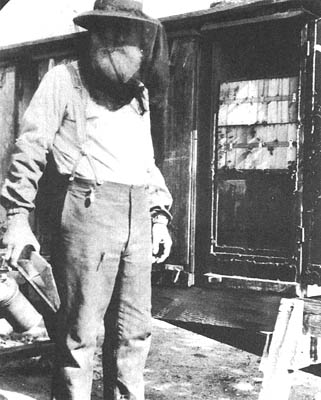
Image The City and County of San Diego: Illustrated and Containing Biographical Sketches of Prominent Men and Pioneers, Page 157, 1888
The ABC of Bee Culture, A. I. Root, 1903 page 415
Additional information here: http://www.sandiegohistory.org/journal/1969/october/harbisonimages/

