Tags
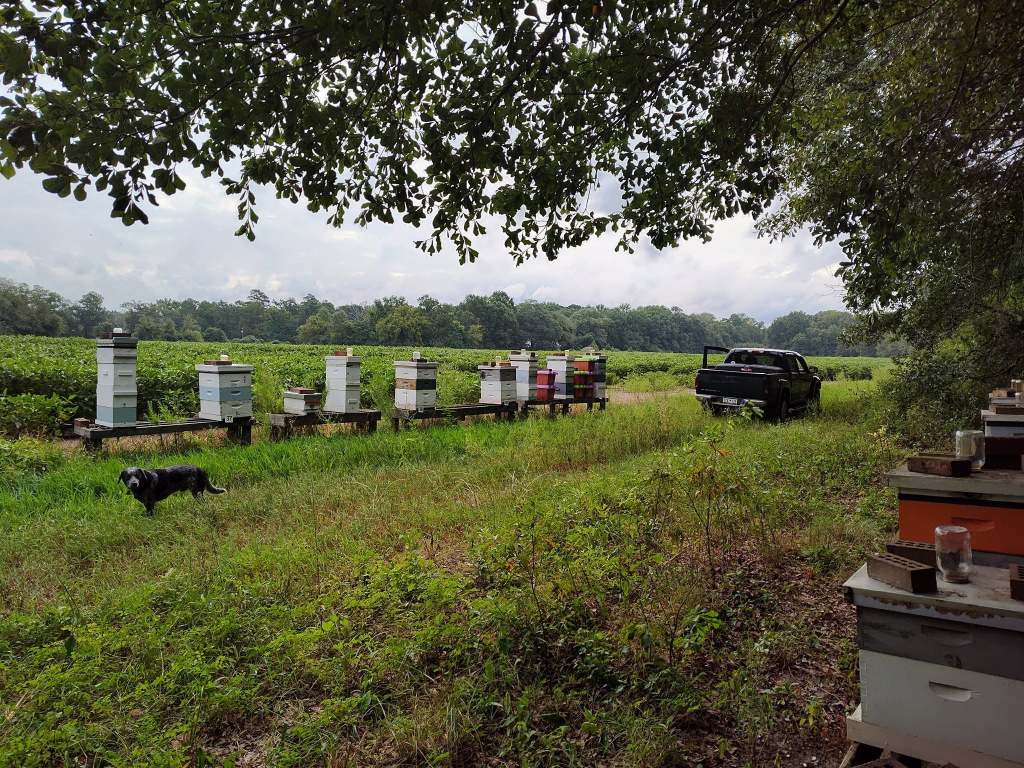
The flow doesn’t taper here in the South Carolina Midlands so much as it closes. Within a few days of the first week of June the whole yard changes character — bees that walked over your gloves in May now follow you back to the truck, and the frames that were getting drawn out and filled last week are getting licked dry instead. Harvest is the last act of a season that has already ended, and every split you make afterward gets made into an empty landscape, on sugar you carried out there yourself, because there is nothing coming in to make it on.
You knew this day would come. You have known it since February. It’s seasonal, in the same place it was last year and the year before, and knowing it never seems to change how the first dry week feels — the sense that the timing is wrong, that the nucs needed another three weeks, that it isn’t fair to shut the tap the same month you’re supposed to start post season splits. The dearth arrives anyway, on schedule, indifferent to all of it.
Watch what the bees do with the same event. When income stops, the colony contracts — the queen’s laying pulls back toward what the minimal nectar income will carry, foragers that were working nectar go to scavenging and to testing their neighbors’ entrances, guards get serious about the door. There is no deliberation in it and no grief. The colony is not being brave. It simply has no forecast to be disappointed by: a summer forager lives about six weeks, so not one bee in that box worked the early spring poplar and not one of them will see the goldenrod. Grievance requires a comparison — a good year to measure this one against, a version of June that owed you something. Nothing in the hive can hold that comparison. Dearth is a word out of the beekeeper’s ledger, a complaint dressed as a technical term. The bees just call it June, if they call it anything, and go on working what’s actually there.
Here’s the part worth staying with, though, because it’s easy to read all that as a sermon about living in the present and stopping too early. The bees are not living in the present. A colony in a flow behaves like an organism that regards scarcity as an absolute certainty — it stores far past any conceivable need, caps it against moisture, and then defends it with its life. Everything you harvest is a provision made against a future the bees have never individually seen and cannot possibly remember. So, they do the entire work of anticipation, seriously and at real cost, and they do it without any of the dread. The provision and the anxiety turn out to be separable. One of them is doing the job, and the other one is riding along claiming credit.
Then go one step further, because this is the thing the dearth actually taught me and it took a few seasons. Honey exists because dearth exists. A colony that never faced a hungry stretch would have no reason to lay up eighty pounds of anything — the surplus you take off in early June is precisely the measure of how seriously the bees take July. There is no available version of the year in which the flow simply keeps running and you still get a harvest. The hardship you spend the spring dreading is not an interruption of the enterprise. It is the foundation of it, the whole reason there’s a surplus to argue over in the first place. You are, in the most literal sense, harvesting the bees’ answer to the problem you’re upset about.
Which reframes what actually goes wrong in a bad summer. The dearth itself kills very few colonies. What kills them is being managed as though it hadn’t started — supers left on for a flow that isn’t coming, a June nuc with a wide-open entrance it hasn’t got the numbers to defend, wet frames set out in the yard in daylight, syrup slopped at the doorway of a weak hive in the middle of a robbing summer. It’s expecting a July queen to mate in a week of poor flying weather and lay like an April queen, then reading a slow buildup as a bad queen rather than a dry month, and requeening a colony whose only problem was the seasonal calendar. And it’s the quiet one: the brood nest contracts while the mite population does not, so the ratio climbs all summer in a hive that looks, from the outside, like nothing much is happening. Nearly every one of these events is solved by a beekeeper working in May. The beekeeper’s injury comes from the mental fight against a natural process, not from the dearth.
Dearth is a certainty. Nothing you do in that yard removes that certainty. You cannot push the poplar back a week because you were traveling, or ask the clover to hold on until the nucs are stronger, or negotiate with a dry spell on the grounds that you lost four colonies last winter and are owed a break. Push on that and you’ll be worn down long before it is. What you can move is yourself — earlier. Feed before they get light instead of after. Reduce the entrances before the robbing starts rather than during. Make the splits earlier knowing they’ll be carried, not hoping they’ll be fed by something outside of your control. Do the mite count in the middle of the dearth, when the numbers are ugly and still fixable, instead of in September when the winter bees are already being raised on borrowed time.
Call that acceptance if you want. In the yard it mostly looks like a seasonal calendar and a bag of sugar, and a beekeeper who has finally stopped having opinions about June.
 Beekeeping365