The Weakest Link by sassafrasbeefarm

Tags

, ,

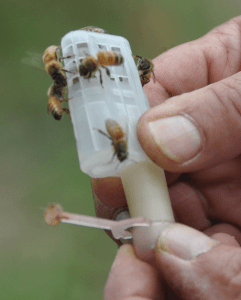
queen cage

Not the actual cage but you get the idea.

It’s been three weeks since I installed some virgin queens in some splits. Yeah a good three weeks. I’ve checked them a few times but with the daily rains for the past  eight or nine days I’ve been behind. Well, that’s my excuse and I’m sticking to it.

I had a friend over the day after I placed them into the mating nucs. I gave him some of the virgins. He opened the first hive and no cage was obvious. “Oh, that cage dropped down between the frames. Just skip that one.”

Fast forward three weeks to today and I’m checking the those colonies that haven’t shown mated queens. I get to the hive with the ‘sunken’ queen cage figuring I’d combine it with another hive should it still be queenless. After all not much time and it will turn laying worker on me. There the cage was between the frames standing on the bottom board. I took it out and laid it to the side.

I inspected all of the frames for eggs and the queen just to be sure. None. The workers were running laps around the bottom board – how odd.

So, I was about to handle the situation when I looked at the queen cage I had pulled out and there were workers all over it. Surely not…

Then I remembered what I had seen just a few minutes earlier: The cage had slid down and the cage exit hole was sitting on the bottom board. Surely she’s dead right? Nope, she’s alive and active.

Probably has missed her opportunity to mate, but hey, let’s give her a chance. She’s been locked up for too long not to give her a chance.

The weakest link is the beekeeper.

Image

Mite Treatments by What Should I Be Doing With My Bees This Month?

Tags

, , , , , ,

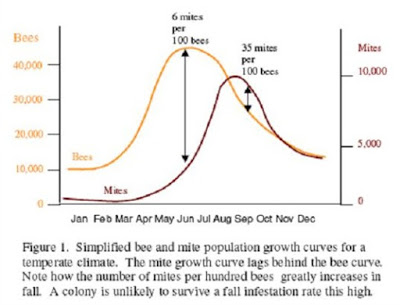
Mite treatments will be the hot topic for all beekeepers very soon. Look at the graph above about the bee and mite population and the timeline. The Varroa population lags the bee population, up until early September. Then the mite population keeps increasing as the bee population goes down. This high infestation of mites damages the bees physically and also exposing honeybees to viruses. This high infestation of mites is what kills honeybee colonies.   Beekeepers need to stop this rising mite population during the month of August before the Varroa population explodes. Looking at the graph one can see there is a sharp rise in the month of August in the mite population. Treating colonies in September in many cases is too late. The bees may be so damaged by the rising mite population that they cannot recover.

Read the full article at:  Mite Treatments — What Should I Be Doing With My Bees This Month?

Quote

Honey Bee Speed: 100 Flowers Per Hour by 67steffen

Tags

,

The typical honey bee (female forager) will visit 100 flowers in an hour’s time before returning to the hive to drop off collected pollen. The bee will repeat this process about ten times in a day. I like to say the honey bee travels at a speed of 100 FPH, even though it  beats it wings around 12,000 times per minute.

View original article here: Honey Bee Speed: 100 Flowers Per Hour — 67steffen

Could Beekeeping Save the US Political System? by Married with Bees

Tags

, , ,

Beekeepers have some amazing qualities. Wouldn’t it be great if we could get our politicians to be more like beekeepers?

Read full article here:  Could Beekeeping Save the US Political System? — Married with Bees

Image

DIY Beard Balm by Keeping Backyard Bees

Tags

, , ,

Beard balm is a leave-in conditioner that softens, moisturizes, and helps style your beard. The beeswax in beard balm offers a light to medium hold, but its main job is to seal in moisture. A well-made beard balm will also condition the skin, leaving it soft and moisturized. Beard balm is a thicker, more moisturizing product than beard oil.

Read full recipe for beard balm here: DIY Beard Balm — Keeping Backyard Bees

In Praise of Bees in Our Yards by Kingfisher Journey- Marina Richie

Tags

, ,

A burly bumblebee nose dives into the unfurling gold petals of a California poppy and vanishes. I lean ever closer until I’m a foot away. The bee spirals up and out, bearing pollen on her legs. Off she hums to the next flower, almost bumping into the honeybees plying the summer morning air.

Read full article with some awesome pictures here: In Praise of Bees in Our Yards — Kingfisher Journey- Marina Richie

Image

Life without fumagillin by Alison McAfee | Honey Bee Hub

The only registered treatment for Nosema disease is no longer commercially available. On April 12, 2018, Medivet Pharmaceuticals Ltd. – a company based out of High River, Alberta – announced that they were closing their doors. And shutting down Medivet means shutting down production of the world’s supply of fumagillin, in the form of their quick-dissolving product, Fumagilin-B.

Read full article here: Life without fumagillin — Alison McAfee | Honey Bee Hub

Image

Types of bees by Fat Daddy’s Apiary

Apis mellifera honey bees are also known as “western honey bees” and “European honey bees”. It is considered that many of the “pure” bees aren’t totally pure due to interbreeding from other sub-species (races). This has come about in the last few hundred years because man has moved bees into areas they were previously excluded […]

Read the full article here: Types of bees. — Fat Daddy’s Apiary

Gallery

Alcohol wash to get a mite count in a beehive by Southeastern Indiana Beekeepers Association

Tags

, , , , , , ,

This gallery contains 5 photos.

This is an excellent article on assessing mite counts in your beehives. Thanks to J.Morgan, Karen Ferguson and SIBA for …

Continue reading

Honeybees, Wasps, or Yellowjackets? by sassafrasbeefarm

Tags

, ,

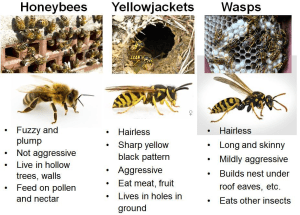
wasps

It’s that time of the year again when we get lots of calls to remove flying insects that are actually yellowjackets or wasps, and not honeybees.

Introducing Queens by Lytchett Bay Apiaries

Tags

, , ,

Whenever a new queen is introduced to the existing colony there is always a chance your worker bees will not accept her, and the result of this could be the death of your new queen – no matter which method of introduction you use.

The main things you need to be sure of when introducing a new queen, whether it be into a full colony or nucleus, is that you do not have a virgin queen or indeed a mated queen that has simply gone off lay in your colony. You need to ensure you have removed all queen cells or queen cups, shake the bees off the frames if necessary to find the queen cells they hide in the edges of the frames. Also ensure you do not have laying workers in your hive.

Read full article here: Introducing Queens — Lytchett Bay Apiaries

Quote

Berry Honey Milkshake by BEEKeeping: Your First Three Years

Tags

, ,


strawberry

BERRY HONEY MILKSHAKE

You can use non-fat milk, ice cream or yogurt if you wish

  • 1 pint vanilla ice cream or frozen yogurt
  • 2-1/2 cups strawberries
  • 1/2 cup milk
  • 1/4 cup honey
  • 4 small mint sprigs (optional)

In blender combine all ingredients except mint. Blend about 30 seconds until smooth and creamy. Serve immediately in tall chilled glasses. Garnish with mint sprigs if desired. Makes four servings.

via Cooking with Honey — BEEKeeping: Your First Three Years

Quote

Over Wintering Nucs- A Better Way by Michael Palmer

Tags

, , ,

I used to buy bees, lots and lots of bees; singles from South Carolina, nuclei from Florida and frames of brood from New York. I used to buy queens, lots and lots of queens; queens from Georgia, queens from Texas and queens from California. Every year it was the same. Pick up the pieces of my apiary in the Spring, send a big check to southern queen breeders, split up my best colonies, and hope I made enough of a honey crop to pay the bills. Some years I did, some years I did not.

Read full article here: Over Wintering Nucs- A Better Way — BEEKeeping: Your First Three Years

Honey – Balsamic Reduction Sauce by snapshotsincursive

Tags

, , , ,

What’s Cooking in Gail’s Kitchen? A Burst of Flavor: Balsamic Reduction Sauce-It’s Sweet! This is the elegant dark sauce you find drizzled over salads, cheese, meats, vegetables, and even fruity desserts in restaurants. At home, it can be made in minutes. You’ll feel like a master chef when you swirl it over your favorite dishes. I do.

HONEY – BALSAMIC REDUCTION SAUCE-IT’S SWEET!

Ingredients:

Read the full recipe here: Balsamic Reduction Sauce — snapshotsincursive

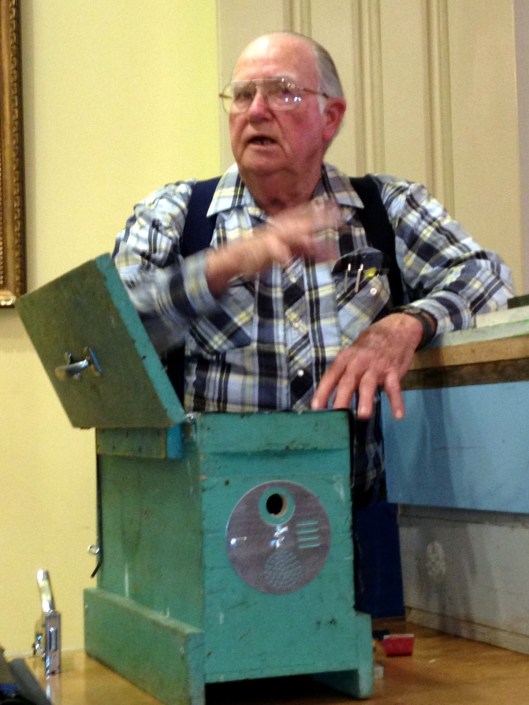
The Quiet Box by sassafrasbeefarm

Tags

, , ,


billy davis

Billy Davis’ Quiet Box for bees.


At the Mid State Beekeepers “Bees in the Backyard” event, while inspecting a hive, I had a question about where the best place is to place a removed frame with a queen on it. Would I lean it against the side of the hive? At the time I was not in my bee yard so I just said that the queen would stay on a frame of larvae. In fact I’ve never seen one leave a frame of larvae unless I placed it back into the hive and she went to another frame. But, when in my own bee yard I use a quiet box for such occasions. In fact, I use my quiet box any time I am doing any in depth inspection into the brood nest area. My first frame comes out and, with bees attached, it goes into the quiet box. Should I find the queen on a frame then the she and the frame she is on also go into the quiet box. If I start to find queen cells – quiet box again. One of the biggest advantage I find is that I know where my queen is and fragile cells if I find any. Once the queen is in the quiet box I can pretty much move through the hive at will and concentrate on reading frames. Here’s an excellent video on using a quiet box and how one is constructed.

Quote

Beekeeping Humor – Self Incrimination, You have a Right to a Lawyer by Stephen Bishop

Tags

Apparently, I had been speeding down a South Carolina highway without wearing my seatbelt (uncharacteristic, I swear) and couldn’t provide a logical answer to a state trooper’s question, “So where you heading?” My conundrum was I didn’t know where I was heading. I was searching the countryside for a logging crew, any logging crew to photograph. I had just written an article, in fact my first ever as a freelancer, for Grit magazine on forest management, and the editor wanted photos to accompany it. The state trooper doubted my story and asked me to exit the car and follow his finger with my eyeballs without moving my head. Then he proceeded to tell me to recite the alphabet backwards from M.

You try.

It’s difficult, even sober. I was sober but petrified because my story sounded ridiculous. After walking a line, toe to toe, which isn’t so easy either under the gaze of a lawman, the trooper asked if he could search my backpack in the passenger’s seat. I consented thankfully. If not, I might have been escorted to the slammer. In that backpack was a copy of William Zinsser’s On Writing Well and about a year’s worth of Writer’s Digest. After that, the trooper handed me a seatbelt violation and let me go on my aimless way.

Today I use that same backpack to tote beekeeping stuff. It contains, among other things, a crowbar-looking thing with a little hook on the end that looks like a perfect tool for burglary. I have a grafting tool that looks like a lock pic and an unlabeled ziplock bag of a white powdery substance. In my truck bed is a long metal wand that I can hook to my truck battery to volatilize my white powdery substance. I reek of smoke. If stopped by a state trooper today, I would soon be sitting behind bars until the lab results came back showing oxalic acid.

Read full article here: Self Incrimination — BEEKeeping: Your First Three Years

Quote

Physical Barriers, Aging, and Beekeeping by Morris Ostrofsky

Tags

,

They say death and taxes are unavoidable. There is a third item that can be added to this list; physical changes whether due to aging or disability.

This article is written for any beekeeper who is encountering physical barriers that affect their ability to continue keeping bees. These barriers can come in the form of mobility issues, arthritis, diminishing strength, back problems, eyesight or other unexpected challenges.

Beekeepers are resourceful and find creative solutions to continue keeping bees. Aging or other obstacles can be addressed on multiple fronts: lifestyle, equipment and management changes. Some of the solutions can be put into practice now and some will take planning and time to implement. The objective of this article is to provide practical information to help beekeepers adapt to changing physical conditions thus allowing them to continue doing what they love.

Read full article here: Barriers — BEEKeeping: Your First Three Years

Biology Dictates Behavior by sassafrasbeefarm

Tags

, ,


queen-bee-682941_960_720Watching reruns of the television series Elementary last night, Sherlock mentions twice the phrase, “Biology dictates behavior.”

In the beehive the genetics of the queen and the multiple drones she mated with is manifested in the behaviors of the workers. While honey bees progress through different work tasks according to their age, other behaviors are less defined and not seen as routine. That is to say, all bees begin as house bees and start by cleaning cells. They progress through various jobs as they age becoming nurse bees, feeding larvae, cleaning the hive of trash and dead bees, tending to the queen, wax excretion, moving nectar, and fanning the nectar or cooling the hive. However, most of these jobs are not compulsory nor do all bees perform all of these tasks as they age. There simply isn’t a need for all bees to progress through the task of feeding the queen nor is there a need for thousands of undertaker bees. The bees tend to have some degree of flexibility in shifting behaviors to meet the needs of the colony. But there is no macro view of the colony so how do they know what tasks need performing to be able to change behaviors. (Imagine an Amazon.com warehouse where all the workers seemingly just know what to do every day when they report to work.)

The same can be said of those bees that have graduated from house bee status and become foraging bees. Some specialize in pollen, other propolis, water, and still others nectar. The bees shift amongst these tasks depending on the needs of the colony but, again, their is no central command issuing “orders of the day” to direct these tasks. Yet, remarkably, the jobs get done.

So what determines bee behavior? We know that there is a biofeedback loop based on pheromones produced by the bees and that the queen has a major role in signaling, through pheromones, the colony needs and wellbeing. That’s one method of directing the day-to-day activities but it doesn’t fully account for the flexibility observed in an organization comprised of tens of thousands of bees operating on a day to day basis and responding to changes that take place in the environment and within the hive.

Let’s consider defensive behavior within a colony. Beekeepers may miss or overlook a lot of bee behavior but they seldom fail to observe a colony that is more defensive than others. Often referred to as “hot,” these colonies stand out to the beekeeper and rightly so as it’s not fun working a colony of bees intend on displaying defensive or aggressive behavior. Once again though, we typically find that even in colonies that display higher than normal defensive behavior we don’t usually see thousands of bees dedicating themselves to delivering their sting, and their life, to the cause. Most often there is one or several ready to act on the behalf of defending the colony. Additionally a measured response is noted with the bees ratcheting up the response as alarm pheromone is spread and triggering more and more bees to act. It’s biology in action.

But it begins with a genetic predisposition to act, either sooner or later, to a stimulus. Some bees tend to jump on the bandwagon early in delivering their venom payload to the unsuspecting beekeeper, seemingly before a genuine need exists to become defensive. If this behavior is excessive beekeepers blame the queen. Of course it may, in fact, be the genetics passed on from one or more of the multiple drones she mated with on her nuptial flight. But regardless, she gets the blame and is sought out for execution for this undesirable trait. The beekeeper replaces her with a queen of better disposition and through normal attrition of her progeny, and the more gentle temperament of the new queen’s offspring, the colony takes on a different personality.

And where in the above is anything other than the title of this article, “Biology dictates behavior.” There are no feelings involved. There is no sorrow for the old queen within the hive. There is nothing but the now of queen-rightness, the sensed reality of queen-lessness, and then the resumption of being queen-right. It’s stimulus response. Should a beekeeper kill the old queen without a replacement the bees simply initiate the replacement process. No rituals exist, no beliefs cloud the process, no judgement, and no processing of the loss. The bees carry on and make plans for the colony’s survival without missing a beat. The hive may fail but they will, through their genetics and biology go forward pushed by urges provided by pheromones (or lack thereof) and their genetic predispositions. Biology dictates behavior.

The beekeeper may wish to mourn the loss of a valued queen but that mourning is for the beekeeper alone. And the new beekeeper does mourn – at least the ones I have met. I too found it difficult to kill the queen early in my beekeeping. The mourning, whether for a queen or a colony, takes it’s emotional toll on some. I’ve met those that said they got out of beekeeping after losing a couple hives because, “It was too hard losing the bees.”

New beekeepers resist what is while the bees do not. Truly to understand the bees we need to learn from them. To force our understanding of them into our mental framework removes the beekeeper from a true understanding. Understanding them through our rose colored glasses discredits the bees and moves us further from what they offer us.

Big Papi’s Honey Grilled Shrimp with Bacon and Salsa Spinach Salad by Bones At The Table

Tags

, , , ,

Honey Grilled Shrimp by Bones at the Table

1/2 teaspoon garlic powder
1/4 tablespoon ground black pepper
1/3 cup Worcestershire sauce
2 tablespoons dry white wine
2 tablespoons Italian-style salad dressing
1 pound large shrimp, peeled and deveined with tails attached
1/4 cup honey
1/4 cup butter, melted
2 tablespoons Worcestershire sauce

In a large bowl, mix together garlic powder, black pepper, 1/3 cup Worcestershire sauce, wine, and salad dressing; add shrimp, and toss to coat. Cover, and marinate in the refrigerator for 1 hour.

Preheat grill for high heat. Thread shrimp onto skewers, piercing once near the tail and once near the head. Discard marinade.

In a small bowl, stir together honey, melted butter, and remaining 2 tablespoons Worcestershire sauce. Set aside for basting.

Lightly oil grill grate. Grill shrimp for 2 to 3 minutes per side, or until opaque. Baste occasionally with the honey-butter sauce while grilling.

Crumble Cooked Bacon over a bed of Spinach add greed Shrimp.

Read the full recipe and lots more delicious recipes at: Big Papi’s Honey Grilled Shrimp with Bacon and Salsa Spinach Salad — Bones At The Table

Quote

Pros and Cons of Feeding Dry Pollen Sub by Bee Informed Partnership

Tags

, ,

Most beekeepers have come to realize that due to lack of natural forage in our urban and agricultural landscapes, feeding pollen substitute has become necessary to keep bees healthy in most parts of the country. Last summer was an especially challenging season in the West due to extremely hot and dry conditions. Despite a wet spring in California and Oregon last year, the spigot was shut off abruptly early in the summer and what little forage was available quickly shriveled. Beekeepers who had not been providing supplemental feed saw their colonies dwindle as the summer went on. Although it’s still early, this year is looking like it could be similar.

Read the entire article here: Pros and Cons of Feeding Dry Pollen Sub — Bee Informed Partnership

Quote

Your beekeeping year is about to change by Honey Bee Suite

Tags

,

Here we are at the Summer Solstice. Here’s some good advice from Rusty…
~sasafrasbeefarm

Your beekeeping year is about to change:

The beekeeping year can be divided into two halves. One half is characterized by expansion, and the other by contraction. Tomorrow we begin the next phase. Whether you live in the northern hemisphere or the southern, the solstices mark the boundaries, the points at which things begin to change.

The most important concept in beekeeping:

If I were to write a book on beekeeping, this is where it would begin. Relatively unimportant issues like how to feed, where to put a hive, or how to inspect would be relegated to the appendix. The how-to part of beekeeping is unimportant compared to the why of it. Once you understand how bee colonies respond to their environment—what they do and why—the how-to stuff becomes easy. You can figure it out without instructions because you understand the purpose.

The honey bee lifestyle is much easier to understand when you look at bees as a part of the natural world, not the man-made one. Honey bees respond to cues provided by nature, and once you understand their place in the ecosystem, their life cycle begins to make sense.

Read full article here: Your beekeeping year is about to change — Honey Bee Suite

Quote

Summer Solstice by Wildflower Meadows

Tags

, , ,

19278748661_7b8ab9ba60_b

For beekeepers and the bees, the summer solstice marks the end of the period of increase and the beginning of the journey to the winter equinox. The next six months will be a period of reduction and preparation for winter.
~sassafrasbeefarm

As the sun reaches its most northerly position relative to the earth, the bees also reach their maximum strength.  The summer solstice, which occurs on June 21st, brings the longest day of the year in the northern hemisphere.  It also marks a delineation between the two broad seasons in the year of a beehive:  the season of expansion and the season of contraction.

Read the full article here: Summer Solstice — Wildflower Meadows

What have you done for me lately?

Tags

, , , ,

IMAG2696

Water in Boardman feeders.

Based on my own experience, and in talking with others, honey removal places an additional stress on the colonies. And, if you think about it, it does so in several ways. Of course we just took away much of their stores. Often we have taken apart their entire structure and rearranged the order they had created. The scent of torn honey combs may have caused some robbers to investigate which necessitated defense of the colony. Simple removal of a hive body changes the thermodynamics and ventilation characteristics. And on top of it all we have done all this at the beginning of one of the most stressful times of the year – dearth and pest season.

I’ve lost colonies within a month of harvesting in prior years. It may have been because of mites or robbing and simply coincided with harvest but regardless, the stress of harvesting played into their inability to maintain the healthy state they were in prior to my disruption.

So, back to my original question, What have you done for me lately? Or more appropriately, What have you done for your bees lately?

Are you providing ventilation to allow them to cool the hive? Screen bottom boards? Small upper entrances to allow air flow? Popsicle sticks under the outer cover? We know they are working hard to cool the hive as evidenced by water gathering. Are you making it easy for them to gather water?

IMAG2694

Syrup on top where it can be protected and not start robbing.

Are you giving them some syrup to replace some of the stores you took? You might say that you left adequate stores on the hive but would access to a little feeding of light syrup not be welcomed rather than having them gather water and reconstitute honey left on the hive? Remember honey harvest occurs at a peek in colony population and brood rearing and they are consuming lots of carbohydrate while unfortunately nectar flow has just dropped off so they must now take on the additional job of diluting honey and using it to feed the larvae along with all the other tasks.

Are you monitoring for hive beetles? I’ve already found a few in smaller nucs. Stronger hives seem to still have them well managed in my apiary. Soon it will be yet another job for them to guard and corral the SHBs.

Have you made adjustments in the size of your hive? You may need to add a hive body or remove one depending on the colony population.

Assess for mites. I checked my mites in early June to be ready for action after harvest. I’ve already completed my second OAV treatment and can see an increase in the enthusiasm of the bees already as the mite load begins to drop. This management of the mites means the bees can do more for themselves by lowering their stress levels so that they can perform the many other jobs they have to do.

It’s hot outside and it can be difficult to motivate yourself to get out and work your bees like you did in the spring. Regardless, your bees need you more than ever right now. Hopefully they are strong and will be able to handle the many challenges awaiting them through dearth, pest season, and ultimately winter. As beekeepers we know that last minute preparations rarely yield the results we want, so we must find a way to work with them now rather than later. Try getting out early in the morning while it’s still cool. I recommend you do as the bees do this time of year – get out and get your work done early and stay home and dance after it gets hot. I’ve found the bees gentle in the early hours recently. Most foragers are out early to gather the nectar produced overnight and the house bees are cordial enough. Limit your inspections to ensuring they have what they need and are well. Lower their stress levels with some ventilation, feed, water, mite and SHB control, and they will do the rest.

Pictures above show thin syrup on top (protected) and water in Boardman feeders.

Quote

National Pollinator Week by Bad Beekeeping Blog

Tags

,

Here’s a reminder from our friend Ron Miksha over at Bad Beekeeping Blog to celebrate NAtional Pollinator Week. Thanks Ron!
~sassafrasbeefarm

National Pollinator Week has arrived: June 18-24! Today, I’m re-running part of a blog I posted last week.  It had some ideas on what you might do to celebrate Pollinator Week.

Pollinator Partnership tells us, “National Pollinator Week is a time to celebrate pollinators and spread the word about what you can do to protect them.” Eleven years ago, when colony collapse was at its peak and the end of civilization was near, the US Senate approved “National Pollinator Week” unanimously. Unanimously! Has the US Senate ever approved anything else by undissented decree? That’s a hundred out of a hundred. Congratulations to them for collaborating, for once, on something important. They wanted every American to recognize the pollination services provided by birds and bees and beetles and bats.

Read the full blog post at: National Pollinator Week — Bad Beekeeping Blog

After the Nectar Flow – Providing Water by sassafrasbeefarm

Tags

, , , ,

water

It’s that time of year when emails start coming in from people asking if someone can come out and gather the swarm that comes to their swimming pool every day. Yeah, it’s not a swarm but arguing over definitions doesn’t get us anywhere closer to solving the problem.

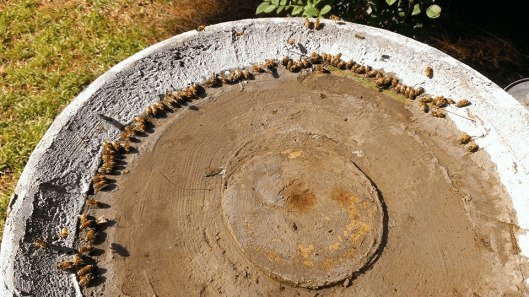
Beekeepers, keep your current water sources for bees filled. You’ll notice the bees need more water than during the spring since they no longer have the moisture provided by nectar. They also need to gather more water now for hive cooling and to dilute honey for consumption.

Use multiple water sources around your apiary. You’ll find they have preferences. My bees usually like concrete bird baths best for some reason.

Another trick I’ve learned is to dilute any syrup fed at open feeding stations. The excess water provides more humidity in the hive and reduces their need for water gathering.

Yet another idea is to keep your potted plants well watered. My wife has an herb garden area with lots of potted plants. This time of year I take it on myself to keep the plants watered, usually to the point of the pans underneath having water in them. The bees seem to like the dirty water that comes out of the bottom of the plant pot.

And don’t forget those Boardman feeders. While not recommended for feeding during dearth, are great as water feeders.

Also, it’s very important to keep your water sources filled to keep the bees coming to your “approved” source. Bees exhibit the same fidelity to water sources that they do with nectar sources. Once established they tend to stay with a known water source. It’s much better to have them hardwired to your water source than to hardwire to your neighbor’s pool. Your neighbors have a legitimate complaint if they can’t use their pool and their kids are getting stung because of your bees.

Post your ideas below.

More information here: https://settlingforbees.com/20…/…/07/water-sources-for-bees/

The Beekeeper’s Lament: Must-read book on bee life, and death by Maggie Koerth-Baker

Tags

,

What’s killing the bees? After reading The Beekeeper’s Lament

—Hannah Nordhaus’ lyrical, haunting book about the complicated lives and deaths of America’s honeybees—my question has shifted more towards, “Good lord, what doesn’t kill bees?”

Domesticated bees turn out to be some amazingly fragile creatures. In fact, Nordhaus writes, bees were delicate even before the modern age of industrial farming. It wasn’t until the second half of the 19th century that humans were able to reliably domesticate bees. Even then, beekeeping was anything but a stable business to be in. But in the last decade, the job has gotten harder, and the bee deaths have piled up faster. Bees are killed by moths and mites, bacteria and viruses, heat and cold. They’re killed by the pesticides used on the plants they pollinate, and by the other pesticides used to protect them from murderous insects. And they’re killed by the almond crop, which draws millions of bees from all over the nation to one small region of California, where they join in an orgy of pollination and another of disease sharing.

Read the complete book review here: The Beekeeper’s Lament: Must-read book on bee life, and death — Boing Boing

Beef and Broccoli Stir-fry with Ginger/Garlic/Honey Sauce by Creator, Creature and Collards

Tags

, ,

Growing up, my dad regularly made stir-fry using bags of frozen stir-fry vegetables, whatever meat seemed like a good idea, and little else. As a result, I never really liked stir-fry. After moving out on my own, I attempted my own stir-fries, with fresh vegetables and complicated concoctions of soy sauce and citrus juice and sesame seeds and whatever else seemed like a good idea. I still did not like stir-fry.

It turns out I actually never really knew what I was doing.

Recently, I have returned to stir-fry thanks to The Supper of the Lamb, by Robert Farrar Capon (which I reviewed here). Capon explains that the joy of the stir-fry is in simplicity and speed. A hot skillet or wok, just a few vegetables, a little meat and a little sauce is all that’s needed.

It turns out I actually do like stir-fry, as long as I don’t mess it up.

Read the full recipe here: Beef and Broccoli Stir-fry with Ginger/Garlic/Honey Sauce — Creator, Creature and Collards

Bees Conversing…And More! by 67steffen

Tags

,

Light humor from the hive. by 67steffen

Here’s a list of possible conversations that these two bees are having at the entrance to their hive…and only one is correct:

  1. “Who’s the guy with the camera?”
  2.  “It’s a jungle out there.”
  3. “Quitting time.”
  4. “I don’t know, what do you want to do?”

Read full article at:  Bees Conversing…And More! — 67steffen

Gardeners can ‘bee friendly’ with little effort by Day by Day

Tags

, , , ,

Robert Frost’s “A Prayer in Spring” reads in part: “And make us happy in the happy bees / The swarm dilating round the perfect trees / And make us happy in the darting bird / That suddenly above the bees is heard.”

We know honeybees produce the sticky, sweet nectar that we spread on toast or pour into recipes. More than 4,000 species of bees are native to North America.

Some consider bees pests. Some unwittingly kill the good bugs and bees while using broad methods to kill true pests. It’s important to know the difference and how and why to prevent extinction of the tiny things that matter.

Birds & Blooms magazine calls all bees unsung heroes that work hard to keep our food web functioning: “One in every three bites of food we eat is courtesy of pollination, and 85 percent of flowering plants and trees rely on pollinators for survival.”

Read full article here: Gardeners can ‘bee friendly’ with little effort — Day by Day

Trees for Bees: Pollinator Habitats in Urban Forests by IPM in the South

Tags

, , ,

The webinar will provide Extension Agents with information and resources to promote pollinator habitats in urban and suburban forests.

Pollinator nest boxes. Credit: Elizabeth Benton

Pollinator habitats are important to all landscapes, including urban and suburban forests. Pollinators need numerous resources in addition to nectar and pollen, such as nesting sites, water, and shelter. The webinar will cover pollinator habitat needs and ways to promote pollinators in urban and suburban forests. Available resource materials and instructions for a hands-on learning activity will be included.


This webinar is part of the series, Understanding Urban and Community Forests: An Extension Webinar Series.

To find out more: Trees for Bees: Pollinator Habitats in Urban Forests — IPM in the South

Bee Report — Splitting Hives and Raising Queens (Part II) by Low Technology Institute

Tags

, , , , ,

This is the second and final part of a short discussion of splitting hives using ideas found in Mel Disselkoen’s On-The-Spot (OTS) queen rearing method and the Coweta Beekeeping Method. In this post, I’ll go over how to finish the split by making hives for honey production or population increase. Check out the first post, where I describe how to split an existing hive and encourage the growth of new queens.

Some queen cells won’t be full sized. A good queen cell should look like a hanging peanut. Sometimes the “emergency” queen cells are noticeably smaller. These should be cut out, leaving only the largest queen cells. This is a chance to see the queens in their larvae stage.

Read Part Two of this article on Splitting Bee Hives here: Bee Report — Splitting Hives and Raising Queens (Part II) — Low Technology Institute

Bee Report — Splitting Hives and Raising Queens (Part I) by Low Technology Institute

Tags

, , , , ,

Many beekeepers depend on purchasing packages (screened boxes full of bees with a queen) or nucleus hives (mini-hives to be inserted into a full-size one), which cost between $150 and 250 each, depending on the local variables. Some beekeepers end up purchasing bees each year to replace dead-outs (bee colonies that died during the winter). In addition to often getting a mix of random bees with no known genetics or winter survival success, its cost has caused some beekeepers to give up the hobby. One solution to this problem is to split your own surviving hives, creating new queens and colonies from your existing resources. Beekeepers have developed many methods to do this, but I follow a modified version of Mel Disselkoen’s On-The-Spot (OTS) queen rearing method and the Coweta Beekeeping Method. In this post, I’ll describe how to split an existing hive and encourage the growth of new queens. In the next post, I’ll go over how to finish the split by making hives for honey production or population increase.

Read part One of this Two Part Series here: Bee Report — Splitting Hives and Raising Queens (Part I) — Low Technology Institute

Honey Potato Salad by The Honey Cottage

Tags

, , ,

We are so excited for BBQ season; it is such a great time to get together with friends and family! One of my favorite dishes at any summer party, picnic, or BBQ is potato salad. I can never get enough and there are so many ways to make it different. From using different potatoes to using a vinegar for the dressing; potato salad can come in so many flavors! I really love adding O’Hara’s sweetwater draw honey dill mustard, but definitely try their other AMAZING honey mustards too!

Read full recipe here: Honey Potato Salad — The Honey Cottage

Breeding a better bee: Three social immunity traits, one massive experiment by Alison McAfee | Honey Bee Hub

Tags

, , , , , ,

Living in a honey bee hive is like living in a house with 40,000  siblings. It’s a pathogen’s dream. Left unchecked, contagious diseases can bring a colony to its knees, but honey bees – as well as other social insects – have evolved a way to fight back. Over millions of years, they have developed a collection of behaviors called ‘social immunity traits’ that help combat disease and parasite outbreaks.

Read the full article here: Breeding a better bee: Three social immunity traits, one massive experiment — Alison McAfee | Honey Bee Hub

Bees adjust to seasons with nutrients in flowers and ‘dirty water’ by The Bee Report

Tags

,

Researchers at Tufts University have discovered that honey bees alter their diet of nutrients according to the season, particularly as winter approaches. A spike in calcium consumption in the fall, and high intake of potassium, help prepare the bees for colder months when they likely need those minerals to generate warmth through rapid muscle contractions. A careful inventory of the bees’ nutrient intake revealed shifting sources (from flowers to mineral rich ‘dirty water’) and how limitations in nutrient availability from these sources can have implications for the health of both managed and wild colonies.

Read full article here: Bees adjust to seasons with nutrients in flowers and ‘dirty water’ — The Bee Report

Disease Management and Guidelines for the Honey Bee by NC State Extension

Tags

, , , , ,

varroa_mite_2

“It is the goal of every beekeeper to maintain healthy, productive colonies. This can only be accomplished by reducing the frequency and prevalence of disease within beehives. The following is an outline of recommendations for detecting and treating colonies for economically important parasites and pathogens of honey bees so that beekeepers may achieve this goal, and do so in a sustainable way for the long-term health of their colonies.”


Overview
Disease/Pest Causative Agent Symptoms
Adult Parasites
Varroa mites The parasitic mite Varroa destructor Presence of adult mites, deformed wings
Tracheal mites The parasitic mite Acarapis woodi K-wings, morbidity
Nosema The protozoan Nosema apis Diarrhea, distended abdomens
Brood Pathogens
American foulbrood (AFB) The bacterium Paenibacillus larvae Discolored larvae, foul smelling brood, ropy remains, scale
European foulbrood (EFB) The bacterium Melissococcus pluton and associated flora Discolored larvae, foul smelling brood, non-ropy remains, no scale
Chalkbrood The fungus Ascophaera apis White or black mummies in cells or on bottom board
Sacbrood A viral infection Brown larvae in the curled “canoe” shape
Hive Pests
Wax moths Larvae of Galaria mellonella Silk cocoons and/or tunnels
Small hive beetle (SHB) Larvae of Aethinda tumida Wet combs, maggot-like larvae

Read the full Extension Guide titled “Disease Management and Guidelines for the Honey Bee by NC State Extension here: https://content.ces.ncsu.edu/disease-management-and-guidelines-for-the-honey-bee

Honey Bee Feeding Considerations during Nectar Dearth by sassafrasbeefarm

Tags

, ,


IMAG1302 - Copy

Picture courtesy David MacFawn


To feed or not to feed…

If they have enough honey you don’t have to feed. We tell new beekeepers to feed because they need to build comb and often their colonies have not stored enough to weather the dearth period, and ultimately the coming winter. Remember, your bees may eat up a lot of what they have stored during our long Midlands dearth period. Fall nectar flow is often minimal in the Midlands and not to be relied on. If your hive has already built out enough comb and filled it with stores then the decision is yours.

As with most things in beekeeping, try to look forward at least a couple months. If your bees have plenty right now then they won’t starve over dearth but keep a close eye on their stores as dearth progresses. You may find they have eaten up much of what they have stored by late summer. That’s fine and you’ll still have time to feed if necessary before cold weather. However, ignoring them and waiting until the winter is imminent will not give them time to ripen (reduce moisture) syrup given too late in the season so plan accordingly and always look forward a couple months.

Other factors: If you have a weak hive sitting in close proximity to strong hives they may be robbed by the stronger hives. The past few years I have used open feeding at a distance from the hives to give the bees something to gather. The stronger hives seem to dominate the open feeders and I get the impression I’m paying off the stronger hives to prevent them from robbing the weaker. Oh, well.

We had a commercial beekeeper speak at a meeting a few years ago that said he open feeds with buckets but severely limits the amount of feed available by limiting the number of holes on the bottom of the feeder to just a few. The bees know feed is there and work the feeder but it takes a while to drain the feeder. I’ve tried doing this but at some point the limited access creates rather brutal fighting for the syrup. It’s an unpleasant sight.

Fat Bee Man feeds on the hive but limits the number of holes in the lid. He uses a staple gun to punch two small holes in the lid. That, he says, provides them with enough feed to maintain the hive without causing excessive storage of feed or overstimulating brood rearing.

How much is enough? I’ve asked this question to some of our more experienced beekeepers in our association. The reply I have heard most frequently for hive maintainance and to sustain the hive is a quart a week. Of course, it also depends on your goals for the hive. If you made a split then you’ll have to offer them as much as they want. The quart a week is more of a maintainance amount for a typical hive to sustain them over summer dearth.

I spoke with a member at last night’s meeting that has hives at quite a drive from his home. He’s going to try open feeding with a bucket after having a recent small disaster feeding on the hive. I can’t remember the whole situation. I think he may have been using boardman feeders and essential oil mix in the feed. He mentioned he thought that the essential oil might be a mistake when he used it but did so anyway. Yes, it caused robbing. There is, perhaps, a time for feed stimulation but during dearth, when food is scarce is not a time to tempt strong hives to rob weaker hives.

If you want to start feeding do so when they stop bringing in nectar or if they need food based on your assessment of their stores. You can tell if they are bringing in nectar by the way they fly, coming and going at the entrance, and if they are storing nectar in the hive. You can also tell by activity at the hive entrance when the nectar has played out for the day by lack of flying as the day progresses. Yet another test can be made by placing a quart jar with syrup at some distance from the hives (far enough so as to not cause a feeding frenzy around your hives). If the bees show strong interest in the test jar then they are obviously hungry because nectar is far more attractive than sugar syrup. Also, some people with an acute eye for such things can see fat bees returning home with payloads of nectar. Make your best judgement as to whether you need to feed, and how to feed, based on your individual situation.

Bee Preview #2: Brother Adam’s Bees by The Honey Op

Tags

, , , ,

More than a century ago, a young Benedictine monk at Buckfast Abbey in southern England starting helping out the older brothers in the abbey’s apiary. The monk, originally from Germany, was known as Brother Adam.

The bees kept at Buckfast at the time were either Italians or a native British strain, and soon after Brother Adam joined Team Bee, a massive die-off occurred. About 2/3 of the abbey’s hives were lost as the bees succumbed to a disease then known as acarine (today I believe it’s more commonly referred to as tracheal mite disease, which tells you all you need to know about it). All the native British bees died. Only the Italian bees made it.

Read the entire artice here: Bee Preview #2: Brother Adam’s Bees — The Honey Op

How to Eat Honeycomb – by Old Swamp Apiary

Tags

, , ,

How to Eat Honeycomb – Three Tasty Options

by Old Swamp Apiary

How to Keep Bees Out of Your Pool by Beekeeping Like A Girl

Tags

, ,

HOW TO KEEP BEES OUT OF YOUR POOL — Beekeeping Like A Girl

Honey bees need water, but often drown while trying to collect it. Do you end up with bees in your pool or dog water bowl? Well you can keep bees from drowning in your pool by providing a safe place for them to drink! The more attractive the alternative water source, the more success you will have. So whether you are a beekeeper looking to give your bees a nice water source or a homeowner with too many bees in your pool, read on for examples of great water sources for bees.

Read full article here: HOW TO KEEP BEES OUT OF YOUR POOL — Beekeeping Like A Girl

Spinning Honey and Melting Beeswax by llewellynhomestead

Tags

, ,

untitled.png

Last weekend we spent a lot of time harvesting the honey from the hives that didn’t make it through the winter. It’s sad, but needed done.

It’s still so amazing how perfect those frames of honey are!

Read the full article on harvesting honey and beeswax here:  https://wp.me/p6kehv-1cz

Dearth and Defensiveness

Tags

, , ,

giphy.gif

By now all the new beekeepers have watched a bunch of YouTube videos showing people without any personal protective equipment handling swarms, doing hive inspections, and maybe even wearing bee beards. Even while visiting mentor and bee buddy bee yards they have seen gloveless inspections and shorts being worn by more experienced beekeepers while handling their bees. A walk through the bee yard or a quick trip out to deliver a jar of syrup is usually done without formal wear. These sorts of super-human feats of coolness are typically performed during nectar flows.

Introducing dearth, a seasonal period when the available nectar is less than colony day-to-day needs. Hungry, irritable bees. Foraging bees with nowhere to ply their trade, jobless and loafing in and around the hive. And I don’t know about you but, like the Snickers commercial, I too am just a bit grumpy when I’m hungry.

Act One, Scene One: Older bees with their fully developed venom sacs hanging out at home, irritable and ready to defend their precious stores of honey goodness.

For the beekeeper dearth means you too must make changes in the manner in which you conduct yourself around the bees.

1) Wear your protective equipment. Once the nectar flow ends I begin wearing my veil even if just walking though the bee yard or exchanging a jar feeder. You may have 1,000,000 honey bees out there but it only takes one bee having a bad day. A sting between the eyes can turn your pleasant evening stroll into a evening on the couch with an ice pack coupled with periodic and annoying questions from family members.

2) Work your bees during mid-day when the foragers are out of the hive. Depending on the size of the hive, the number of ill tempered foragers not in your way makes a big difference. A hive filled with mild mannered nurse bees is a pleasure compared to cranky guards and foragers. Also, avoid working on days that keep the bees from flying like rainy or windy days. I have noticed that if we get a mid-day rain shower the foragers will return and, during dearth, many will stay home even if the sun comes back out – learned that the hard way.

3) When going into the hive suit up, use smoke, move slowly, and get out when they tell you – when you hear them increasing their “roar.” Your time inside may be limited so work efficiently. Don’t feel you “must” look at everything regardless of them being annoyed. If you’re showing a friend your bees and yammering away then go briefly into a few hives rather than keep one open too long.

4) Start to look at how your your body mechanics affect the bees while working them. Are you frequently moving your hands across the top of the frames as you break apart the frames. Instead, use your right hand to break the entire line of bars along the right side then do the left side (with your left hand preferably). Pull the frames closest to you first so you don’t reach across any more than needed. Don’t stand in front of the hive. If possible, try working from the side of the hive instead of the back and you won’t be reaching across them as much. If you have multiple boxes and you “must” inspect to the bottom take the tower of boxes off first and inspect from the bottom, adding one box back at a time rather that stirring them up in each box as you work downward. And finally, if you have to shake bees off the inner cover, out of a box, or elsewhere, save that until last – no need to stir them up while you still have work remaining.

5) When all else fails walk away. You may even have to walk away, wait a few minutes and return to close them up. And if you do get stung, after you take care of yourself, take a picture. We’d like to welcome you to the club!

If you have more ideas and suggestions feel free to add them below.

May the Honey Bee with You by Campus Buzz

Tags

,

dsc_0181-e1492692360899

“Honey has been consumed by humans for over ten thousand years: the Egyptians were the first to practice the art of beekeeping and it has been reported that the Romans used honey instead of gold to pay their taxes. This sweet substance not only contains a complex mixture of sugars but has many other natural constituents. It is a combination of these that make it a unique and nutritious food, for both bees and humans! The composition and concentration of these constituents varies and depends on honey floral and geographical origin, honey processing and storage, and seasonal and environmental factors. Honey can also contain many contaminants mainly due to anthropogenic activities.”

cont.

Read full article here: https://wp.me/p8q7ap-em

Promoting Pollinator Habitat as Landscape Architects by Anthony Fettes, ASLA, PLA, AP

Tags

, , , , ,

sasaki_garden-02_900x600

“As landscape architects, one of the most effective ways we can improve the ecological benefit of any landscape is knowing how to identify, enhance, and create habitat for pollinators. But before maxing out a planting design with an abundant array of colorful blooms and anticipating the buzz of activity, there is more to consider than simply specifying a preselected pollinator seed mix or plugs. So, what exactly is pollinator habitat? For many, an open wildflower meadow or garden with the familiar stacked box (Langstroth) style beehive may be the first thing that comes to mind. However, pollinator habitat includes a diversity of floral resources for foraging, safe locations, and materials shelter/nesting sites (or host plants for butterflies and moths—Lepidoptera).”

cont.

Anthony Fettes, ASLA, PLA, SITES AP, is a Senior Landscape Architect and Ecologist at Sasaki in Watertown, MA.

Read full article here: https://wp.me/p2opir-25p

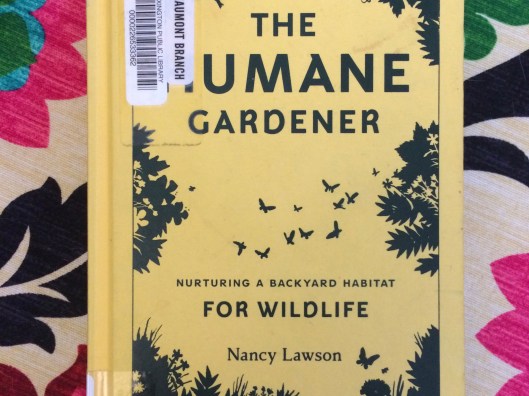
Book Review: The Humane Gardener by EARTHeim

Tags

, , , ,

fullsizeoutput_3e0

“The book has six chapters and covers topics like native plants, letting nature guide your garden, gardening for pollinators and birds, our relationship with wildlife and how are gardens are a meeting ground, and the life cycle of nature relating to our garden.

Throughout the book are also 6 interviews with ecological gardeners who have turned their property into a ‘living landscape’. It is interesting to see how their garden transformed from its original purchased state. One lady in Florida even found a threatened native lily growing on her property after allowing her garden to become more natural.

There are nice color photos on nearly every set of pages as examples of the topic discussed. In the back of the book is a list of online learning resources and a native plant list, to continue your endeavor on creating an ecological garden.”

cont.

Read full article here: https://wp.me/p4dO9X-1zx

Old-fashioned Honey Wafer Recipe by A Hundred Years Ago

Tags

, , , ,

I’m always on the look-out for “healthy” hundred-year-old cookie recipes, so I was thrilled when I came across a recipe for Honey Wafers. The recipe uses honey as the primary sweetener – though it does contain a small amount of sugar.

Old-fashioned Honey Wafers are delightful with coffee. They have a distinct honey flavor, with mild undertones of lemon. Don’t expect these cookies to taste like sugar cookies.

I used a 2-inch in diameter round cookies cutter when making these cookies. This was a good size. Small is better. The honey is very predominant, and made for savoring.

These cookies got relatively hard after a day or two, but were still good. They could also be softened by putting in an airtight container with a slice or two of apple.

Read full article and get recipe here: Old-fashioned Honey Wafer Recipe — A Hundred Years Ago

All About Splits: The Three Major Techniques for Splitting your Colonies by The Daily Guide to Beekeeping

Tags

, , ,

Whether you are a hobbyist, sideliner, or a commercial beekeeper, spring is a busy time for many beekeepers. Of all the spring tasks, splitting colonies may be the most crucial. Whether beekeepers split to expand their operation, to re-queen their colonies or control varroa, splitting is an important, yet time consuming task. In many ways, splitting is a right of passage for beekeepers.

Read full article here: ALL ABOUT SPLITS: THE 3 MAJOR TECHNIQUES FOR SPLITTING YOUR COLONIES — The Daily Guide to Beekeeping

Goals in Beekeeping and Upper Entrances

Tags

, ,

As with all beekeeping we have to ask ourselves what our goals are. Do we want to keep bees just to have bees? Do we want to keep them in as “natural” a way as possible? Do we want to make bees for sale as nucleus hives? Or do we want to manage our bees for honey production?

If one wants to manage their bees in as natural a manner as possible then do so by following their lead. Thomas Seeley and others have determined that honey bees will choose a dry cavity approximately 40 liters in size with an entrance of approximately 2 square inches. The bees select that size because it gives them what they need to meet their ultimate goals – reproduction and survival. They build up fast, fill it, and swarm which has definite advantages for them from pest, disease, and reproduction standpoints. If we want to keep bees more naturally we simply need a gum log or empty 40 liter box with a hole bored in the side – no frames, no foundation, nor fancy hive accessories.

But most of us don’t keep bees naturally. The moment we step away from that gum, skep, or single 40 liter box we are managing them in a manner to accomplish our goals not their goals. I’m not interested in raising bees in cavities like they select. I’m interested in managing bees in cavities I select based on the goals I wish to attain. But that’s not so bad. My bees benefit from disease management, protection from starvation, and pest control which they would not have if left on their own.

For me that’s different management and different box configuration for making queens, a different box configuration for overwintering, and lots of boxes for honey production. And it’s also lots of management every step of the way. Adding ventilation, boxes, making early splits, treatments, IPM, regular assessments, and interventions just so I can support them while they focus their efforts on plundering the local nectar resources.

Regarding upper entrances, they are added when needed for ventilation, reduce brood nest congestion, and increase traffic efficiency. They also create a disruption in the swarming process. They allow nectar to be cured quicker with less effort increasing the bees’ efficiency, decreasing their caloric expenditure, and saving precious wing wear and tear for their future as foragers. But managing upper entrances also means getting them back off when they are no longer needed which is after the nectar flow and prior to the major pest onslaught such as hive beetles and yellow jackets. For the most part it is a two month a year manipulation. It is work for me which increases the efficiency of the hive such that they can grow far beyond what nature intended. But it requires management.

Beekeeping is science based management. It is not for the lazy nor for procrastinators. Most people want their beekeeping to be something in between a gum standing in the backyard and what I strive for. Most probably don’t want large hives – they want a little honey and a well pollinated garden. That’s great. For them they can choose any number of hive types such as Langstroth, TBH, Warre, Long Lang, etc. and have good outcomes while enjoying their bees. It’s all good if you know your goals and follow your ideals and science.

Usurpation in the Bee Yard

Tags

, , ,

Interesting event in the bee yard. A couple weeks ago I performed a cut out on a top bar hive that had gone burr comb crazy. I cut and rubber banded brood into deep Langstroth frames and brought it home. After letting them settle down I inspected the hive and was pleasantly surprised to find the queen unharmed. She was nice and big and had a dark color. Happy with myself, I closed them up. I did note that they seemed less than industrious and after over a week they took little sugar syrup and other than attaching the old brood comb to the frames they were not building new comb. There were plenty of loafers around the front while seemingly there was plenty of work to be done!

Then, they were gone! Not like a swarm or a new package sometimes absconds in a few days. It had been well over a week; maybe ten days. It could be they were thinning down the queen for flight. I though to check if that fat, heavy queen had been left behind but she was gone. It also seemed they might have waited until almost all of the brood hatched out before they left.

I checked all the trees because I look at all my hives daily and they had been there the day before. Nothing. Then I checked the swarm traps. Nothing. Not even scouts.

I resigned myself to losing them. Then I noticed a hive I had split the week earlier. It was three doors down from the absconded colony. The split had a queen cell but I didn’t think a laying queen yet. And the split had been a weak split of just a few frames of bees. But wait. Now the split was bubbling over with bees. By now you’ve guessed it. A usurpation had occurred. Wyatt Mangum writes about this happening especially during summer when a normal swarm would have almost no chance of otherwise surviving because of dearth. Wow.

10201286238412827

Honey Bee Usurpation


A quick-start guide to honey bee antennae by Honey Bee Suite

Tags

, , ,

Every few weeks a photo of a fly lands in my inbox, always accompanied by the same question: “What kind of bee is this?” The answer is simple. If your insect has short, stubby, barely visible antennae, it is not a bee.

On the contrary, a bee antenna is long, graceful, mobile, and insanely cute. But beyond that, the antennae are a bee’s major data collection tools, containing receptors for touch, taste, and smell. Antennae can also detect temperature, humidity, and carbon dioxide, along with gravity and wind speed.1 Much of what a bee “knows” arrives through those two slender filaments.

The word antenna is derived from the Latin antemna. On Roman sailing ships, an antemna was a type of horizontal mast-mounted spar designed to spread square-rigged sails. With a little imagination, perhaps you too can envision your bees with rigging. Sail ho!

Read full article here: A quick-start guide to honey bee antennae — Honey Bee Suite

Happy Birthday Anton Janša (1734-1773), the first teacher of modern beekeeping by Ron Miksha

Tags

,

World Bee Day was initiated in Slovenia, Europe, and has been quickly catching around the world. For example, German Chancellor Angela Merkel concluded a major speech Wednesday with a rousing endorsement of World Bee Day, telling members of the Bundestag to do something good for the bees:

“I want to finish with something that some may consider insignificant but is actually very important: on May 20 is the first World Bee Day. On this day we should really think about biodiversity and do something good for the bees.”

World Bee Day became World Bee Day after a successful campaign by the country of Slovenia (Anton Janša’s birthplace) to promulgate the message. Their petition to the United Nations was accepted in December 2017, so this year marks the first official World Bee Day.  I’ve been following (and promoting World Bee Day) ever since I heard the effort was underway a couple of years ago, so below you’ll see some of my earlier posts.

Read more here: May 20: World Bee Day — Bad Beekeeping Blog

The Father of European Beekeeping – The Apiculture of Anton Janša — An Illustrated History of Slavic Misery

Tags

In this modern world of everyone being expected to have hyper-exaggerated opinions on anything and everything, not a day goes by without the fate of the bee (and with it the fate of ALL LIFE ON EARTH AS WE KNOW IT) being dramatically lamented. I’m certainly not going to argue the importance of the bee […]

via The Father of European Beekeeping – The Apiculture of Anton Janša — An Illustrated History of Slavic Misery

HONEY, HONEY, HONEY — Discordia Meadery

Tags

, ,

Perhaps one of oldest, natural food substance known to mankind. Produced by bees, collected and utilized for lot of different purposes, whether to drink with warm water to soothe a sore throat, or to create delicious desserts and souses, or to ferment into mead. We can say that honey is quite the protagonist…

Throughout history, honey always played a significant role in society. In the old Pagan world, it was believed that honey was a direct link to the Gods themselves. In ancient Rome, it was a status symbol and those who produced the finest, sweetest honey were considered to be esteemed, prestigious citizens. Later in the middle ages, thanks to the ancient Greek medicine men, honey was associated with medicine and was viewed as a form of remedy for several alignments and thus, it was used by pharmacists (back then, known as Apothecary) and even Alchemists for medicinal purposes to heal the sick.

Read the full article here: HONEY, HONEY, HONEY — Discordia Meadery

April Showers Bring May Flowers by settling for bees

Tags

, , , ,

Treat yourself today to a visit to this interesting article filled with beautiful pictures of the current nectar flow sources in Maryland. ~SassafrasBeeFarm

And the nectar flow!  The Maryland nectar flow relies upon tulip poplar, black locust and blackberry, all beginning to bloom as my scaled hive proves with steady increases of five to seven pounds each day last week.  As we revel in warm weather, watching our busy girls returning to the hives with full bellies of nectar and fat pollen pants, it’s time to think about…the fall.  While there’s an abundance of blooms outside this month, have you considered what your bees will eat after you harvest honey and the supplemental plants are spent?  We can take a lesson from the bees and plan now for what’s to come.

Read full article and see the beautiful pictures here: April Showers Bring May Flowers — settling for bees

Finding the Queen by East Riding Honey

Tags

, ,

Though I say it myself I am usually pretty good at finding queens. Obviously this is in a beekeeping context,  I don’t roam the streets looking out for flamboyant blokes with a touch of the Quentin Crisp! In my beekeeping career I must have found thousands of queens during hive inspections, searching nucs and mini nucs and also in swarms. Sometimes it can be like looking for a moving needle in a moving haystack but there are things you can do to help yourself.

Read full article here: Finding the Queen — East Riding Honey’s Blog

Ross Rounds – Comb Honey

Tags

, ,

Looks like I get to cross another one off my beekeeping bucket list. Comb honey! When I started beekeeping I read Richard Taylor’s book, The Joys of Beekeeping and have had the idea of making comb honey ever since. I crowded this hive after the first month of the flow by removing a super when they actually needed one, and replaced it with a super of Ross Rounds. Now, about three weeks later, all 32 rounds are beautifully capped. I realized after pulling it today that I had no space in the freezer so I put it back on top after inserting a medium. They deserve the space for all their hard work! Currently when foragers return at the end of the day it looks like a package of bees hanging from each entrance.

Wild Honey Bees in Congaree National Park May, 2018 by David MacFawn

Tags

, , , ,


dave-congaree-nat-park.jpg

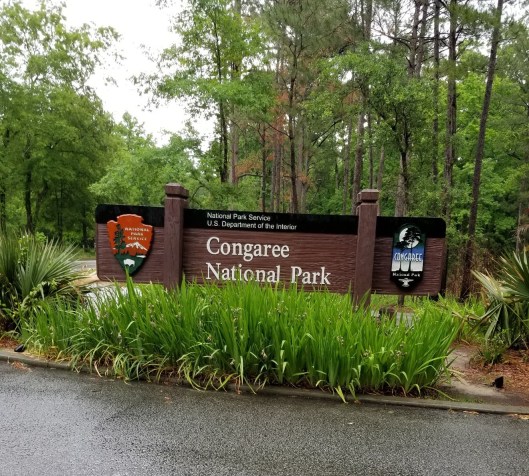
Figure 1: Congaree National Park Entrance (Image Credit David MacFawn )

In March, 2018 David MacFawn, Fleming Mattox and Dave Schuetrum began an effort to explore wild bees in Congaree National Park (CONG, https://www.nps.gov/cong), which is just southeast of Columbia, South Carolina (Figure 1). We are interested determining the size and health of the feral honey bee population there. Various staff and visitors have reported a few others over the years, and we recently found one wild “bee tree” in the park, which was located quite far from any trail. Much of the park is a vast wilderness area, however, and researchers have not systematically searched for bees before. The first phase of our project, (hopefully with follow-on studies), to determine if honey bees are surviving in the forest. The second phase is to study how they are dealing pests and diseases (e.g., Seeley, T.D., et.al. 2015; Seely, T. August, 2017; Tarpy, D.R., Delaney, D.A., Seeley, T.D. 2015).

fig2

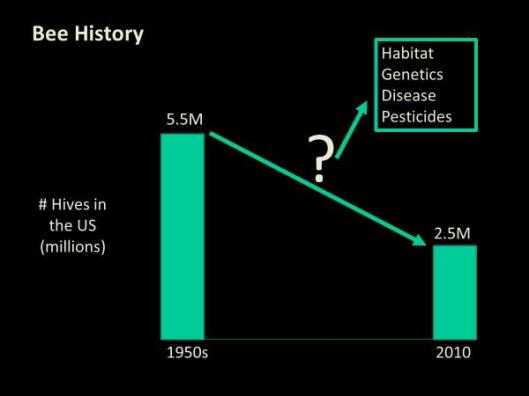
Figure 2: Number Hives in The United States http://ento.psu.edu/publications/van-mex-2010 Image Credit: Fleming Mattox)

The bee population in the United States has been declining over the past few decades (Figure 2, vanEngelsdorp and Meixner, 2010). Scientists are studying several possible factors that impact the bee population including habitat, genetics, disease, and pesticides. Bee keepers are actively managing their apiaries to treat for diseases in order to improve survivability. Beekeepers also provide hives for the bees to live in, selectively breed the bees, treat for diseases, and work to keep the bees away from chemicals and pesticides (Graham, J. M., editor. 2015).

Above left: old-growth cypress tree at Congaree National Park (Credit: D. Schuetrum)

Above right: Cypress Swamp in CONG (Credit: D. Schuetrum)
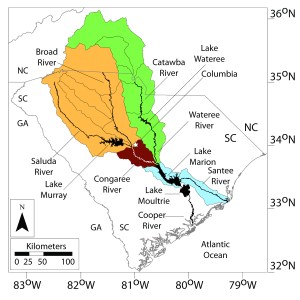
fig4

South Carolina River Basins (NPS/D. Shelley)

According to the park’s Foundation Document (NPS, 2014), which summarizes the park’s key legislation and priorities, the mission of Congaree National Park is to protect, study, and interpret “the resources, history, stories, and wilderness character of the nation’s largest remaining tract of southern old-growth bottomland forest.” The park was preserved as Congaree Swamp National Monument in 1976 after grassroots campaign, and re-designated in 2003 as a national park. The park’s 26,000+ acres include 11,000 acres of old-growth, which bear no ecological or historical evidence of being clearcut (and certainly not in the last several hundred years) as well as >15,000 acres of wilderness area protected by the Wilderness Act of 1964. The wilderness designation is relatively rare in the eastern United States and sets a high priority for keeping the area “untrammeled;” more information on the Wilderness Act and land management is available on the web at https://www.wilderness.net. Furthermore, the park does not apply insecticides in the forest. CONG is also home to the NPS Old-Growth Bottomland Forest Research and Education Center, which works to connect scientists to parks and people with park science.

fig5

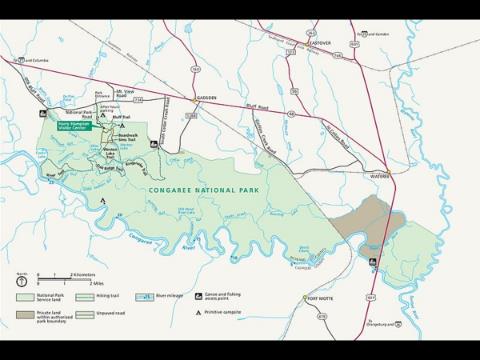
Congaree National Park trail map from the park website

Because of its protected status, CONG offers a unique opportunity to study wild bees in a floodplain forest where nature is generally left alone to develop naturally. Studies in other natural areas have documented wild colonies with an average density of 2.5 colonies per square mile (Seeley, T.D., et.al. 2015; Seely, T. August, 2017; Tarpy, D.R., Delaney, D.A., Seeley, T.D. 2015).

CONG has no beekeeper and the bees within the park are left to their own survival. This presents an opportunity to address a number of questions related to human impacts on hives:

1) What is the bee density within the park?

2) What is the bee distribution within the park?

3) Are the bees within the park genetically different from bees outside the park?

4) How are the bees surviving without active management?

5) Are pesticides a problem within the comb of the hive?

6) What is the bee pollen source and is this different from bees outside the park?

The purpose of our study is to begin to answer these questions in a logical and organized manner. The first part is to attempt to determine bee density within the park and to see if there is genetic uniqueness to this species.

Study Design

The first part of the study in 2018 is to capture bees both within the park and in adjacent areas. Bees will be lured using sugar syrup laced with a natural pheromone, anise oil. Approximately 12 captured bees per lure will be sent to the University of Delaware for genetic analysis. Since hives normally have 15,000-60,000 bees, the removal of several dozen bees will have no impact on hive survival.

If phase 1 documents abundant, genetically distinct wild bees in the park, then a second phase of the project will seek to locate the colonies and possibly sample comb for chemical analysis to determine pesticide loads. Colonies will also be monitored to determine health and survivorship.
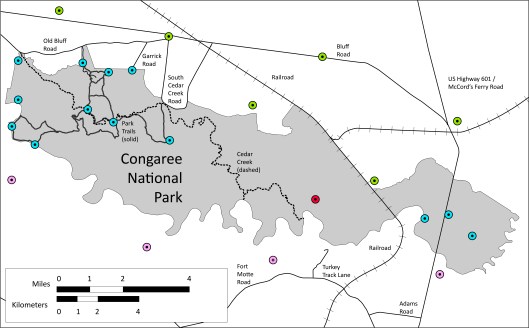
fig3

Figure 3: Proposed collection sites. In-park sites are in blue, with one known bee tree (as of April, 2018) in red. Sites north of the park are in green, while sites south of the park are in pink. The exact locations will be finalized through on-the ground work and (for non-park sites) landowner contacts through the Mid-State Bee Keepers Association. (NPS/D.Shelley)

Volunteer Opportunities:
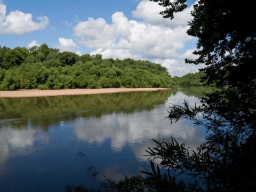
fig8

Congaree River along the southern border of the park (NPS Photo/S.McNamara)

The project is currently being funded through the generosity of Mid-State Beekeepers’ Association and the South Carolina State Beekeepers’ Association.

Through local beekeeping associations we are seeking volunteers that may be interested in volunteering to assist with this project. Sampling (Figure 3) will take place over 1-2 weeks in June. The sampling will involve three day trips to the sites, including one day to deploy the lures, one day to check (and hopefully refill) them, and one day to sample. Volunteers do not have to commit to all three sampling days. Some sites are more remote than others, and volunteers should have a range of options in terms of physical challenge and difficulty.

Trail Descriptions (link):
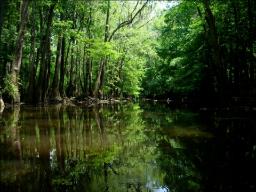
fig9

Cedar Creek at Congaree National Park (NPS/T.Thom)

Boardwalk (2.4 Miles) – The boardwalk begins on a bluff at the Harry Hampton Visitor Center with an elevated section that leads down into the old-growth bottomland hardwood forest. A variety of different tree species can be observed including bald cypress and tupelo trees in the lowest elevations. Loblolly pines, oaks, holly trees and maples can also be observed. The boardwalk has benches along the way and is wheelchair and stroller accessible.

Bluff Trail #1 (1.7 Miles) – This upland trail loops north of the visitor center and connects to the elevated boardwalk for a short distance. The Bluff Trail passes through a young forest of loblolly and longleaf pines. Evidence of prescribed fires can be found along the Bluff Trail.
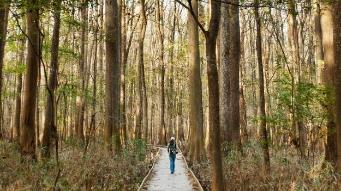
fig10

Take a boardwalk stroll through a cypress tupelo forest at Congaree National Park (NPS/jt-fineart.com)

Sims Trail #2 (3 Miles) – The Sims trail, an old gravel road, runs from the Bluff Trail on its northern end to Cedar Creek on its southern end, crossing the boardwalk twice. The clearing at the intersection with the Weston Lake Loop Trail was once the site of a hunt club where Harry Hampton was a member.

Weston Lake Loop Trail #3 (4.4 Miles) – This loop provides great views of Cedar Creek where otters and wading birds may be observed. The eastern portion of the trail follows a cypress-tupelo slough (dried-up river bed) where many cypress knees can be seen sticking out of water.

Oakridge Trail #4 (6.6 Miles) – Passing through a rich stretch of old-growth forest, the Oakridge Trail traverses a subtle ridge where a variety of large oaks grow. The number of low-lying sloughs (dried-up river beds) makes this trail great for viewing wildlife.
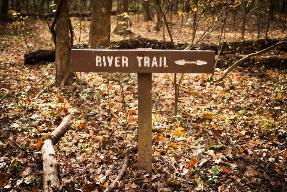
fig11

Trail marker at Congaree National Park (NPS/jt-fineart.com)

River Trail #5 (10.0 Miles) – This trail leads to the Congaree River, the lifeblood of the park’s great natural diversity. Approximately ten times a year, the river overflows its banks and pulses water throughout the bottomland forest. When the river is low, a large sandbar may be visible. Much of the forest along the river was logged prior to the park’s establishment and vegetation here is notably denser than that of other trails.

Kingsnake Trail #6 (11.7 Miles) – The Kingsnake trail, which is not a loop, is a favorite trail for birders because of the diverse vegetation and proximity to Cedar Creek. When the sloughs (dried-up river beds) are full of water, beautiful views are around every bend.
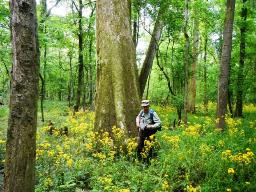
fig12

Springtime at Congaree National Park finds butterweed blooming under cypress trees (Credit: D. Schuetrum)

Bates Ferry Trail #7 (2 miles) – Starting from Route 601, this trail follows a 1920’s ferry road south to the Congaree. It is a remnant of the area’s rich history, which includes colonial-era ferries that once crossed near here. While at the river, please be aware that the bank is steep and could potentially be slippery. It is best to stay on the marked path, as old side trails are unmarked and not maintained.
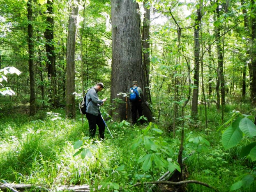
fig13

Volunteers measure an old-growth sweetgum at Congaree National Park (Credit: D. Schuetrum)

Longleaf Trail #8 (.6 miles) – This trail branches off the Bluff trail, providing access to the Longleaf Campground.

Personnel

• David E. MacFawn, Master Craftsman Beekeeper and lead: dmacfawn@aol.com, 803-629-8076 (c)

• Bill Couch, Couchws@gmail.com

• Marc Johnson, dovedog99@gmail.com

• Dr. Fleming Mattox, halidon15@yahoo.com

• Dave Schuetrum, d14ds0604@att.net

• Dr. David C. Shelley, Congaree National Park, david_shelley@nps.gov

• Dr. Deborah Delaney, University of Delaware, dadelane@udel.edu

References:

Graham, J. M., editor. 2015. The Hive and the Honey Bee: A New Book on Beekeeping which Continues the Tradition of Langstroth on the Hive and the Honeybee. Dadant & Sons, Hamilton, IL. 1057 pages ISBN 978-0-915698-16-5.

NPS, 2014. Foundation Document: Congaree National Park, South Carolina. U.S. Department of the Interior, Washington, D.C., 76 pp. Accessed May 7, 2018, from https://www.nps.gov/cong/learn/management/upload/CONG_FD_SP.pdf.

Seeley, T.D., Tarpy, D.R., Griffin, S.R., Carcione, A., Delaney, D.A. 2015. A survivor population of wild colonies of European honeybees in the northeastern United States: investigating its genetic structure. Apidologie (Springer Verlag) v. 46, no. 5, p. 654-666.

Seely, T. August, 2017. Honey Bee Environment of Evolutionary Adaptness (EEA). Presentation To Eastern Apiculture Society, July/August, 2017 conference, Newark, Delaware.

Tarpy, D.R., Delaney, D.A., Seeley, T.D. 2015. Mating Frequencies of Honey Bee Queens (Apis mellifera L.) in a Population of Feral Colonies in the Northeastern United States. PLoS ONE, v. 10, no. 3, 12 pp. doi:10.1371/journal.pone.0118734, accessed May 7, 2018 from http://journals.plos.org/plosone/article?id=10.1371/journal.pone.0118734.

vanEngelsdorp, D., Meixner, M.D. 2010. A historical review of managed honey bee populations in Europe and the United States and the factors that may affect them. Journal of Invertebrate Pathology, v. 103, p. S80-S85, doi: 10.1016/j.jip.2009.06.011, accessed May 15, 2018 from http://ento.psu.edu/publications/van-mex-2010.


What Exactly is The PER? by The Bee’s Knees.Org

Tags

, , ,

In Apis Mellifera or honeybees, the Proboscis Extension Reflex, PER, is part of the honeybee’s feeding behavior.   The PER is a natural behavioral reflex in which the honey bee extends its proboscis in response to antennal stimulation with a sugar solution, during normal foraging behavior, PER occurs when the honey bee finds nectar in a flower. For example, If a honeybee went out of the hive to find nectar in flowers, and then found nectar, it would stick its Proboscis out to sense and smell it. After the Proboscis senses it, the bee will collect the nectar and then bring it back to the hive. If this bee was impaired form the toxic Neonicotinoid, Imidacloprid, it wouldn’t be able to sense the nectar, collect it, nor bring it back to the hive. That is how Imidacloprid can affect a whole hive, just by infecting one honeybee and impairing its Proboscis Extension. The PER can be seen as one of the honeybees most vital tools. This is because, without it, the bee wouldn’t able to test if the substance it is retrieving is nectar, or another, poisonous, substance. Therefore the PER is vital to the honeybees survival and could mean life or death if it becomes impaired under the influence of the toxic neonicotinoid Imidacloprid. The PER happens as one swift motion in a honey bee, it is absolutely amazing to watch!

Read the full article here: What Exactly is The PER? — The Bee’s Knees.Org

Famously Hot South Carolina Midlands

Tags

, , ,

It’s 97 degrees in South Carolina and today’s date is May 13th. I’ll bet that most of you reading this have already flipped that switch on your central air unit from Heat to AC. Well, the bees do the same thing – almost. They switch from keeping the brood warm to keeping it cool. And the way they do it is fascinating! And you can participate too!

Summer Bee Hive Temperature Regulation and Hive Ventilation

Honey bees have a knack for maintaining the internal temperature of the hive at around 93 to 95 degrees Farenheit. They do this primarily because this is the ideal temperature for their brood. How they do it is remarkable. Watch them on the landing board fanning. Some hang upside down on the lip of the brood box, others stand on the landing board. Sometimes you may even notice that bees on one side of the landing board are facing towards the box and on the other side of the landing board they are facing away – just to create a flow of air through the hive. Inside they are also busy fanning creating currents of air to keep the temperature correct and also to evaporate the nectar into honey. Standing outside your hive you can hear them inside buzzing like a motor or fan running.

In the heat of the summer it gets to be a big job for them to maintain the correct temperature inside. The lack of watery nectar further reduces the effects of evaporative cooling so the bees gather water and return to the hive placing droplets of water inside thus reducing the temperatures via its evaporation. This also helps maintain the correct humidity for the brood.

Yet another method they employ is to gather outside to reduce the internal heat. We call this bearding. While cold blooded, the heat generated by the muscle activity of tens of thousands of bees heats up the interior of the hive. It makes good sense to reduce the number of bees inside.

When the temperatures in the Midlands get into the nineties outside you will see the bees doing all of the above in an effort to keep the internal temperature 93-95F

What can you do to help them maintain the correct temperature of the hive? Depending on the configuration of your equipment you may be able to help. One of the simpliest methods is to simply place a popsicle stick under the corners of the outer cover allowing the heat to escape. I have a few migratory covers this year and will be slipping popsicle sticks between them and the upper most box. The thin popsicle stick, or two, is not large enough to allow robbers to invade but will allow the rising hot air to exit the hive.

Screened bottom boards should be open during the hot summer. The bees inside will circulate the air inside the hive such that cooler air is pulled in and around the interior and exhausted to the outside.

If your inner cover has an upper entrance keep it open to allow heat to escape. If the colony is weak a little screening across the upper entrance may be needed.

With dearth many beekeepers will reinsert their entrance reducers to prevent robbing. If you have a screened bottom board this reducing of the entrance will probably be fine. If you are using a solid bottom board I recommend you leave the entrance reducer out, replacing it with #8 hardware cloth bent into a U shape and pushed into the opening (remember to leave them an entrance to come and go). The screen will allow airflow which would have otherwise been blocked.

Other ideas:

Go traditional and paint your outer cover reflective white. Why not, it’s after Easter.

Place a slightly longer piece of cardboard over the hive making an awning over the front porch (assuming it’s facing south).

Clean up any debris under the hive to allow air to circulate.

Make a 1 1/2″ shim to go between the inner cover and outer cover and drill 1 inch ventilation holes on the sides (cover holes with hardware cloth to keep out robbers).

Got more ideas? Add them below.

Happy Birthday Major Franz Hruschka

Tags

, ,

Logo

major hruschka

THE HONEY EXTRACTOR INVENTOR

Major Franz Hruschka was born on 13th May 1819 in Vienna. He lived his childhood in Czech Budejovice. He moved with his father in 1827 to Graz, where he attended the elementary school and three years of the secondary school. At the age of 14 he was drafted and as a cadet of the 19th Infantry Regiment Hessen-Homburg he was assigned to the cadet’s unit in Graz.

THE YEAR 1868

Hruschka in a meantime became known to the whole beekeeping world. It was rightly written by vicar Bastian, that Hruschka with his invention gained the finest place among beekeepers of all times. Hruschka gets an honorable membership in the Verona beekeepers association in 1868. Baroness Berlepsch wanted to give her husband an album with pictures of outstanding beekeepers of those days as a christmas present in 1867. She asked several prominent beekeepers to send their pictures to her, Hruschka including. Hruschka readily fulfilled her wish. It appears the Berlepsch couple thanked Hruschka in writing. It was probably their letter Hruschka mentions in his October article for Eichstaett news as a pleasant surprise: “While I am writing these lines I am surprised by a nice letter from far away, for once I can be mostly pleasantly surprised and I thank for it heartily.”

The above was taken as excerpts from: https://www.fhruschka.cz/en/Hruschka.aspx