Tags
William Frank Longgood (1917–2000)
Born: September 12, 1917 — St. Louis, Missouri Died: August 9, 2000 (aged 82) — Cape Cod, Massachusetts
William Frank Longgood was a Pulitzer Prize-winning journalist, author, and teacher. Born in St. Louis, he spent most of his working life in New York, and only came to beekeeping — and to the book he’s remembered for by beekeepers — late in that life.
Journalism career
Longgood graduated from the Missouri School of Journalism in 1940 and spent the next two years in Niagara Falls working as a radio salesman and writer. World War II interrupted the career he was building: he served in the U.S. Armed Forces from 1943 to 1946. Afterward he returned to reporting, first at the Newark Evening News (through 1948), then at the New York World-Telegram, where he stayed for seventeen years, from 1948 to 1965.
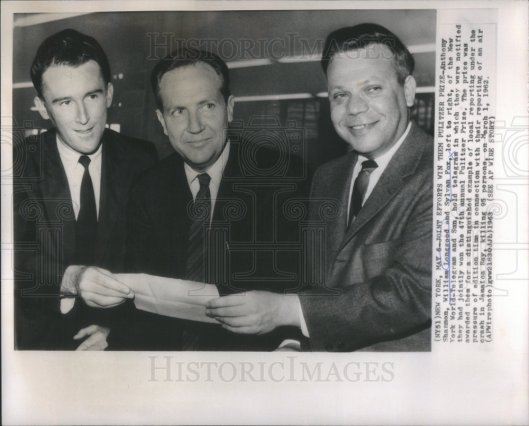
It was at the World-Telegram that Longgood did the work he’s best remembered for as a journalist. In 1954 he won the George Polk Memorial Award from Long Island University. Then, in 1963, he shared the Pulitzer Prize for Local Reporting, Edition Time, with fellow World-Telegram and New York Sun reporters Sylvan Fox and Anthony Shannon, for their coverage of the crash of American Airlines Flight 1 into Jamaica Bay on March 1, 1962, which killed 95 people.
After leaving daily journalism in 1965, Longgood spent three years as a text editor at Time-Life Books (1965–1968), then taught writing at the New School for Social Research in New York from 1966 to 1972.
Books
Longgood was the author of seven books over his career, ranging well beyond bees. His 1960 book Poisons in Your Food was an early and pointed critique of chemical additives and antibiotic use in the American food supply — the kind of consumer-advocacy journalism that prefigured much of what would come later in the environmental movement. His 1972 book The Darkening Land documented environmental pollution and was well received critically.
Beekeeping and The Queen Must Die
Longgood came to beekeeping relatively late, well after his newspaper career had wound down, and it was this hobby — not journalism — that produced the book beekeepers actually know him for: The Queen Must Die: And Other Affairs of Bees and Men (1985, W.W. Norton). It is not a biology text, and it doesn’t try to be. It is a beekeeper’s meditation — part natural history, part personal essay — using the hive as a lens for thinking about mortality, order, sacrifice, and the uneasy parallels between insect societies and human ones. Reviewers and beekeepers alike have praised it less for its technical content than for the quality of its prose: it reads like a career writer’s love letter to a hobby he found late, written with the same eye for narrative and detail that had won him a Pulitzer decades before.
Here’s a nice review found here on WordPress by Bees with ebb:
https://beeswitheeb.wordpress.com/2016/02/21/the-queen-must-die/
He relocated to Cape Cod, Massachusetts in 1973, and lived there until his death on August 9, 2000, at age 82.

