• Beekeeping Educational Files
  • About
  • Contact
  • Beekeeping365 Blog

Beekeeping365

~ The more I studied beekeeping, the less I knew, until, finally, I knew nothing. But, even though I knew nothing, I still had plenty to unlearn. Charles Martin Simon

Beekeeping365

Author Archives: Beekeeping365

Everything Starts with a Tasty Meal: The Science Behind a Beekeeper’s Best Pest-Management Insight

28 Friday Aug 2026

Posted by Beekeeping365 in beekeeping

≈ Leave a comment

This piece expands on “Everything Starts with a Tasty Meal” by sassafrasbeefarm (Beekeeping365, August 1, 2021). The original essay makes a simple, argument: hive pests like Small Hive Beetles, wax moths, and yellow jackets can’t reproduce until they eat, so a beekeeper’s best defense is cutting off their meal. What follows is that argument traced down into the actual biology, chemistry, and behavioral ecology that back it up — and a couple of places where the research complicates the picture in interesting ways.


The Original Insight

The essay’s logic runs like this: Abraham Maslow argued that humans secure basic needs — food and safety — before pursuing anything more sophisticated. Other animals, lacking our behavioral flexibility, run a cruder version of the same program: an instinctual sequence that starts with food and ends with reproduction. Small Hive Beetles, wax moths, and yellow jackets are, in this framing, simply hungry opportunists trying to eat and then breed. A beekeeper’s job is to jam the machinery between those two steps — deny the meal, and the pest never reaches the reproduction stage. The essay then sketches two tactics: starve the pests (entrance reducers, right-sized equipment, careful feeding practices) and trick them (bait traps that exploit hunger without luring in honey bees).
It’s a good insight. It also turns out to be a fairly accurate compression of several decades of chemical ecology and behavioral research — with a few added wrinkles that make it even more useful.

Fact-Checking the Starting Point: Maslow’s Hierarchy

Worth pausing on the source material itself. Maslow’s hierarchy comes from a single 1943 paper, “A Theory of Human Motivation,” published in Psychological Review — not a book, not a series of studies, a single theoretical article. Two details are commonly missed. First, Maslow never drew a pyramid; the triangular diagram everyone pictures was a later addition by management writers popularizing the idea, not something in the original text. Second, the strict “you must fully satisfy one level before the next kicks in” reading of the theory doesn’t hold up well empirically — later cross-cultural survey work (Tay & Diener, 2011) found people pursue safety, belonging, and growth needs in parallel, not in a rigid queue, and some psychologists have flagged the hierarchy as more of a compelling narrative than a well-tested model of human behavior.


None of that sinks the beekeeping essay’s use of it, though — if anything it sharpens the analogy. Maslow’s theory is at its weakest describing humans, who really do juggle multiple motivations simultaneously. It’s a much better fit for an insect, which has neither the neural hardware nor the behavioral repertoire to do anything but respond to its most pressing physiological state. A hungry beetle is not deciding whether to prioritize food or selfactualization. For a simple nervous system, “deficit needs dominate behavior until resolved” isn’t a debatable psychological theory — it’s close to a complete description of how the animal operates.


Instinct’s Own Logic: Proximate Drives, Ultimate Ends

Biology has its own, more precise version of the essay’s food-thenreproduction chain, developed decades before anyone tried to apply Maslow to bugs. The ethologist Niko Tinbergen (1963) proposed that any animal behavior can be explained on two separate levels: the proximate cause (what mechanism triggers the behavior right now — a hormone, a smell, a hunger signal) and the ultimate cause (why that mechanism was favored by evolution — because it improves reproductive success). A beetle following an odor plume toward a beehive isn’t proximately “trying to reproduce” — it’s proximately responding to an olfactory cue that smells like food. But the reason that response exists at all, baked into the beetle’s nervous system by natural selection, is that ancestors who found food reliably out-reproduced ones who didn’t. Food-seeking is the proximate mechanism; reproduction is the ultimate function it serves.


This matters for pest management because it tells you where the chain is interruptible. You can’t argue a beetle out of its hunger, but you can jam the proximate mechanism — block the smell, remove the food, or disrupt access — and the ultimate goal simply never gets reached. This is also why Small Hive Beetles, wax moths, and yellow jackets are such persistent, fastreproducing opportunists in the first place: all three are classic examples of what ecologists call an opportunistic, “r-selected” life history (MacArthur & Wilson, 1967) — organisms built to find a rich, short-lived resource patch and convert it into as many offspring as possible before the patch disappears or gets defended. A beehive bursting with pollen, honey, and brood is about as rich a patch as an opportunist could hope to find.


Case File 1: The Small Hive Beetle’s Hijacked Alarm Bell

The Small Hive Beetle (Aethina tumida) is the clearest illustration of the essay’s whole thesis, and the actual chemistry behind it is stranger than the essay lets on.


Beetles don’t find hives by luck. They home in on a specific odor blend, and the dominant component of that blend is isopentyl acetate — the honey bee’s own alarm pheromone (Torto et al., 2007, PNAS). Worse, the beetles carry a yeast, Kodamaea ohmeri, that colonizes fermenting pollen and hive debris and, as it grows, produces a volatile bouquet that mimics that same alarm pheromone (Benda et al., 2008, Journal of Apicultural Research). In chemical-ecology terms, this is a kairomone: a signal that evolved for one purpose (bees warning each other of danger) but that a second species has hijacked to its own advantage (beetles using it as a dinner bell). The result is a nasty feedback loop — a few beetles ferment some pollen, the yeast smell draws in more beetles, and a hive with “few beetles” can suddenly host hundreds.


This is precisely the mechanism the original essay gestures at when it asks whether a feeding program “announces food availability with fragrant oils.” Fermenting syrup, spilled feed, and exposed comb all produce the same class of volatile organic compounds that this whole detection system is built to find. You’re not just feeding bees; you’re broadcasting.


The essay’s “deny them food” strategy also holds up well at the mechanical level. Colonies with reduced or modified entrances host measurably fewer adult beetles than colonies with open entrances (Ellis et al., 2002a, cited in Neumann, Pettis & Schäfer, 2016) — entrance reducers aren’t just folklore, they’re a documented barrier to invasion. But the research adds a genuine complication to the simple “starve them out” model: strong, healthy, foodrich colonies actually attract more beetles than weak ones, precisely because they have more to offer (Neumann, Pettis & Schäfer, 2016, Apidologie). What determines the outcome isn’t food availability alone — it’s whether the colony has enough workers, relative to the amount of comb it’s trying to guard, to intercept the beetles once they arrive. Weak or queenless colonies with a low bee-to-comb ratio are dramatically more vulnerable to serious SHB damage than strong ones, even when the strong ones host more total beetles (Annand, 2011, and Mustafa et al., 2014, both cited in Neumann et al., 2016). This is the scientific basis for “hive rightsizing”: matching the number of boxes and frames to the actual size of the colony isn’t about tidiness, it’s about keeping the ratio of guards to guarded comb high enough that food denial can actually be enforced.
And when bees do catch a beetle, the “deny them food” strategy turns out to be under active evolutionary counterattack. Honey bees can’t easily kill a Small Hive Beetle outright — its shell deflects stings and bites — so instead they wall it into a small propolis cell and post guards, sometimes for months (Ellis, Pirk, Hepburn, Kastberger & Elzen, 2002, Naturwissenschaften). By the essay’s logic, an imprisoned, foodless beetle should starve. Most don’t. Researchers found that trapped beetles solicit food from their guards through the same begging behavior honey bee larvae use, and the guard bees respond by feeding them protein-rich glandular secretions via trophallaxis — mouth-to-mouth feeding (Ottati et al., 2021, Journal of Experimental Biology, titled, fittingly, “Prisoners receive food fit for a queen”). The beetle isn’t just hungry; it has evolved a way to trick the bees into feeding it inside its own prison cell. It’s a small but vivid example of the arms race underneath the essay’s tidy metaphor — every time bees close off one route to food, some pests evolve a workaround, and beekeeping pest management is really an ongoing skirmish, not a single move that ends the game.


Case File 2: The Wax Moth’s Cruel Paradox

Wax moths (Galleria mellonella, the greater wax moth, and its smaller relative Achroa grisella) run a similar food-to-reproduction script, but with a twist that refines the essay’s “deny them food” rule even further.


Female wax moths lay eggs in hive cracks and crevices, and the larvae tunnel through comb eating not the clean wax itself but the protein residues embedded in it — pollen, cocoon silk, and brood-cell debris left behind by developing bees. A moth can’t complete development on pure, never-used wax; it needs that protein signature of an active or recently active brood nest. Here’s the paradox: research indicates female wax moths often prefer to oviposit in strong, healthy colonies, because that’s where the richest concentration of brood-associated protein is. Yet it’s the weak colonies that suffer the worst wax moth damage — not because moths target them, but because a small, understaffed workforce can’t patrol enough comb surface to find and remove eggs and young larvae before they tunnel in and become unreachable. It’s the same lesson as the Small Hive Beetle case, arrived at independently: food availability draws the pest, but colony strength — not food denial per se — determines whether the pest actually gets to complete its life cycle.


On the “trick them” side of the essay’s strategy, researchers have made real progress identifying the wax moth’s sex pheromone components (compounds including nonanal, decanal, and undecanal show up across several studies, with the exact blend ratio varying somewhat by moth population), and male moths have been shown to fine-tune their own pheromone release in response to the wingbeat frequency of nearby females — an acoustic-chemical feedback loop layered on top of the basic scent signal. Pheromone-baited traps built on this research are useful for monitoring wax moth populations in stored equipment, though they’ve proven less reliable as a stand-alone in-hive control method — which is exactly why the standard beekeeping advice is still to keep colonies strong and to freeze or tightly store unused drawn comb, denying the moth’s larvae both the workforce-patrolled hive and any long-term undefended stash of protein-laced wax to grow in.


Case File 3: Yellow Jackets and the Calendar of Hunger

Yellow jackets (mostly Vespula species) make the essay’s dearth-season observation almost self-explanatory once you look at their annual colony cycle. A single mated queen founds a nest in spring and spends early summer as the sole forager, hunting insects and other protein to feed her first larvae. Those larvae, in turn, secrete a sugary substance that they exchange with adult workers for masticated protein — a mutual trophallaxis arrangement that fuels the colony’s rapid summer growth. Through midsummer, colony demand is protein-heavy, which is why wasps are aggressively hunting live prey and carrion in that window.


By late summer, the calculus flips. The colony begins producing new queens and males instead of more workers, larval production drops off, and with it the supply of larval sugar secretions that adult workers depend on. A colony full of adult wasps that suddenly has far less of its usual sugar source has to go looking elsewhere — right at the moment natural nectar sources are also drying up. That collision is precisely the “food dearth” window the original essay flags, and it explains why yellow jacket pressure at hive entrances and feeders spikes hardest in exactly the weeks beekeepers most need their colonies left alone.


The essay’s “trick them without tricking your bees” strategy also has a welldocumented chemical basis. Heptyl butyrate is a synthetic attractant that draws several common pestiferous Vespula species into traps with reasonable species-selectivity, while doing essentially nothing to attract honey bees (Reierson, Rust & Vetter and related field trials). Large-scale trapping studies have shown that heptyl-butyrate-baited or protein-baited traps can measurably suppress local yellow jacket forager numbers for weeks at a stretch, though researchers are consistently clear that trapping alone rarely eliminates a well-established population — it reduces pressure rather than solving the problem outright, which is a useful caveat to add to the essay’s otherwise tidy trapping advice.


The Common Thread: Three Links in One Chain

Laid side by side, the three case studies point to the same refinement of the essay’s core claim. “If they don’t eat, they don’t reproduce” is true, but a pest actually has to clear three separate hurdles to get there, and each one is a different point of intervention:


Locate the food. This step is chemical, not behavioral — beetles follow hijacked alarm pheromone, moths follow protein-scented comb, wasps follow protein and (in season) carbohydrate cues. Anything that adds fragrant, fermenting, or spilled food odor to an apiary — including well-meaning feeding practices — recruits pests at this stage before a beekeeper even knows they’re there.

Get access to it. This is where physical exclusion works: entrance reducers, robbing screens, screened bottom boards, and right-sized equipment don’t remove the food, they just narrow the number of doors a pest can use to reach it, concentrating the colony’s limited guard force where it can actually do its job.

Complete development undisturbed. This is the step the SHB and wax moth research keeps landing on: a hungry pest that finds food and gets inside still has to survive long enough, uninterrupted enough, to finish its life cycle — and that survival window is set almost entirely by whether the colony has enough workers, relative to the space it’s defending, to keep finding and evicting it.
The essay’s two tactics — starving pests and baiting them — map neatly onto hurdles one and two. The bee-to-comb ratio research reviewed above adds a third lever the essay doesn’t explicitly name but clearly gestures at with “hive right-sizing”: defense capacity, not food access alone, is often what decides the outcome.


Putting the Science to Work

None of this changes the essay’s practical recommendations so much as it explains why they work and adds one more:


 Cut off the scent trail. Avoid open or fragrant feeding, clean up spills promptly, and be mindful that essential-oil feed additives and fermenting syrup produce exactly the class of volatiles that draw in opportunists looking for a hijacked signal to follow.


 Narrow the doors. Entrance reducers, robbing screens, and screened bottom boards reduce the number of access points pests can exploit and concentrate a colony’s guard force where it matters — a strategy with direct research support in the SHB literature.


 Right-size the box to the bees. Keep the amount of comb a colony must defend proportional to its actual population. An over-supered, understrength hive isn’t just an SHB risk; it’s a wax moth risk for the same underlying reason — not enough guards per square inch of comb.


 Bait the hunger, not the hive. Species-specific attractants — mineraloil/vinegar SHB traps, pheromone lures for stored wax moth comb, heptyl-butyrate traps for yellow jackets — exploit the same detection systems pests use to find your hive, redirecting that hunger somewhere it can be safely dead-ended instead. This is a version of what integrated pest management researchers call a “push–pull” strategy: making the protected resource harder to find or reach (push) while offering a more attractive, disposable decoy nearby (pull).


 Expect an arms race, not a solved problem. The SHB’s trick of getting guard bees to feed it inside its own prison cell is a useful reminder that every defensive measure is answered, eventually, by some counteradaptation. Pest management in an apiary is maintenance, not a single fix.


Closing Thought

The original essay ends by suggesting that during a food dearth, it pays to think like a pest for a while. The research bears that out more literally than the essay probably intended: these pests aren’t reasoning about anything, they’re running fixed chemical and behavioral programs tuned by evolution to find food fast and convert it into offspring before the opportunity closes. That’s actually good news for a beekeeper. A fixed program is a predictable one. Learn the cue it responds to — a hijacked alarm pheromone, a proteinscented comb, a queen’s shifting nutritional demands — and you don’t have to outsmart the pest so much as quietly turn its own wiring against it.

Sources:
Review, 50(4), 370–396.
 Tay, L., & Diener, E. (2011). Needs and subjective well-being around the world. Journal of Personality and Social Psychology, 101(2), 354–365.
 Tinbergen, N. (1963). On aims and methods of ethology. Zeitschrift für Tierpsychologie, 20(4), 410–433.
 MacArthur, R. H., & Wilson, E. O. (1967). The Theory of Island Biogeography. Princeton University Press.
 Torto, B., Boucias, D. G., Arbogast, R. T., Tumlinson, J. H., & Teal, P. E. A. (2007). Multitrophic interaction facilitates parasite–host relationship between an invasive beetle and the honey bee. Proceedings of the National Academy of Sciences, 104(20), 8374–8378.
 Benda, N. D., Boucias, D., Torto, B., & Teal, P. (2008). Detection and characterization of Kodamaea ohmeri associated with small hive beetle
Aethina tumida infesting honey bee hives. Journal of Apicultural Research, 47(3), 194–201.
 Neumann, P., Pettis, J. S., & Schäfer, M. O. (2016). Quo vadis Aethina tumida? Biology and control of small hive beetles. Apidologie, 47(3), 427–466.
 Ellis, J. D., Pirk, C. W. W., Hepburn, H. R., Kastberger, G., & Elzen, P. J. (2002). Small hive beetles survive in honeybee prisons by behavioural mimicry. Naturwissenschaften, 89(7), 326–328.
 Ottati, S., et al. (2021). Prisoners receive food fit for a queen: honeybees feed small hive beetles protein-rich glandular secretions through trophallaxis. Journal of Experimental Biology, 224(2), jeb234807.
 Reierson, D. A., Rust, M. K., & Vetter, R. S. Traps and protein bait to suppress populations of yellowjackets (Hymenoptera: Vespidae).
International Conference on Urban Pests proceedings.
 Boyd-Wilson, K. et al., and related field studies on greater wax moth (Galleria mellonella) pheromone identification and biology (various regional studies).
Feel free to share this on:

  • Share on Facebook (Opens in new window) Facebook
  • Share on X (Opens in new window) X
  • Share on Pinterest (Opens in new window) Pinterest
  • Email a link to a friend (Opens in new window) Email
  • Share on LinkedIn (Opens in new window) LinkedIn
  • Share on Reddit (Opens in new window) Reddit
  • Share on Tumblr (Opens in new window) Tumblr
  • Print (Opens in new window) Print
  • Share on Telegram (Opens in new window) Telegram
  • Share on WhatsApp (Opens in new window) WhatsApp
Like Loading...

The Skip in Their Step: Rethinking Oxalic Acid Use

21 Friday Aug 2026

Posted by Beekeeping365 in beekeeping

≈ Leave a comment

Tags

beekeeping, bees

The story starts years ago when I noticed that the bees flew with more enthusiasm and worked harder in the days following a varroa mite treatment (oxalic acid vaporization). I asked others if they too saw this behavior change. Some said they never took notice; others said it was obvious. Years later I measured the coming and going on the landing board using one of those click counters. It was true; the bees were energized after a treatment. But I didn’t have the answer as to why. Last summer I spoke to someone more knowledgeable than I in entomology and he used the analogy, “Have you ever noticed how good a dog feels the day after a flea dip?” A great reply that satisfied me for a while. But I thought, putting a dent in a 3% mite load — not even eliminating the mites — couldn’t increase the entire colony’s enthusiasm as evidenced by the increase in activity on the landing board. Could it? Or was something else going on? But I’m getting ahead of myself.


Oxalic Acid as a Disinfectant

Back in 2021, I started doing some research and learned that the EPA first approved oxalic acid (OA) in 1957 as a disinfectant in bathrooms, swimming pools, and sewage and drainage systems, among other uses.1 It’s still used today in cleaning solutions for industrial food-production machines, not to mention good old Bar Keeper’s Friend. If you’re not sure of the definition of disinfectant, look it up — it’s different from a sanitizer, cleaner, or antibacterial. The EPA’s own regulatory definition of “disinfectant” does include destroying or inactivating viruses, not just bacteria.2 But here’s a wrinkle I didn’t appreciate until I went back and checked: a product can’t legally claim virus-killing power just because it’s registered as a disinfectant in general. EPA requires specific test data before a virucidal claim goes on a label, and oxalic acid’s original 1957 registration only carries data for bacteria and general germs — not viruses.3 So the “disinfectant” label tells me OA belongs to the right broad category of chemical, but it doesn’t, by itself, prove OA is killing viruses in my hives. That’s still my hypothesis to prove, not a fact I get to borrow from the EPA paperwork. Was OA also acting as a chemical scrubbing of the internal surfaces of the hive and the bees themselves? Was I killing bacteria and viruses as well as mites? I didn’t know, but I wanted to try a few things.


Starting the Routine Schedule

Over two years ago, in January 2022, I started treating my bee hives routinely with OA vapor — “routine schedule” meaning a set date each month on my calendar, similar to taking a blood pressure medication on a routine schedule, or a medicine for a chronic condition like diabetes or reflux. I think of it as an IPM treatment for mites and their accompanying viruses.


This isn’t as far a stretch as it might sound. In nursing, we’re taught to administer medications only after verifying the five rights: right patient, right medication, right dose, right route, right time. Applying that framework to pesticide administration isn’t a stretch either — both involve delivering a chemical substance to a living organism in hopes of a beneficial outcome. Physicians sometimes order medications on schedules that fall outside the manufacturer’s standard recommendation, tailored to a particular patient’s situation, and as treatment has advanced, we’ve moved toward managing chronic illness before it becomes acute — we don’t wait for the stroke or the diabetic coma before we intervene, and then discharge without ongoing management. We manage the disease continuously. I think we currently let our bees stay sick much of the time, performing sub-par, and only step in when they’re approaching the acute, terminal stage. I fully support not overusing pesticides in the hive — the reasons economic thresholds exist are good ones, and an overused pesticide breeds tolerance and becomes useless. But I think there’s a version of “right schedule, right rotation” that lets us manage the chronic illness of our bees without letting them get sick first.


My goals were to 1) decrease the number of yearly OA treatments and 2) reduce the likelihood of resistance to OA developing. Really, all I was changing was one aspect of treatment — the dosing schedule — from one that targeted the mites’ reproductive cycle to one that disinfected the colony’s environment on a regular interval. Any varroa mites killed in the process would be a value-added outcome.


That year I had no colony losses during the spring, and I made more honey than usual. I did have some colony failures (~10%) after the nectar flow during our dearth period, as is typical — multiple stressors (small hive beetle, harvest, and climbing mite-to-bee ratios) take their toll during that window as mite load climbs and viral load along with it. I intervened with a single series of OA treatments and the losses stopped, which pointed me toward mite/viral load as the most critical stressor. After that series, I resumed my scheduled monthly treatments and had no winter losses.


In January 2023, I continued the routine schedule and again had no losses during the nectar flow. This year I made a change for the post-nectar-flow period: a treatment every two weeks (the 1st and 15th) from June through October, adding about five extra treatments for the year — pushing me toward the edge of my own goal to limit total treatments. In November I went back to the monthly schedule. The result: no colony losses in spring, summer, fall, or winter of 2023. Honey production ran about 65 lbs. per hive, roughly 50% above what’s typical in the SC Midlands. Keeping bees healthy through the nectar flow keeps them working harder, rather than the more common pattern of letting their health decline over the season until they collapse just ahead of a “salvation” treatment.


That brings me to 2024. No mite or virus-related losses so far. Coming out of winter I saw the occasional weak colony needing a new queen or help with small hive beetles, but buildup was fast in the pre-season. I did my tax accounting and used less sugar last year, having left more honey on the hive thanks to their productivity (and my reluctance to pay for sugar). They’re healthy and handling stressors well.

What Research Actually Says

I spent some time this year researching organic acids as disinfectants and antimicrobials, and there’s real science here — organic acids can be antivirals, and it’s dose- and pH-dependent to a degree. A 3% oxalic acid solution, the concentration most beekeepers mix, lands somewhere around pH 2, though the exact number moves with concentration — straight crystals run closer to pH 1.5, and a well-diluted solution can sit up near pH 4.4 There are some unidentified factors at play too. A 2024 study in the journal Tropical Medicine and Health tested acetic, oxalic, and citric acid head-to-head against influenza, SARS-CoV-2, and feline calicivirus at matched pH levels, and found that acetic acid could inactivate the flu virus at a milder pH than oxalic or citric acid needed to do the same job — meaning virucidal effect isn’t simply a function of how acidic the acid is.5 That’s a nice confirmation of something I’d suspected but couldn’t fully source: the reason organic acids kill viruses, and which ones do it best against which viruses, is still something of an open question in the literature.


Where I have to be honest with myself: that research is about organic acids and viruses in a petri dish, not specifically about oxalic acid and bee viruses in a hive. I went looking for a study that would confirm OA directly suppressing bee viruses the way I’m proposing, and I didn’t find one that backs it cleanly — one field trial I came across actually measured viral loads (Deformed Wing Virus and Acute Bee Paralysis Virus) rising after an oxalic acid trickle treatment, right alongside a rise in the untreated control group.6 So this part of my theory stays a hypothesis, not a demonstrated fact, and I want to be upfront about that rather than dress it up as settled science.


Why is this interesting anyway? First, because it shouldn’t be working — one would think my colonies would be mite-ridden and failing, since this schedule gives mites more time between treatments than a reactive approach would. But I haven’t seen a case of deformed wing in years, and skewering drone pupae shows the mites are under control. Second, because mite levels are now out of the treatment-decision loop, I’ve stopped watching my bees decline before they trip whatever this season’s action threshold happens to be. Third, I honestly wouldn’t mind if my mite counts were high — it would confirm something other than mite-killing is doing the work. Fourth, I’m exposing my bees to the same amount of OA, or less, than a standard reactive schedule would use. Fifth, more time between treatments means less chance of building resistance — and it’s worth saying plainly that as of now there are no confirmed reports of varroa developing resistance to oxalic acid anywhere, which is a genuinely good track record compared to the synthetic acaricides.7 That said, extension entomologists still recommend rotating treatments as a hedge rather than relying on any one product indefinitely, so I’m not treating “no resistance yet” as a guarantee it’ll stay that way.8 Sixth, it simplifies a process that overwhelms a lot of new beekeepers — mite assessment, seasonal thresholds, choosing the right miticide for the month and temperature. Seventh, my bees stay healthy and productive all year, without the yo-yo of cleaning them up only to let them slide back toward collapse before the next rescue series. That yo-yo isn’t healthy living. We don’t let diabetics go into a coma before treating them, or let HIV patients run high viral loads before we intervene — we manage the illness rather than wait for the crisis. Our colonies don’t die from the mites; they die from the high viral loads the mites bring with them.


How is this working? My supposition is that I’m killing viruses, or a subset of them, directly — bypassing the need to fight the mite as a vector. Another possibility is that I’m interrupting the mite-virus relationship to the mite’s detriment. I don’t know which, if either, is right. It could be something else entirely that I haven’t considered.


The Breakthrough Thought — and Where I’ve Had to Pull Back

One thing that’s plagued me is that noticeable change in demeanor within a day or two of treatment — more energy, more intent, more enthusiasm on the landing board. It never made sense that killing some fraction of a 3% mite load would produce a colony-wide mood shift. My working theory for a while was that removing even a few mites reduced viral load enough to matter, since bees pass food and pheromone constantly through trophallaxis — if one bee carries virus, the whole colony is soon exposed through contact, grooming, and shared food.


I’d been citing a 2015 source that described oxalic acid as an antibacterial compound and framed mite reduction as a side effect of that antibacterial action. Going back to properly source that for this rewrite, I couldn’t relocate or verify the site, so I’m setting that particular citation aside until I can pin down where it actually came from — I don’t want to build an argument on a quote I can’t stand behind.
Here’s where I land instead: it’s reasonable to think that a monthly dose of OA is doing some general sanitizing of the hive’s internal surfaces and the bees themselves, similar to how a household disinfectant works on a countertop — and, notably, cleaning products with proven antiviral action against human pathogens are common and unremarkable. What makes OA unusual is that it can be safely delivered directly onto a living colony, which most disinfectants can’t claim. If the bees were living in an environment thick with viruses and passed constantly through trophallaxis, they’d plausibly feel run-down most of the time, the way we do with a low-grade infection — and a monthly disinfecting dose might give them room to recover between exposures. That’s a coherent hypothesis. It just isn’t a proven one yet, and I want to say that plainly rather than lean on the “disinfectant equals antiviral equals proven” logic I was using before — that chain has a real gap in it once you look closely at what the label was actually tested for.


One more correction I owe myself: I’d been saying bees don’t really have an immune system the way we do, and that most of their defense runs through the propolis envelope and nutrition. That’s an overstatement. Bees do have an individual innate immune system — immune cells in the hemolymph, defense proteins like phenoloxidase — it’s just a scaled-down one compared to solitary insects, carrying roughly a third of the immune-related genes some other insects have.9 What they’ve evolved instead is social immunity: propolis, grooming, hygienic behavior, all working alongside the individual system rather than replacing it. So “the colony’s immune system leans hard on propolis and nutrition” is fair; “bees don’t have one” isn’t.


On the mite-killing side, we still don’t fully know the mechanism — the EPA’s own label for oxalic acid says as much, listing the mode of action as unknown.10 We do know mite knockdown peaks within the first two to three days post-treatment, tapering afterwards.11 One open question I keep turning over: could OA be disrupting a symbiotic relationship between the mite and some other microbe, say in its gut, causing a slower die-off over those first few days rather than a direct kill? I don’t have an answer.
Using OA once a month shouldn’t promote tolerance, given it breaks down in the hive faster than the synthetic acaricides and there’s no confirmed resistance on record. I suspect it could be used more frequently than monthly, but once a month is the more sustainable choice for most beekeepers. If I were pitching this to a pharmaceutical company’s R&D team, the next questions would be the obvious ones: best dosage, best frequency, best route. My best guess is that vaporization is the right route, since it coats the entire interior with OA crystals; the right dosage is still undetermined and could turn out to be higher or lower than current guidance. It’s also worth noting the guidance itself has kept moving in a direction that makes this easier: the EPA cleared OA for use with honey supers on the hive back in 2021, reversing the old restriction,12 and more recently raised the allowed vaporizer dose from 1 gram to 4 grams per brood chamber based on research showing the higher dose is effective without harming the bees.13 Both changes make a routine, honey-season-friendly schedule more practical than it would have been when I started this in 2022.


One more thing worth naming: this experiment might produce colonies with higher mite counts that never get sick, which means future mite counts alone may not be the right barometer of success. Who cares if my mite counts run higher, as long as the bees stay healthy and productive?


Takeaways: Oxalic acid is unusual among disinfectants in that it’s safe to administer directly within a living hive. The benefit I’m chasing isn’t a lower mite count — it’s year-round, consistent colony health and productivity, instead of the current default of cycling between “sick” and “well” periods.
This honey season is off to a great start. All supers are already deployed, and I’m wondering how I’m going to keep up with giving the bees enough space now that they’ve gone gangbusters. Cheers!


Brief update, 7/20/2025: I’m just back from my state beekeepers’ association’s summer conference. Talk of mites always triggers a little guilt that I haven’t updated this in a while, so the effort continues. I’ve tried to maintain the routine monthly schedule, with some disruption during a personal health event. The healthy-bees, minimal-losses pattern has held — a near-perfect survival rate in the middle of record national losses across the US is rewarding to see. I don’t make it to as many conferences as I used to, but among the people I’ve shared this with, there’s a shared read that I may simply be keeping the viral threshold below the point where illness develops. Randy Oliver has written about colonies hitting a tipping point at a certain mite count, beyond which they’re doomed to failure — a framing that lines up with the broader consensus that varroa itself rarely kills a colony outright; it’s the virus the mite carries that does. I think that’s a reasonable read of what I’m seeing too — that the viral threshold is being held in check, by a little or by a lot, I still can’t say for certain.

Notes
U.S. EPA, Pesticides — Fact Sheet for Oxalic Acid (PC-009601): oxalic acid was first registered as a pesticide in 1957 for bathroom disinfectant use, swimming pool water systems, drainage and sewage systems, and eating establishments. epa.gov (archived reregistration fact sheet, www3.epa.gov/pesticides/chem_search/reg_actions/reregistration/fs_PC-009601_1-Dec-92.pdf) ↩
U.S. EPA, “Selected EPA-Registered Disinfectants”: a disinfectant is defined as a substance that destroys or irreversibly inactivates bacteria, fungi, and viruses on hard surfaces. epa.gov/pesticide-registration/selected-epa-registered-disinfectants ↩


U.S. EPA, Interim Guidance for the Evaluation of Products for Claims Against Viruses (Oct. 2024): registered products may not carry pathogen-specific efficacy claims, including virucidal claims, unless EPA has reviewed supporting data and approved the label language. epa.gov/system/files/documents/2024-10/11108-02_interim_virucidal_claim_guidance_2024_10_10.pdf ↩


pH figures for oxalic acid at various concentrations, per whatistheph.com/substance/Oxalic_Acid and completeera.com’s oxalic acid pH overview — undiluted crystals run roughly pH 1.5–2, with pH rising as the solution is diluted. ↩


Ogura, T. et al., “pH-dependent virucidal effects of weak acids against pathogenic viruses,” Tropical Medicine and Health (2024). Acetic acid inactivated influenza virus at approximately pH 4, while citric and oxalic acid required a lower pH for the same effect. pmc.ncbi.nlm.nih.gov/articles/PMC10785384/ ↩


Field trial comparing oxalic acid trickle treatment to lithium citrate found Acute Bee Paralysis Virus and Deformed Wing Virus loads increased significantly in the oxalic-acid group post-treatment (loads also rose in the untreated control). PMC, ncbi.nlm.nih.gov/pmc/articles/PMC9510912/ ↩


Washington State University Extension, “Oxalic Acid Options for Controlling Varroa destructor“: no reports of miticide resistance to oxalic acid to date. pubs.extension.wsu.edu/product/oxalic-acid-options-for-controlling-varroa-destructor/ ↩


NC State Extension, “Oxalic Acid for the Control of Varroa Mites”: recommends rotating treatments rather than relying on oxalic acid alone, even though resistance hasn’t yet been documented. content.ces.ncsu.edu/oxalic-acid-for-the-control-of-varroa-mites ↩


Honey bees innate and social immunity: bees possess hemolymph immune cells and defense proteins such as phenoloxidase but carry comparatively fewer immune-related genes than many other insects, relying heavily on social immunity (propolis, grooming, hygienic behavior) to compensate. See overviews at imanagement.ch (apisavoir.ch, “Social Immunity in Honey Bees”) and the review in Revista Mexicana de Ciencias Pecuarias, scielo.org.mx/pdf/rmcp/v10n3/2448-6698-rmcp-10-03-705-en.pdf ↩


U.S. EPA oxalic acid product label (EPA Reg. No. 091266-00001): resistance management section states oxalic acid’s mechanism of action is unknown. www3.epa.gov/pesticides/chem_search/ppls/091266-00001-20210430.pdf ↩


Honey Bee Suite, “Using Oxalic Acid Vaporization When Brood Is Present”: peak mite drops typically occur within the first two to three days of treatment. honeybeesuite.com/using-oxalic-acid-vaporization-when-brood-is-present/ ↩


EPA label amendment, effective 4/30/21, permitting oxalic acid use with honey supers on the hive. Reported via OxaVap, oxavap.com/information/, and MiteCalculator.com’s coverage of the label change. ↩


University of Florida IFAS, “Using research to change regulation: Honey bee research impacts EPA labeling” (2025): EPA raised the allowed oxalic acid vaporizer dose from 1 gram to 4 grams per brood chamber following UF/IFAS research. blogs.ifas.ufl.edu/news/2025/09/17/using-research-to-change-regulation-honey-bee-research-impacts-epa-labeling/ ↩

Feel free to share this on:

  • Share on Facebook (Opens in new window) Facebook
  • Share on X (Opens in new window) X
  • Share on Pinterest (Opens in new window) Pinterest
  • Email a link to a friend (Opens in new window) Email
  • Share on LinkedIn (Opens in new window) LinkedIn
  • Share on Reddit (Opens in new window) Reddit
  • Share on Tumblr (Opens in new window) Tumblr
  • Print (Opens in new window) Print
  • Share on Telegram (Opens in new window) Telegram
  • Share on WhatsApp (Opens in new window) WhatsApp
Like Loading...

Pest Control

19 Wednesday Aug 2026

Posted by Beekeeping365 in beekeeping

≈ Leave a comment

Here in the Midlands of South Carolina we are well into the pest control season for honey bee management.

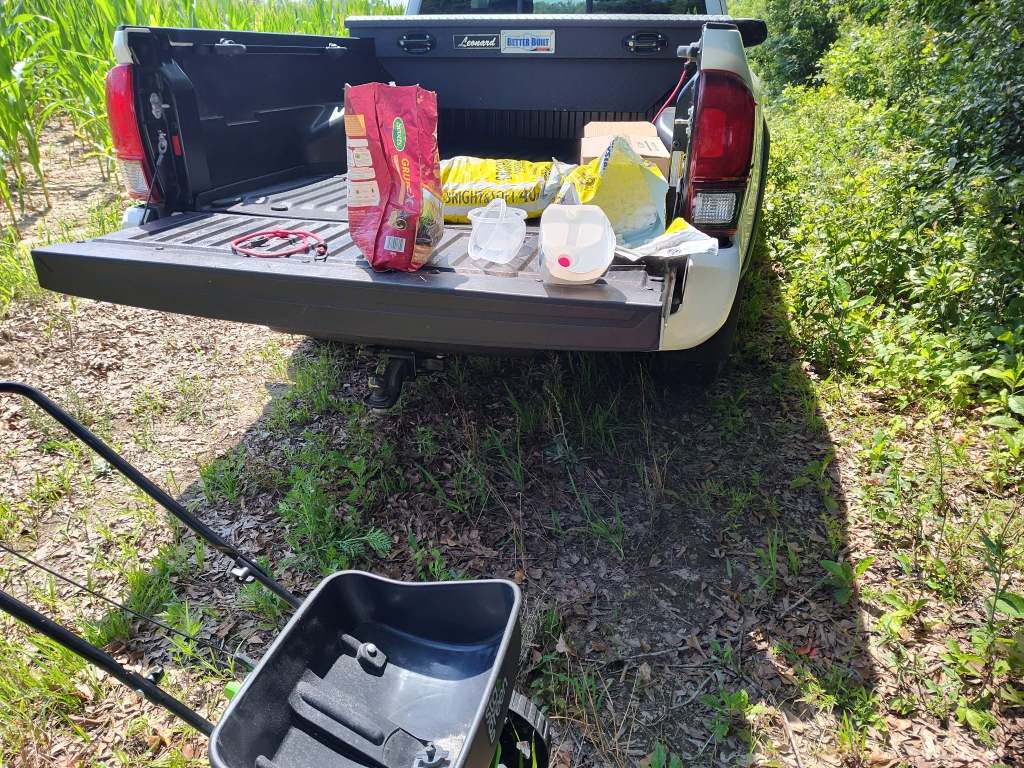
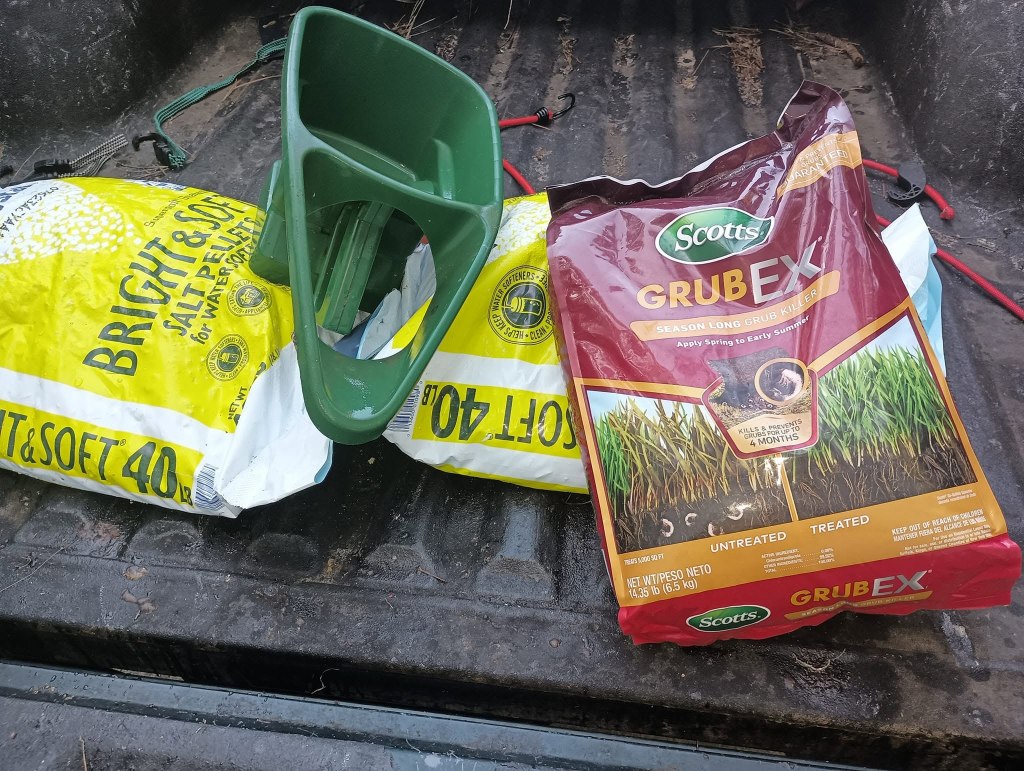
It’s time to begin pest control. For wax moths, manage internal volume as we enter the period of declining population by removing space so bees can adequately cover the frames. For SHB, you have multiple methods such as oil traps, dry unscented Swiffer pads, hive tool whack-a-mole, vacuums, and/or interrupting their life cycle with soil drench, DE, or bait. Choose one or more. Pictured: Pool salt and GrubX.

Stress reduction for bees. Reduce pest pressure on your bees through pest management. Kill SHB at the source – as they seek to pupate in the ground.

Feel free to share this on:

  • Share on Facebook (Opens in new window) Facebook
  • Share on X (Opens in new window) X
  • Share on Pinterest (Opens in new window) Pinterest
  • Email a link to a friend (Opens in new window) Email
  • Share on LinkedIn (Opens in new window) LinkedIn
  • Share on Reddit (Opens in new window) Reddit
  • Share on Tumblr (Opens in new window) Tumblr
  • Print (Opens in new window) Print
  • Share on Telegram (Opens in new window) Telegram
  • Share on WhatsApp (Opens in new window) WhatsApp
Like Loading...

State Fair Wax Preparation

11 Tuesday Aug 2026

Posted by Beekeeping365 in beekeeping

≈ Leave a comment

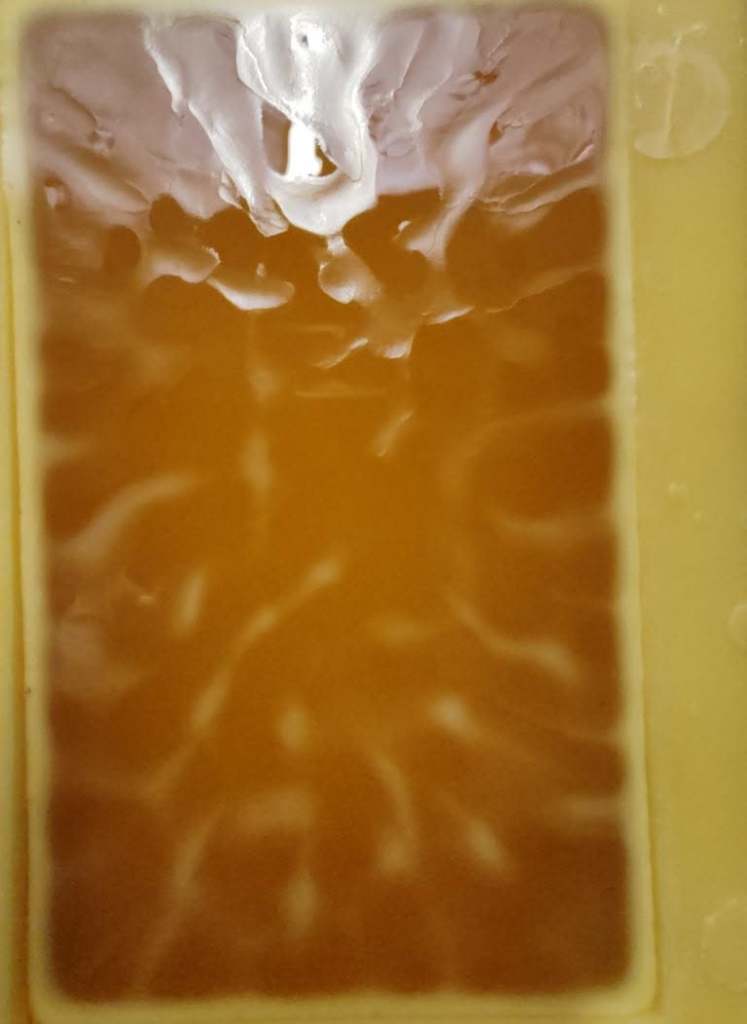
Register for the State Fair honey show this month! Photo: watching wax harden is like waiting for a pot to boil.

Feel free to share this on:

  • Share on Facebook (Opens in new window) Facebook
  • Share on X (Opens in new window) X
  • Share on Pinterest (Opens in new window) Pinterest
  • Email a link to a friend (Opens in new window) Email
  • Share on LinkedIn (Opens in new window) LinkedIn
  • Share on Reddit (Opens in new window) Reddit
  • Share on Tumblr (Opens in new window) Tumblr
  • Print (Opens in new window) Print
  • Share on Telegram (Opens in new window) Telegram
  • Share on WhatsApp (Opens in new window) WhatsApp
Like Loading...

Sherlock Holmes and Beekeeping: A Unique Connection

23 Thursday Jul 2026

Posted by Beekeeping365 in beekeeping equipment

≈ Leave a comment

Tags

famous beekeepers, honey bees, Sherlock Holmes

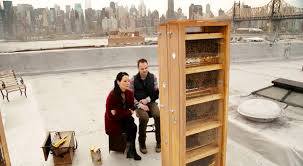
Anyone watch the Sherlock series titled Elementary? One of Holmes’ interests is beekeeping which they thread through the series. In the last episode of last season we finally got a look at his aviary, Two five to six foot tall, beautifully crafted observation hives on top of his brownstone in NYC.

Feel free to share this on:

  • Share on Facebook (Opens in new window) Facebook
  • Share on X (Opens in new window) X
  • Share on Pinterest (Opens in new window) Pinterest
  • Email a link to a friend (Opens in new window) Email
  • Share on LinkedIn (Opens in new window) LinkedIn
  • Share on Reddit (Opens in new window) Reddit
  • Share on Tumblr (Opens in new window) Tumblr
  • Print (Opens in new window) Print
  • Share on Telegram (Opens in new window) Telegram
  • Share on WhatsApp (Opens in new window) WhatsApp
Like Loading...

Transforming a Vintage Beekeeping Machine for Better Performance

30 Saturday May 2026

Posted by Beekeeping365 in beekeeping

≈ Leave a comment

Tags

beekeeping, extracting honey, honey

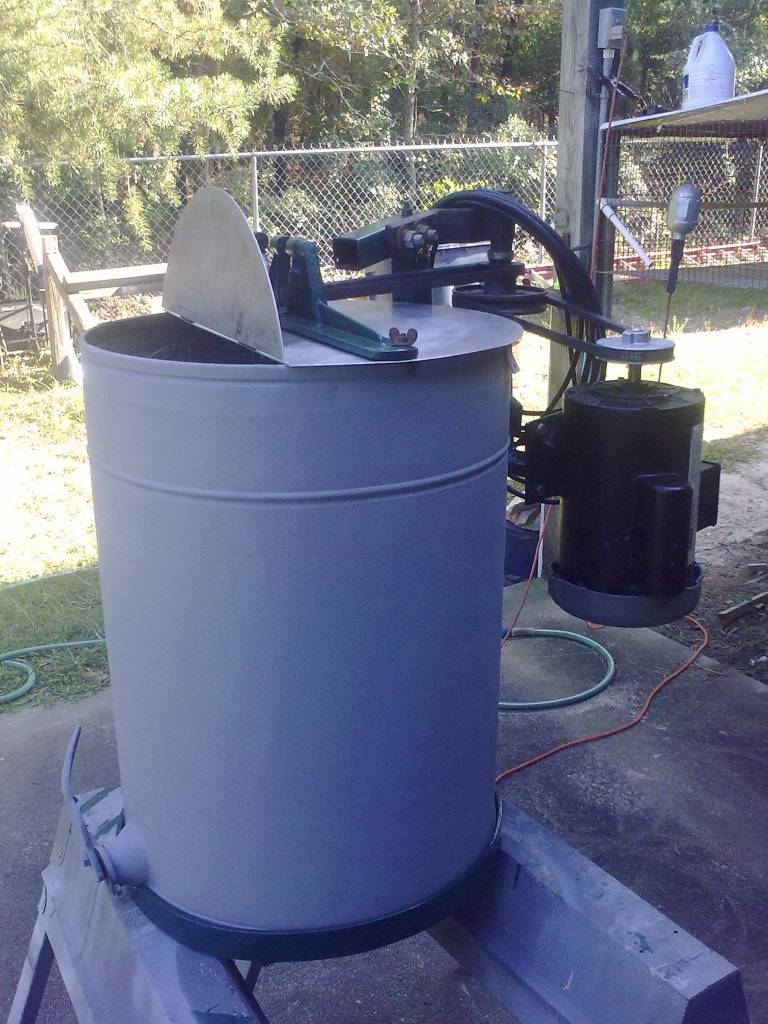
She’s a brick—-house.

Scored this work in progress. Looks like an old hand crank model converted by some clever farmer to a motorized unit. Was under powered with 1/2 HP when I got her so I upgraded her to a 1 HP Ag use motor that I had sitting on a shelf. Now she spins like a champ. I can’t figure out how many frames she holds though. Looks like 4 deeps/8 mediums size but after I placed 8 mediums in the radial position, the basket still has room for me to place 4 more mediums in the tangential position. She’s functional now but still needs some rehab.

Feel free to share this on:

  • Share on Facebook (Opens in new window) Facebook
  • Share on X (Opens in new window) X
  • Share on Pinterest (Opens in new window) Pinterest
  • Email a link to a friend (Opens in new window) Email
  • Share on LinkedIn (Opens in new window) LinkedIn
  • Share on Reddit (Opens in new window) Reddit
  • Share on Tumblr (Opens in new window) Tumblr
  • Print (Opens in new window) Print
  • Share on Telegram (Opens in new window) Telegram
  • Share on WhatsApp (Opens in new window) WhatsApp
Like Loading...

Swarm Removal at Olive Garden: Quick and Efficient

29 Friday May 2026

Posted by Beekeeping365 in beekeeping

≈ Leave a comment

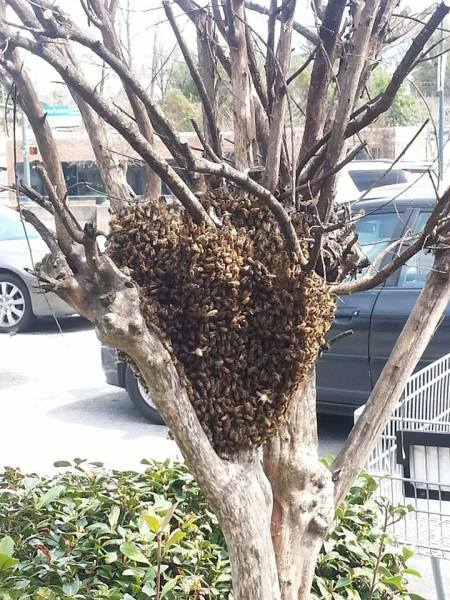
Received call today regarding a swarm in Crepe Myrtle tree outside Olive Garden. Have Nuc will travel… Danny and I had it hived and were gone in 15 minutes. Didn’t even suit up – just shorts and tee shirts for both of us. Of course they were Italians.—

feeling happy at Olive Garden Italian Restaurant.

Feel free to share this on:

  • Share on Facebook (Opens in new window) Facebook
  • Share on X (Opens in new window) X
  • Share on Pinterest (Opens in new window) Pinterest
  • Email a link to a friend (Opens in new window) Email
  • Share on LinkedIn (Opens in new window) LinkedIn
  • Share on Reddit (Opens in new window) Reddit
  • Share on Tumblr (Opens in new window) Tumblr
  • Print (Opens in new window) Print
  • Share on Telegram (Opens in new window) Telegram
  • Share on WhatsApp (Opens in new window) WhatsApp
Like Loading...

Bait Hives Make Good Neighbors

13 Tuesday Jan 2026

Posted by Beekeeping365 in beekeeping

≈ Leave a comment

Tags

swarm bait hives

Bait Hives Make Good Neighbors

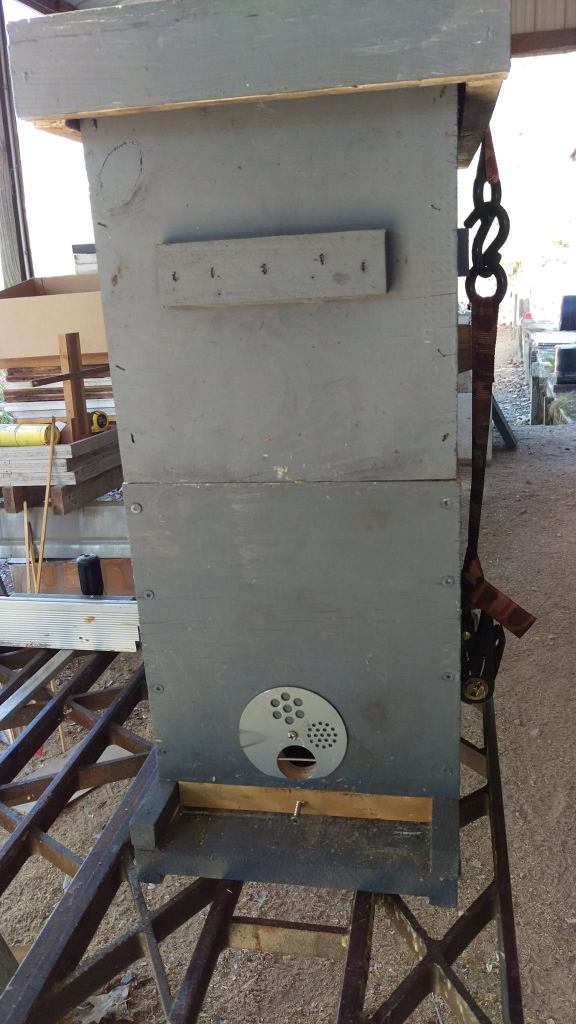
After several years of catching swarms, I think I have my preferred bait hive design down pat. Lightweight, easy to transfer frames to permanent hive, recycles frames, easy to transport, and irresistible to swarms.

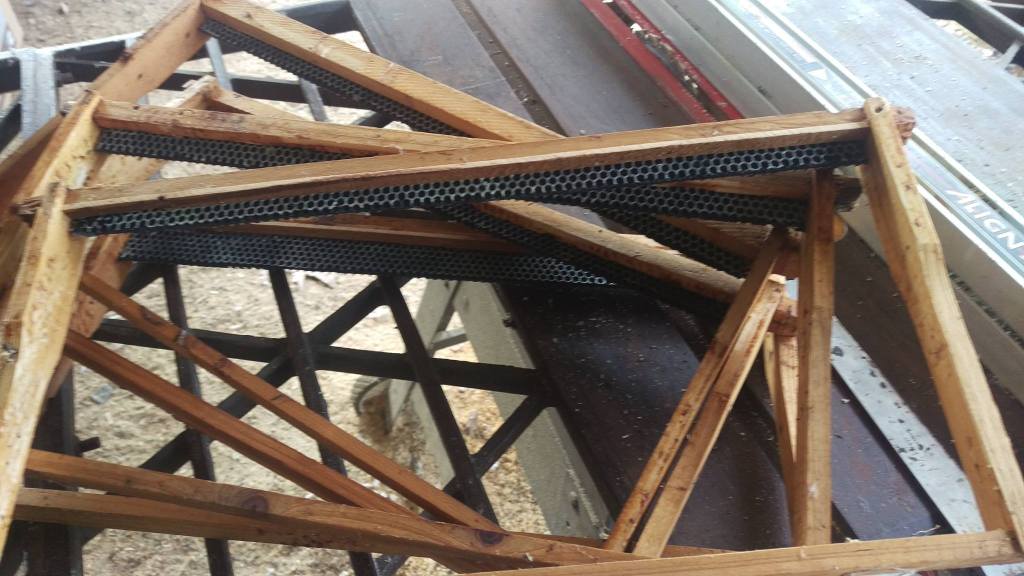
Double 5 frame nuc boxes, with old propolised frames only in the upper box (one frame with old comb, and four with starter strips heavily coated with beeswax), bottom box is empty, bottom board with small screened drainage/ventilation hole is attached to bottom box, 1 1/4″ entrance hole with bird excluder (nail) and with closure disk for quickly closing the entrance for moving, main entrance blocked (screw used as handle if it needs to be removed), ratchet strap holds it all together. It’s not heavy and easy to transport. I’ll place this now and bait it with scent attractant in about a month. Placement of traps are 75 to 200 yards away from the main bee yard and along tree lines. Height is best at 12 – 15 ft. but I’m not keen on lugging ladders through the woods so I keep them at manageable heights I can reach sanding on the ground. Scout bees will give the bait hive a thorough inspection with points given for correct cavity size, correct entrance size, odor, dryness, height, and location. The more of these you satisfy the more points you earn and the greater the likelihood they will choose the bait hive.

Feel free to share this on:

  • Share on Facebook (Opens in new window) Facebook
  • Share on X (Opens in new window) X
  • Share on Pinterest (Opens in new window) Pinterest
  • Email a link to a friend (Opens in new window) Email
  • Share on LinkedIn (Opens in new window) LinkedIn
  • Share on Reddit (Opens in new window) Reddit
  • Share on Tumblr (Opens in new window) Tumblr
  • Print (Opens in new window) Print
  • Share on Telegram (Opens in new window) Telegram
  • Share on WhatsApp (Opens in new window) WhatsApp
Like Loading...

Nuc and Swarm Trap Building

04 Sunday Jan 2026

Posted by Beekeeping365 in swarms

≈ Leave a comment

Tags

nucleus hives, swarm bait hives, swarm traps

Been on a nuc and swarm trap building binge. Now for some paint.

Feel free to share this on:

  • Share on Facebook (Opens in new window) Facebook
  • Share on X (Opens in new window) X
  • Share on Pinterest (Opens in new window) Pinterest
  • Email a link to a friend (Opens in new window) Email
  • Share on LinkedIn (Opens in new window) LinkedIn
  • Share on Reddit (Opens in new window) Reddit
  • Share on Tumblr (Opens in new window) Tumblr
  • Print (Opens in new window) Print
  • Share on Telegram (Opens in new window) Telegram
  • Share on WhatsApp (Opens in new window) WhatsApp
Like Loading...

Image

Beekeeper Watching the Blooms

03 Saturday Jan 2026

The image shows the painting “Beekeeper” by the Russian artist Ivan Kramskoy. 

Artist: Ivan Kramskoy (1837-1887), a prominent figure in the Russian Realist movement. 
Date: Painted in 1872. 

Location: The original oil on canvas painting is housed in the Tretyakov Gallery in Moscow, Russia. 

Subject: It depicts an elderly beekeeper sitting on a log, resting amidst tall grass and several beehives in the background. 

Feel free to share this on:

  • Share on Facebook (Opens in new window) Facebook
  • Share on X (Opens in new window) X
  • Share on Pinterest (Opens in new window) Pinterest
  • Email a link to a friend (Opens in new window) Email
  • Share on LinkedIn (Opens in new window) LinkedIn
  • Share on Reddit (Opens in new window) Reddit
  • Share on Tumblr (Opens in new window) Tumblr
  • Print (Opens in new window) Print
  • Share on Telegram (Opens in new window) Telegram
  • Share on WhatsApp (Opens in new window) WhatsApp
Like Loading...

Posted by Beekeeping365 | Filed under beekeeping

≈ Leave a comment

Varroosis: Acute, Chronic, or Somewhere in the Middle?

30 Wednesday Jul 2025

Posted by Beekeeping365 in beekeeping

≈ Leave a comment

Tags

chronic-illness, deformed wing virus, economic-indicator-level, honey bees, science, varroa mites, varroosis, viral-diseases

For Your Consideration,

Some years ago, I remember reading on Randy Oliver’s page his discovery of a threshold with regards to varroa. As I recall, it was at around 3,000 mites in a standard colony. When that threshold was reached the colony would enter an unrecoverable death spiral. At that mite load, and accompanying virus load, the colony simply could not recover from the viral illnesses. Even if the colony looks viable it’s doomed. It’s fatally ill.

I think it’s worth frequently repeating that it’s the viruses that deal the final blow. We focus on the vector so much that often our sole effort is directed at the mites. Kill the mites is our mantra. And there is a bit of truth to that. Certainly, if we could eliminate the mites our problems would disappear. But after about 30 years we’re still experiencing the same problems with managing acceptable mite levels in order to have acceptable, sublethal virus levels.

Some things that have always bothered me are the ever-changing acceptable and unacceptable levels of varroa. Especially, Economic Injury Levels (EIL). The Economic Injury Level (EIL) is a concept that defines the pest density at which economic damage occurs. It helps farmers make informed decisions regarding the need for pest control. The EIL is determined by the cost of damage relative to the cost of control, and it serves as a threshold for applying control measures to prevent further economic damage. I’m sorry but I can’t get behind this way of thinking. As humans do we consider the price of treatment for ourselves versus how ill we may become if not treated? I guess, unfortunately sometimes we must if we don’t have the financial resources. But with our honey bees we do have the resources. The choice to treat always favors treatment. After all, what’s the cost of a new colony vs saving an existing colony?

So, over the years we have jumped around on what constitutes a level of mites indicating treatment is warranted. When I started keeping bees about 15 years ago the rule of thumb was always monitor your mite load and treat when it’s over 5 mites per hundred. Of course, later that number came down. And consistently, I heard that, one should always treat in the fall – period, hard stop! I found that I couldn’t usually wait until fall and couldn’t wait until that magic mite:bee ratio was reached if I wanted to stop the mite bombs from exploding and decimating my bee yard.

I also saw something else. My bees were sick long before they died. Being workaholics, hoarders and industrious they always did the best they could, but they just didn’t perform the way the bees did in the old-school books I read. I decided to do a better job and monitor mites all year and treat before a crisis developed. By this time, it had become mainstream to monitor more frequently but that EIL remnant lingered. I had already formed a negative opinion of relying on the officially decided EIL level would be in any particular year. Instead, I would go rogue. I noted that colonies crashed with some consistency following harvest, through our hot late summer, and many never made it to fall. So, I treated when I felt it necessary both seasonally, at lower mite levels, and before reaching the latest prescriptive level.

What I learned along the way was my bees not only started surviving, they also started thriving. The first time I noted the difference between bees that thrive and bees that are sick was in the spring of one year. For a couple of years, I had been treating with oxalic acid in December during the brood break. That year, I decided to administer oxalic acid treatments in early December, January, and February. During that year’s early build up I witnessed an enthusiasm on the landing board, as well as the prettiest fuzzy bees I had yet to see earlier in my beekeeping. They had it all and made lots of honey that year as I broke through honey production expectations. I couldn’t help but wonder if individual bee life expectancy had increased as well as overall health. I suspect both longer lived and healthier bees was a result of those early season treatments that cleaned them up reducing their viral loads. They felt better and it showed.

In the years that followed I came to believe that varroosis (death by varroa, or perhaps more accurately, by the viruses they transmit) was not an acute occurrence. That while it appeared to occur suddenly and acutely, I believed the evidence indicated varroosis was a chronic disease ending with sudden death. The bees were sick all along as the virus levels steadily increased throughout the nectar producing season. Steadily getting sicker and sicker, living shorter and shorter lives, working less and less, until finally the viral load crossed a lethal threshold and then, it presented as a sudden death. But it wasn’t sudden. They were becoming sicker every day that followed that last pre-season treatment. Why was it an acceptable practice to let our bees reach death’s door before we intervened? Why did we only treat them for an acute illness rather than a chronic illness? Acutely vs chronic management differs and perhaps we were travelling the incorrect path.

With human healthcare we manage chronic health problems like diabetes, heart health, high blood pressure, HIV (virus levels), and the like. We also have a different management practice to manage acute health problems like colds, flu, infections, and trauma. So, which do you think our bees are displaying with regards to varroosis? Is the viral load a chronic problem or an acute problem? Should it be managed only when your bees are at death’s door and reach an arbitrary EIL level or should we manage them as one would with a chronic illness? One might say that use of typical mechanical and cultural IPM methods is treatment along the lines of chronic management. That is true to some extent, but I’ve never seen any IPM treatments successfully mitigate the need for more aggressive treatments. Maybe our typical IPM methods slow the villain, but he steadily drags them down over time and eventually kills the bees.

So, if you’ve read this far, tell me what you think. Are our problems with mites and viruses acute or chronic? If you think the scale tips towards chronic perhaps we need a change in our treatment plan. What solutions might we offer to change the way we help our bees not only survive but truly thrive throughout the year?

Feel free to share this on:

  • Share on Facebook (Opens in new window) Facebook
  • Share on X (Opens in new window) X
  • Share on Pinterest (Opens in new window) Pinterest
  • Email a link to a friend (Opens in new window) Email
  • Share on LinkedIn (Opens in new window) LinkedIn
  • Share on Reddit (Opens in new window) Reddit
  • Share on Tumblr (Opens in new window) Tumblr
  • Print (Opens in new window) Print
  • Share on Telegram (Opens in new window) Telegram
  • Share on WhatsApp (Opens in new window) WhatsApp
Like Loading...

I’ve stopped worrying about killing the vector and started killing the pathogen.

08 Monday Apr 2024

Posted by Beekeeping365 in beekeeping, oxalic acid, varroa, varroa destructor, varroa mites

≈ Leave a comment

Tags

antiviral, beekeeping, bees, deformed wing virus, varroa, varroa destructor, virus

The story starts years ago when I noticed that the bees flew with more enthusiasm and worked harder in the days following a varroa mite treatment (oxalic acid vaporization). I asked others if they too saw this behavior change. Some said they never took notice; others said it was obvious. Years later I measured the coming and going on the landing board using one of those click counters. It was true; the bees were energized after a treatment. But I didn’t have the answer as to why. Last summer I spoke to someone more knowledgeable than I in entomology and he used the analogy, “Have you ever noticed how good a dog feels the day after a flea dip?” A great reply that satisfied me for awhile. But I thought, putting a dent in a 3% mite load (not even eliminating the mites) couldn’t increase the entire colony’s enthusiasm as evidenced with the increase in activity on the landing board. Could it? Or was something else going on? But I’m getting ahead of myself.

Back in 2021, I started doing some research and learned that the EPA first approved oxalic acid (OA) in 1957 as a disinfectant in bathrooms and septic systems among other uses. It’s still used today in cleaning solutions for industry food production machines, not to mention good old Bar Keeper’s Friend. If you’re not sure of the definition of disinfectant look it up. It’s different than sanitizer, cleaner, or antibacterial. So, is OA also acting in that manner in the hive? Is it giving the internal surfaces of the hive and the bees a chemical scrubbing? Am I killing bacteria and viruses as well as mites? I didn’t know but I wanted to try a few things.

Over two years ago (January 2022) I started treating my bee hives routinely with OA vapor. That’s “routine schedule” as meaning a set date each month to treat on my calendar. Similar to you taking an antibiotic on a routine schedule, or a medicine for a chronic condition like hypertension, diabetes, or reflux. Consider it an IPM treatment for treating mites and accompaning viruses. Also included in my goals were to 1) decrease the number of yearly OA treatments and 2) reduce the likelihood of resistance to OA. But simply put, all I was actually doing was going to be changing one aspect of treatment – the dosing schedule from one that targeted the mites’ reproductive schedule, to one that disinfected the colony’s environment regularly. Of course, any varroa mites killed would be a value-added outcome.

That year I did not suffer any colony losses during the spring, and I made more honey than usual. However, I did have some colony failures (~ 10%), as is typical, after the nectar flow during our dearth period. Multiple stressors (SHB, harvest, and climbing mite to bee ratios) take their toll during this period as the mite load climbs, increasing the viral load. I intervened with a single series of OA treatments and the losses stopped, leading me to believe the stressor most critical is mite/viral load. After completing the single series of treatments, I resumed my scheduled monthly treatments as before and had no winter losses. After the first year, I tried to make sense of that year’s interventions and outcomes and develop a plan for next year.

In January 2023, I continued my routine treatment schedule and, as experienced the previous year, I had no losses during the nectar flow. But this year I decided to make a change to the dosing schedule during the post nectar flow time period. I changed to a once every two-week treatment schedule (actually on the 1st and 15th) and continued this schedule until fall – so that would be twice monthly treatments June – October. This added about 5 additional treatments to the year which pushed me to the edge on my goal to limit the number of treatments per year. In November, I resumed the routine monthly schedule. This scheduling model resulted in no colony losses in the spring, fall, summer, or winter of 2023. My honey production was about 65 lbs. per hive which is about 50% higher than expected in the SC Midlands. Keeping bees healthy during the nectar flow keeps them working harder rather than our current method of allowing the bees’ health to decline over the season and often collapse just prior to treatment salvation.

All this brings me to this year (2024). So far, I have not sustained any mite/virus related losses. Coming out of winter I saw the occasional weak colony, needing a new queen, or help with SHBs. But my hives built up quickly in the pre-season. I just did my accounting for taxes and used less sugar last year having left more honey due to their productivity (and my reluctance to pay for sugar). My point is they are healthy and handling stressors.

Recently I spent some time researching organic acids as disinfectants, antimicrobials, etc. There are some studies on this with viruses. Yes, organic acids can be antivirals. It is dose and pH dependent to some extent. OA is around 2 on the pH scale so it’s potent. But there are some unidentified factors as well. For instance, acetic acid sometimes is more effective with certain viruses than acids with lower pH. So, the reason organic acids (and which) kill viruses still is somewhat a mystery.

Why is this interesting? First, because it shouldn’t be working. One would think my colonies would be mite ridden and failing. This OA dosing schedule should be allowing the mites too much freedom to reproduce. However, I haven’t seen a case of deformed wing in years and my skewering of drone pupae shows me the mites are under control. Second, because varroa mite levels are out of the treatment consideration loop, I no longer concern myself with watching my bees become increasingly ill before tipping this season’s / year’s suggested EIL level. Third, I could care less even if my mite levels were high. In fact, I would be happy to find they were as it would confirm what I’m doing is working by a mechanism other than killing mites. Fourth, I’m exposing my bees to the same or less OA than I would if I was using currently acceptable OA vapor treatment schedules. Fifth, I’m allowing more time between treatments which lessens the possibility of miticide or antiviral resistance. Sixth, after seeing many new beekeepers struggle with the myriads of options for mite assessment, the complexity of understanding mite counts during different seasons, and the best choice of miticide for each time of year and temperature, what a gift it would be to simplify this process. Seventh, my bees stay healthy and productive all year. Gone is the yo-yo of cleaning them up only to let them fall to approaching colony collapse before a lifesaving series of treatments. That yo-yo isn’t healthy living. We don’t allow diabetics to go into diabetic coma before treating them nor do we allow HIV patients to live with high viral loads. No, we manage these illnesses rather than wait for a crisis to develop. We should keep in mind that our colonies don’t die from the mites they die from high viral loads.

How is this working? My supposition is that I am killing viruses (or a subset of the many virus types) directly, thus bypassing the need for vector (mite) control. Another possibility is I am interrupting the relationship between the virus and the mite – to the mite’s detriment. But to be honest, I don’t know. It could be something entirely different that I haven’t considered. I’ll continue the effort and will start to compile the research and data I have collected.

This honey season is off to a great start. All supers are already deployed and I’m wondering how I’m going to deal with keeping the bees with enough space now that they’ve gone gangbusters. Cheers!

Brief Update 7/20/2025: I’m just back from my state beekeepers assocation’s summer conference. The talk of mites always triggers some guilt that I have not updated this blog entry in some time. So, the effort continues. I have tried to maintained routine monthly treatments although there was some disruption during a personal health event. The success of healthy bees continues with minimal losses. It is rewarding to have a near perfect survival rate in the midst of record national losses in the US. I don’t get to as many conferences as I used to but with those I have shared this effort with, the idea that there is a possibility that I am simply keeping the viral threshold below the point of illness development. Randy Oliver wrote some time back that at a certain mite count within a colony they enter tipping point after which they are doomed to colony failure. I think this is a valid explanation – that the viral threshold is possibly being held in check. By a little or a lot is unknown. If you have ideas let me know. larrycoble@bellsouth.net

Feel free to share this on:

  • Share on Facebook (Opens in new window) Facebook
  • Share on X (Opens in new window) X
  • Share on Pinterest (Opens in new window) Pinterest
  • Email a link to a friend (Opens in new window) Email
  • Share on LinkedIn (Opens in new window) LinkedIn
  • Share on Reddit (Opens in new window) Reddit
  • Share on Tumblr (Opens in new window) Tumblr
  • Print (Opens in new window) Print
  • Share on Telegram (Opens in new window) Telegram
  • Share on WhatsApp (Opens in new window) WhatsApp
Like Loading...

Happy Birthday Petro Prokopovych

12 Tuesday Jul 2022

Posted by Beekeeping365 in beekeeping

≈ Leave a comment

Wikipedia: Petro Prokopovych (1775–1850, Ukrainian: Петро Прокопович) was a revolutionary Ukrainian[1][2][3][4] beekeeper, the founder of commercial beekeeping and the inventor of the first movable frame hive.[5] He introduced novelties in traditional beekeeping that allowed great progress in the practice. Among his most important inventions was a hive frame in a separate honey chamber of his beehive. He also invented a crude queen excluder between brood and honey chambers.[6][7] Petro Prokopovych was also the first to ever model a ‘bee beard’ after delineating and calculating ‘bee swarm behaviour”, inspiring students for generations.[8]

From http://beekeeping.com.ua: Petro Prokopovych was born in Ukraine, in the village of Mytchenky, near Baturyn, where he spent his childhood. The parents sent eleven-years-old Petro to Kiev-Mohyla Academy, where he studied for eight years. 


After the academy he wanted to be a teacher. However, the future genius of beekeeping was to go to a military career. Despite it was quite successful (the state awarded him, etc.), in 1798 he resigned.


At the brother’s small bee-garden the retired officer admired the life of mysterious small flying beings, which were kept in primitive hives, made from pieces of log. 


In 1799 Petro Prokopovych decided to devote himself to beekeeping and in 1808 he already had 580 bee-families. All these years he tried to understand the internal life of bee-family and to improve existing methods of beekeeping. One of directions of his research was looking for a way to take honey without wanton destruction of the family. 


In 1814 the tireless search resulted in the invention of the first in the world dismountable frame beehive, in which it was possible to control family and to actively influence the course of its development. In this beehive Prokopovych for the first time has considered a frame as a module of bee-hive – which used today by millions beekeepers all over the world. It was a landmark in the history of beekeeping, which has begun the epoch of rational beekeeping. 


One more his invention – the wooden partition with apertures, which were passable only for working bees. It made possible getting pure honey in the frames. 


Amos Root highly praised the inventions of Prokopovych: ” His frame has much in common with a modern section frame with openings for passage of bees, the walls of his beehive were joint in the lock. He applied methods, which far outstripped his time “. 


Prokopovych possessed not only the gift of researcher but also that of teacher. The school, founded by him, during 53 years of its existence prepared more than 700 qualified beekeepers with the most advanced experience of that time. The school apiary in 1855 had 2542 bee-families. 
Prokopovych published more than 60 articles in the newspapers and magazines. Many of his findings remain important now; for example, the drugless method of treatment foul brood by driving of bees to a new hive. 


Prokopovych considered beekeeping the most profitable branch of the agriculture and proved it, having become rather rich man. He had 6600 beehives of his own design only. 


Petro Prokopovych is buried  in a village Pal’chyky in the Chernigiv region, where his beekeepers’ school was located. The monument of Prokopovych is erected here,  the Ukrainian Institute of Beekeeping is named after him.

All this plus a great gravestone showing him with a removable frame!

Feel free to share this on:

  • Share on Facebook (Opens in new window) Facebook
  • Share on X (Opens in new window) X
  • Share on Pinterest (Opens in new window) Pinterest
  • Email a link to a friend (Opens in new window) Email
  • Share on LinkedIn (Opens in new window) LinkedIn
  • Share on Reddit (Opens in new window) Reddit
  • Share on Tumblr (Opens in new window) Tumblr
  • Print (Opens in new window) Print
  • Share on Telegram (Opens in new window) Telegram
  • Share on WhatsApp (Opens in new window) WhatsApp
Like Loading...

Why did my bees die?

31 Thursday Mar 2022

Posted by Beekeeping365 in beekeeping, beekeeping management, beekeeping pest management, management

≈ 5 Comments

Tags

beekeeping chores, beekeeping diagnostics, fall management, spring management, varroa mites, what killed my bees?

2016-05-08 15.37.47.jpg

Why did my bees die?

This is a question often asked and sometimes difficult to answer. The beekeeper looking at a dead colony is left with clues that can sometimes indicate the cause of death. More often though the beekeeper looks at the “crime scene” and makes an incorrect assumption. We’ve all heard it, “Wax moths killed my bees.” or “They got robbed.” or Small hive beetles killed them.” Most often though these are the results of problems that were missed or not addressed earlier.

I like murder mysteries. And, like in murder mysteries, what kills the bees isn’t always the most obvious suspects. It’s not the one the mystery writer wants you to initially think it is. After all what fun would that be? Instead the beekeeper must use some logic in backtracking the history of the colony to solve the mystery. Many times the downward spiral started some time back and we missed it before it lead up to wax moths, robbing, small hive beetles, or other maladies.

This past winter I had a 9% overwinter loss coming into the spring buildup. All in all, in today’s world of beekeeping that’s pretty good. Early in this season’s buildup, in February, I rotated boxes as a swarm prevention technique. I noted that a particular row of hives were not building up as fast as my other hives. As I rotated the hive bodies I inspected and found that they were all queen-right though so I just chalked the slow buildup up to “one of those unexplained things.”

That row of thirteen colonies coming into spring lost six colonies AFTER that first box rotation of spring. All of my other colonies continued to grow and expand.  Granted the ones lost were not the strongest but they had queens (I saw them). How were these different than the ones that were thriving? Time to put on my detective hat. They were unique in that they are all on same row, were not taken down in size last fall (I just ran out of energy), and had older queens. So what killed them? I don’t know but I suspect the stress of the box rotation on an already stressed colony. How were they already stressed? Why did they not build up like the other areas in my bee yard? Thinking about the differences: this group  had older queens, larger hives usually have/maintain higher mite counts,  and were in  an isolated  row in the bee yard.  I don’t know exactly which stressor was the largest but I suspect some or all of the above come into play.

Now my overall losses were at 27% instead of the 9% prior to this event and most likely because I failed to reduce size, monitor this row for Varroa better, and not re-queen in the fall. Which exactly? Beekeepers always want to know which one is the culprit. I don’t know. Maybe it was multiple stressors and not just one. But I do have some excellent suspects! Regardless of which stressor killed these colonies I failed to do that which a good steward should have done for these bees. Ultimately it’s on me.

…

So, after writing the above I was further pondering the possibilities while making up some sugar syrup, and I was thinking about the stressors and it came to me what killed those colonies. Distilling it down to a single element – laziness. I should have taken those hives down to 2 boxes post nectar flow last summer. I should have monitored Varroa better in that row instead of assuming it would be the same as the newer hives in other areas. And I should have re-queened as would have happened easily if I had made splits last year when I should have taken them down in size. My laziness killed those colonies. So there, I came up with a single cause, identified the culprit, and solved the mystery!

It won’t happen again. Maybe something else but not this.


Feel free to share this on:

  • Share on Facebook (Opens in new window) Facebook
  • Share on X (Opens in new window) X
  • Share on Pinterest (Opens in new window) Pinterest
  • Email a link to a friend (Opens in new window) Email
  • Share on LinkedIn (Opens in new window) LinkedIn
  • Share on Reddit (Opens in new window) Reddit
  • Share on Tumblr (Opens in new window) Tumblr
  • Print (Opens in new window) Print
  • Share on Telegram (Opens in new window) Telegram
  • Share on WhatsApp (Opens in new window) WhatsApp
Like Loading...

Happy Birthday Dr. Wladyslaw Zbikowski

29 Tuesday Mar 2022

Posted by Beekeeping365 in beekeeping, birthday, birthdays, famous beekeepers

≈ Leave a comment

Tags

beekeeper, beekeeper birthdays, Dr. Wladyslaw Zbikowski, famous beekeepers, inventor

RossRoundsFrame
comb_honey_platter
rr3

Birth: March 29, 1896

Death: November 1, 1977

Inventor of the Cobana round comb honey sections, later to become “Ross Rounds.”

The modern round plastic section appeared in 1954. It was called “Cobana” and seems to have been designed by a Pennsylvanian beekeeper named Dr. Wladyslaw Zbikowski, a retired physician.

From Badbeekeeping blog of 2010: The gentleman who receives the credit for the modern invention, a retired physician from (get ready) western Pennsylvania designed the round section device which he called Cobanas in 1954. Dr. Wladyslaw Zbikowski (1896-1977) was born in Beaver Falls, PA, but educated in Russia and Poland. He started keeping bees in 1953, after retiring from medicine. Dr Zbikowski made the modern plastic round section the very next year. http://www.badbeekeeping.com/beeblog2010.htm

More on rounds sections here: http://www.dave-cushman.net/bee/sectionsround.html

Feel free to share this on:

  • Share on Facebook (Opens in new window) Facebook
  • Share on X (Opens in new window) X
  • Share on Pinterest (Opens in new window) Pinterest
  • Email a link to a friend (Opens in new window) Email
  • Share on LinkedIn (Opens in new window) LinkedIn
  • Share on Reddit (Opens in new window) Reddit
  • Share on Tumblr (Opens in new window) Tumblr
  • Print (Opens in new window) Print
  • Share on Telegram (Opens in new window) Telegram
  • Share on WhatsApp (Opens in new window) WhatsApp
Like Loading...

Swarm Catcher Checklist and Tips

26 Saturday Mar 2022

Posted by Beekeeping365 in beekeeping

≈ Leave a comment

This time of year, in my truck, I keep a deep 10 frame Langstroth box with 10 frames installed, screened bottom board, inner cover, and either migratory or telescoping top. And a ratchet strap to hold it all together for transportation. The entrance reducer is either closed or I replace it with #8 hardware cloth folded in a “U” shape. I also have ready for quick loading a swarm bucket with attachable telescoping painters pole and a ladder.

Additional, sometimes useful, items I usually have on hand include: A queen clip, a spray bottle of imitation almond extract, small and large limb pruners, and a spray bottle of sugar water to spray them with before the shake.

Turn your telephone on with volume up this time of year. You need to ask how high. If they say “not too high” ask what that means. Head height? Taller than two men, etc. How large is the cluster – baseball? soccer ball? or basketball? Are they in a bush or tree? If they say they are flying around their front porch ask if they are clustered? (yes, people call because their ornamental holly is blooming and attracting bees). After you determine they indeed have a honey bee swarm and not miner bees, yellow jackets, or carpenter bees, get the address and get there soon.

When you return home with your swarm now in your equipment let them settle down for a couple hours before you open them and insert a frame of open brood from another hive. This will typically lock them to the hive (remember they didn’t choose your hive as their preferred cavity). One final item is to place a feeder on them. They will want to draw comb and it takes carbohydrate to do so. You can get some fantastic drawn comb in a short amount of time from a swarm. Then open the entrance to let them fly and orient to their new home.

Here’s another method used called the queen’s throne. It uses a frame of brood or brood comb to lure the bees into the bucket. In the video he is capturing bees at a school yard and wants to minimize flying bees.

Add any tricks you have below.

Feel free to share this on:

  • Share on Facebook (Opens in new window) Facebook
  • Share on X (Opens in new window) X
  • Share on Pinterest (Opens in new window) Pinterest
  • Email a link to a friend (Opens in new window) Email
  • Share on LinkedIn (Opens in new window) LinkedIn
  • Share on Reddit (Opens in new window) Reddit
  • Share on Tumblr (Opens in new window) Tumblr
  • Print (Opens in new window) Print
  • Share on Telegram (Opens in new window) Telegram
  • Share on WhatsApp (Opens in new window) WhatsApp
Like Loading...

Uses of propolis

25 Friday Mar 2022

Posted by Beekeeping365 in beekeeping, hive products, honey bee biology, propolis

≈ Leave a comment

Tags

beekeeping, honey bee biology, propolis

propolis

The varnishing of cells?

Where does this get a mention? It’s in the study notes..

https://books.google.co.uk/books?id=J59OdJG05mUC&pg=PA289&lpg=PA289&dq=propolis+varnish+cells&source=bl&ots=wWcZEVXjSE&sig=xA3wPwE9dEx1IeRKw_fWmAxrFKI&hl=en&sa=X&ved=0ahUKEwiahsn55p7RAhVhI8AKHS4_D3MQ6AEILDAD#v=onepage&q=propolis%20varnish%20cells&f=false

http://basicbeekeeping.blogspot.co.uk/2011/12/lesson-113-sticky-subject-of-propolis.html

They asked lots of people too.

In Ribbands, Chapter 27, Huber (1814) observed that new combs become more yellow, more pliable stronger and heavier and sometimes there were reddish threads on the inner walls. Chemical tests showed this was propolis.


Source: Uses of propolis

Feel free to share this on:

  • Share on Facebook (Opens in new window) Facebook
  • Share on X (Opens in new window) X
  • Share on Pinterest (Opens in new window) Pinterest
  • Email a link to a friend (Opens in new window) Email
  • Share on LinkedIn (Opens in new window) LinkedIn
  • Share on Reddit (Opens in new window) Reddit
  • Share on Tumblr (Opens in new window) Tumblr
  • Print (Opens in new window) Print
  • Share on Telegram (Opens in new window) Telegram
  • Share on WhatsApp (Opens in new window) WhatsApp
Like Loading...

Swarms

23 Wednesday Mar 2022

Posted by Beekeeping365 in beekeeping, beekeeping equipment, equipment, management, swarms

≈ 2 Comments

Tags

beekeeping, honey bees, management, swarm bucket, swarms

10277494_10202554907848770_3038799712607440902_n

This week reports of swarms have increased indicating that swarm season has started in earnest. The flood of calls has yet to begin but will start soon. This picture, from last year shows a swarm capture utilizing my friend Dave’s combination arborist’s tree tool and a homemade bucket with paint strainer modification. These bees were about 28 feet up.

In the US, those interested in catching swarms should visit Bees on the Net which lists beekeepers willing to go out and retrieve swarms in their area.

Feel free to share this on:

  • Share on Facebook (Opens in new window) Facebook
  • Share on X (Opens in new window) X
  • Share on Pinterest (Opens in new window) Pinterest
  • Email a link to a friend (Opens in new window) Email
  • Share on LinkedIn (Opens in new window) LinkedIn
  • Share on Reddit (Opens in new window) Reddit
  • Share on Tumblr (Opens in new window) Tumblr
  • Print (Opens in new window) Print
  • Share on Telegram (Opens in new window) Telegram
  • Share on WhatsApp (Opens in new window) WhatsApp
Like Loading...

“At the Hive Entrance” free ebook

18 Friday Mar 2022

Posted by Beekeeping365 in beekeeper education, beekeeping, beekeeping history, beeswax, book review, honey bee behavior

≈ Leave a comment

Tags

beekeeping, beekeeping history, beeswax, book review, honey bee behavior

th

It’s time to start enjoying your bees!

Do you like to watch behavior? Are you itching for more during this “leave ’em alone” period of time after package installation? Okay here’s your treat. Recently a friend, posted a positive review about a book link she had read titled, “At the Hive Entrance” by H. Storch. It was one of my favorites when I started beekeeping. And it’s something you can do now – watch the hive entrance. Just place your chair off to the side of the front entrance about 6 or 8 ft. away and watch. After a few days you’ll start to see the routine of the bees. You’ll notice different pollens coming in on different days. Some days they’ll almost jump into the air on takeoff and zoom in on landings. Other days they’re a little slow. You’ll start to relate this to the temperatures, the flow, the season, and other things. You’ll get a feeling for the range of normal behavior (which also varies depending on seasons). In time, you’ll also notice behavior that’s not their norm which may necessitate an inspection. Which brings up the single warning about enjoying this book – it is only one factor in your assessment – entrance observation. If it looks like something unusual you may have to open them up to take a look. Enjoy.

https://breconandradnorbka.files.wordpress.com/2016/03/at-the-hive-entrance.pdf

Ebook is available via: Brecknock and Radnor Beekeeping Association

Feel free to share this on:

  • Share on Facebook (Opens in new window) Facebook
  • Share on X (Opens in new window) X
  • Share on Pinterest (Opens in new window) Pinterest
  • Email a link to a friend (Opens in new window) Email
  • Share on LinkedIn (Opens in new window) LinkedIn
  • Share on Reddit (Opens in new window) Reddit
  • Share on Tumblr (Opens in new window) Tumblr
  • Print (Opens in new window) Print
  • Share on Telegram (Opens in new window) Telegram
  • Share on WhatsApp (Opens in new window) WhatsApp
Like Loading...

Scientific Queen Rearing by Gilbert M. Doolittle (free download)

15 Tuesday Mar 2022

Posted by Beekeeping365 in beekeeping, beekeeping author, beekeeping books, book review

≈ Leave a comment

Tags

beekeeping authors, beekeeping books, book review, famous beekeepers

scientific queen rearing

Scientific Queen Rearing by Gilbert M. Doolittle

I’ve been very busy lately preparing for the upcoming nectar flow and have been neglectful of Beekeeping365. For that I apologize. But after daily work in the barn and the bee yard I have had a few moments to read some each day. This week  I’ve spent my free moments reading Scientific Queen Rearing by Gilbert M. Doolittle. Written in 1889, it’s subtitle reads:

“Scientific queen-rearing as practically applied; being a method by which the best of queen-bees are reared in perfect accord with nature’s ways. For the amateur and veteran in bee-keeping.”

As I have read the book I can’t help but be impressed with the tenacity of Mr. Doolittle. It appears as though he rarely allowed himself to wallow in defeat. One instance of frustration is mentioned in the book whereby he goes home without success in a particular endeavor, the bees behavior having defeated him it would seem. But he rallies and in the next paragraph explains how he awoke the next morning with a new and fresh idea ready to try again.

Relentlessly he overcame difficulties and in the end gave us the product of his efforts which serve queen breeders to this day. I  recommend reading his short book, Scientific Queen Rearing, to increase one’s knowledge on the subject but also as a lesson in perseverance.

The book can be found in its entirety here: Scientific Queen Rearing by Gilbert M. Doolittle

Feel free to share this on:

  • Share on Facebook (Opens in new window) Facebook
  • Share on X (Opens in new window) X
  • Share on Pinterest (Opens in new window) Pinterest
  • Email a link to a friend (Opens in new window) Email
  • Share on LinkedIn (Opens in new window) LinkedIn
  • Share on Reddit (Opens in new window) Reddit
  • Share on Tumblr (Opens in new window) Tumblr
  • Print (Opens in new window) Print
  • Share on Telegram (Opens in new window) Telegram
  • Share on WhatsApp (Opens in new window) WhatsApp
Like Loading...

Book Review: The Bee-keeper’s Manual, Henry Taylor

11 Friday Mar 2022

Posted by Beekeeping365 in beekeeping, beekeeping author, book review

≈ Leave a comment

Tags

beekeeping, beekeeping authors, book review

beekeeper's manual

Source:

Bookish Chronicles
bookishchronicles.wordpress.com
 

The Bee-keeper’s Manual, Henry Taylor

The Bee-keeper’s Manual,

Or

Practical Hints On The Management And Complete Preservation Of The Honey-Bee;

With A Description Of The Most Approved Hives, And Other Appurtenances Of The Apiary.

This review was long due. “Review” would be a misplaced word here. How do you do a critical appraisal of a beekeeping manual written 166 years ago? A technical know-how book is hardly a thing of leisure reading, unless you have an inherent interest in the particular field. I don’t even do beekeeping; neither do I fancy myself taking up this occupation in the future. But this is precisely what is appealing about Henry Taylor’s The Bee-keeper’s Manual. To read the book, you don’t need to have an interest in beekeeping, just a healthy appetite for curiosity.

My curiosity in the subject of beekeeping was sparked when I read Neil Gaiman’s The Case of Death and Honey. Right after reading Gaiman’s Sherlock Holmes short story, I found The Bee-keeper’s Manual while browsing Project Gutenberg on a dull day at work. Enticed by the book’s fine Victorian woodblock illustrations (illustrator unknown) of beehives, I thought “Why the hell not?”

The Beekeeper’s Manual is about the art of beekeeping and not just the technicalities of the apiary—an occupation that needs a Zen-like dedication, for when dealing with bees, as the author says, “Entire quietness is the main requisite.”

Henry Taylor was an amateur bee-keeper extraordinaire. In his words, he took up bee-keeping to seek “occasional relaxation from weightier matters in watching over and protecting these interesting and valuable insects.” Following a friend’s request, he wrote the book as a brief practical handbook on the management of bees. The book must have been quite a success considering it went for six reprints.

Taylor starts off by introducing the poetic sounding Apis mellifica, the domesticate honeybee found in his native country, England. Although outdated to be adapted to modern times, the book covers every aspect of starting an apiary including, but not restricted to, how to deal with bee stings (in case you are attacked by a swarm of bees, stick your head into a nearby shrub). Clear and concise descriptions along with beautiful illustrations show how to construct different hives, protect the hives, manage the hives in different seasons, protect the bees from disease and predators and aid the bees in their work without annoying them.

Bees are sensible creatures. They follow a clockwork precision, yet adapt themselves to changing circumstances. Each bee has its function in the hive spelled out: build cells for the hive, nurse the larvae, lay eggs, and bring farina to make wax and honey, or impregnate the queen.

The last category of bees—the drone—is the most interesting one. The only job of the drone bee is to fertilize the queen bee. Once this is done, the drone bees are kicked out of the hive or killed. Although drastic, this is quite a practical measure from the perspective of space conservation. Additional cells are required in the hive for the larvae that the queen will lay. Also, the drone bees are pretty much useless after the breeding season, unlike the worker bee that works throughout the year. So, it is only prudent to do away with the unwanted drones than to construct new cells. Why carry the extra baggage?

During the swarming season (similar to migration session of birds), the combs in the hive are occupied by larvae. It is also the season when honey is in abundant. However, there is no room to store the collected honey. The bees can’t wait for the young ones to hatch and leave the hive. The flowers will wither and there will no honey to make. Te young bees can’t kick out too early, the brood will diminish. So how do to work around this dilemma? Although, preprogrammed by nature to work and live by a set schedule of weather, bees are clever little fellows. This is what Henry Taylor observes:

Mark the resources of the industrious bees. They search in the neighbourhood for a place where they may deposit their honey, until the young shall have left the combs in which they were hatched. If they fail in this object, they crowd together in the front of their habitation, forming prodigious clusters. It is not uncommon to see them building combs on the outside.

And they quite attached to their brood as well, especially the queen. As the queen moves around the hive, the bees show their affection by bringing their antennas in contact with the queens. She returns this gesture likewise.

She is the mother of the entire community, her office being to lay the eggs from which all proceed, whether future queens, drones, or workers. Separate her from the family, and she instinctively resents the injury, refuses food, pines and dies.

Henry Taylor’s humane perspective towards the bees makes the book a delight to read. The technicalities of beekeeping are quite extensive throughout the book. However, they are easily absorbed due to the author’s empathy towards his subject. Bees are just not the means to obtain an end product—honey and wax. They are “wonderful creatures” that teach “perfect organization and faultless adaption of means to an end, a lesson of humility; and finally, by the contemplation of their beautiful works.”

…How oft, when

wandering for

and erring

long,

Man might learn

Truth and

Virtue from

the Bee!

-Bowring

Source: The Bee-keeper’s Manual, Henry Taylor

Feel free to share this on:

  • Share on Facebook (Opens in new window) Facebook
  • Share on X (Opens in new window) X
  • Share on Pinterest (Opens in new window) Pinterest
  • Email a link to a friend (Opens in new window) Email
  • Share on LinkedIn (Opens in new window) LinkedIn
  • Share on Reddit (Opens in new window) Reddit
  • Share on Tumblr (Opens in new window) Tumblr
  • Print (Opens in new window) Print
  • Share on Telegram (Opens in new window) Telegram
  • Share on WhatsApp (Opens in new window) WhatsApp
Like Loading...

Happy Birthday Émile Warré

09 Wednesday Mar 2022

Posted by Beekeeping365 in beekeeping, beekeeping history, birthday, birthdays, famous beekeepers

≈ Leave a comment

Tags

Émile Warré, beekeeper birthdays, beekeeping, beekeeping history, famous beekeepers

AVT_Emile-Warre_7558

Abbé Éloi François Émile Warré ( March 9, 1867 in Grébault-Mesnil – Died on April 20, 1951 )

Source: Wikipedia

Abbe Warré developed the popular hive based on his experience with 350 hives of different systems existing at the time as well as on the natural behaviors of the bee .  In order to disseminate his works, he wrote several books: Health or the Best Treatments of All Diseases , Honey, Its Properties and Uses , Health, Guidebook for the Sick and Well- Being and especially the Most Important ‘Beekeeping for all’ , a new edition was published by Coyote in 2005. The previous edition was published in 1948.

Its goal was to obtain a hive closest to the natural conditions of the bee, while being practical for the beekeeper.  He preferred to make savings rather than profits and was looking for savings instead of productivity. His hive was thus based on a small financial investment for its manufacture and its exploitation. He hoped that everyone could have a hive and harvest honey without having to equip themselves with many tools of extraction.

Source: Wikipedia

Feel free to share this on:

  • Share on Facebook (Opens in new window) Facebook
  • Share on X (Opens in new window) X
  • Share on Pinterest (Opens in new window) Pinterest
  • Email a link to a friend (Opens in new window) Email
  • Share on LinkedIn (Opens in new window) LinkedIn
  • Share on Reddit (Opens in new window) Reddit
  • Share on Tumblr (Opens in new window) Tumblr
  • Print (Opens in new window) Print
  • Share on Telegram (Opens in new window) Telegram
  • Share on WhatsApp (Opens in new window) WhatsApp
Like Loading...

Image

Ready for the Nectar Flow

08 Tuesday Mar 2022

Tags

beekeeping, management, spring buildup, spring management

12472778_10207294429973861_7343056154124547156_n

Bubbling over! These bees are overdue for some spring nectar!

Feel free to share this on:

  • Share on Facebook (Opens in new window) Facebook
  • Share on X (Opens in new window) X
  • Share on Pinterest (Opens in new window) Pinterest
  • Email a link to a friend (Opens in new window) Email
  • Share on LinkedIn (Opens in new window) LinkedIn
  • Share on Reddit (Opens in new window) Reddit
  • Share on Tumblr (Opens in new window) Tumblr
  • Print (Opens in new window) Print
  • Share on Telegram (Opens in new window) Telegram
  • Share on WhatsApp (Opens in new window) WhatsApp
Like Loading...

Posted by Beekeeping365 | Filed under beekeeping, management, nectar flow, sustainable

≈ Leave a comment

In the Blink of an Eye

05 Saturday Mar 2022

Posted by Beekeeping365 in beekeeping

≈ 1 Comment

I had one of my bee buddies call me yesterday. He was headed out of town for a few days. He wanted to tell me how well his colonies were doing on the lower Congaree River. Booming! He had just come from inspecting them and said they were dripping out when he lifted the inner cover. He said he rotated boxes and placed a super.

My question to him was, “How much capped brood did you see?” He replied that there were multiple, multiple frames of deep frames with capped brood.

From my experience, if they have not yet started queen cells his efforts may work for a few days tops. By then they will probably start queen cells and swarm. Why? Because a deep frame of capped brood with clinging bees represents about 9000 bees (very close to a package worth). That’s 1000 of clinging bees on each side and ~3700 capped cells per side. Cappped on day 9 and emerged on day 21 means within the next 12 days all of those capped cells will emerge (and all the ones on other frames as well). That’s roughly 7000+ more bees in that brood nest per capped frame in a short period of time. One of the “events” leading to swarming is congestion of bees in the brood nest which can happen very fast this time of year. And my friend said he had multiple frames of capped brood.

Another way of thinking about this is simply that the queen is laying 1000- 1500 eggs a day. Therefore, every day 1000-1500 new bees will emerge. Probably a minimum of 7000 – 12000 per week – about a package worth of bees per week.

Why am I so concerned about all this? Well, it’s the bees end-game to swarm. Swarming = Success They started this effort back in the fall and upped their game in January. And about 4 weeks ago they started the spring buildup. Bees start final swarm preparations 2-4 weeks prior to actually leaving the parent hive. My friend’s efforts are appropriate if there were no swarm cells but his efforts will be short lived unless he takes measures to reduce congestion. And in case you were wondering, that super he placed above will do little to prevent congestion in the brood nest. Simply, nurse bees have a job to do and that job is in the brood nest which is where they want to be – not that super given to them way up above.

Those that have suffered through my presentation on swarm prevention know that swarm prevention can be divided into two phases – early and late swarm prevention. Early swarm prevention starts at the first signs of spring pollen production while night time temperatures still threaten freezing. These measures are low stress which take into account that the bees’ population is still low and unable to heat the brood if we are too aggressive and disrupt their nest too much. Low stress swarm prevention methods include hive body rotation and checkerboarding honey frames in the boxes above the brood nest.

Then there is the second phase of swarm prevention. These are interventions that we can do after the weather warms enough to allow us to disrupt the brood nest. We are able to disrupt the brood nest during this late swarm prevention period because 1) the night time temperatures are higher and 2) we now have many more bees to heat the colony and brood area. The bees can now handle the addition stressors. Manipulations which can now be done late phase to interrupt the swarm urge include opening the brood nest with drawn comb, or even foundationless frames. Another method is an early Demaree which involves moving open brood out of the brood nest and into a hive body and placing above the brood nest separated by an empty super. This will reduce brood nest congestion as the nurse bees will migrate upward to cover the open brood. Pretty disruptive but remember that congestion in the brood nest must be lessened to disrupt the urge to swarm. A final option is to simply make splits moving frames of open and closed larvae out of the brood nest and replacing those frames with drawn comb. A word of caution here, do not insert frames of foundation in the middle of the brood nest. By doing so you may create a wall further restricting the queen. The drawback of making splits instead of working within the parent hive is you are losing 9000 future foragers with every frame you take out. That’s like reducing your nectar gathering work force just before they are needed to make surplus honey.

Swarm prevention hopefully does what the name suggests – prevent swarms. So what happens if the bees beat us and start queen cells. Well, first realize they have more practice than we do at this so don’t despair. If they make queen cells they will be relentless in their efforts and more drastic measures must be used.

After queen cells are created, these measures are called Swarm Control. The easiest is to simply split them which, for the bees, seems like they swarmed. Sure you’ll lose out on a bountiful honey harvest from that colony but hey, they won the battle so make lemonade from the lemons – you get a new colony of bees anyway. Other ways of handling include the Demaree method, and several other methods all of which fool the bees into thinking they have swarmed. Google: Snelgrove, Padgen, or Taranov all of which fool the colony into thinking they have swarmed.

Feel free to share this on:

  • Share on Facebook (Opens in new window) Facebook
  • Share on X (Opens in new window) X
  • Share on Pinterest (Opens in new window) Pinterest
  • Email a link to a friend (Opens in new window) Email
  • Share on LinkedIn (Opens in new window) LinkedIn
  • Share on Reddit (Opens in new window) Reddit
  • Share on Tumblr (Opens in new window) Tumblr
  • Print (Opens in new window) Print
  • Share on Telegram (Opens in new window) Telegram
  • Share on WhatsApp (Opens in new window) WhatsApp
Like Loading...

Happy Birthday George S. Demuth

02 Wednesday Mar 2022

Posted by Beekeeping365 in beekeeping, beekeeping history, birthday, birthdays

≈ Leave a comment

Tags

beekeeping, beekeeping history

5b9fa59751c9fbb1dce2f05e238339b3

Born on 2 Mar 1871 to Elias Demuth and Susannah Miller. Died 1934

Worked as a Apicultural Assistant with the USDA Bureau of Entomology. Wrote many pamphlets and books on honey bees.

Commercial comb-honey production / by Geo. S. Demuth.

Five hundred answers to bee questions pertaining to their behavior and relation to honey production.

The temperature of the honeybee cluster in winter / by E.F. Phillips and George S. Demuth

Wintering bees in cellars / E.F. Phillips and George S. Demuth

The preparation of bees for outdoor wintering / E.F. Phillips and George S. Demuth.

Comb Honey 1917

George S. Demuth is buried in  Spring Grove Cemetery, Medina. Medina County, Ohio, USA

Feel free to share this on:

  • Share on Facebook (Opens in new window) Facebook
  • Share on X (Opens in new window) X
  • Share on Pinterest (Opens in new window) Pinterest
  • Email a link to a friend (Opens in new window) Email
  • Share on LinkedIn (Opens in new window) LinkedIn
  • Share on Reddit (Opens in new window) Reddit
  • Share on Tumblr (Opens in new window) Tumblr
  • Print (Opens in new window) Print
  • Share on Telegram (Opens in new window) Telegram
  • Share on WhatsApp (Opens in new window) WhatsApp
Like Loading...

Lethargy on the Landing Board

02 Wednesday Mar 2022

Posted by Beekeeping365 in beekeeping

≈ Leave a comment

Tags

swarming behavior

This time of year, the bees should be flying with purposeful intent, gathering pollen and looking for nectar. However, it’s also the time of year when we anticipate swarming behavior. This usually first occurs in healthy overwintered colonies a week or two prior to the start of the nectar flow (early deciduous leaf out). There will be some colonies that are ready early and some won’t be ready if ever. When you walk your bee yards notice the behavior at each hive. Just prior to swarming, there will be a lethargy on the landing board. I’ve noticed this several times over the years and only recently been able to understand why. Thanks to Jamie Ellis I now attribute this behavior to the soon to be swarming bees having engorged themselves with honey in anticipation for the coming swarm event. So, as a beekeeper this sign is your very last notice to take action if you wish to prevent losing 50 – 60% of your bees and possibly your honey crop from that colony. The choice is yours to take action then and there or risk seeing your bees take flight. Just look at those chubby bees!

Feel free to share this on:

  • Share on Facebook (Opens in new window) Facebook
  • Share on X (Opens in new window) X
  • Share on Pinterest (Opens in new window) Pinterest
  • Email a link to a friend (Opens in new window) Email
  • Share on LinkedIn (Opens in new window) LinkedIn
  • Share on Reddit (Opens in new window) Reddit
  • Share on Tumblr (Opens in new window) Tumblr
  • Print (Opens in new window) Print
  • Share on Telegram (Opens in new window) Telegram
  • Share on WhatsApp (Opens in new window) WhatsApp
Like Loading...

Balance in the Hive

28 Monday Feb 2022

Posted by Beekeeping365 in beekeeping, beekeeping seasons, honey bee behavior, honey bee biology, management, seasons

≈ Leave a comment

Tags

beekeeping, honey bee behavior, honey bee biology, management, seasons

It’s spring colony splitting time and one thing we should keep in mind as we delve into the congested and complex  hive is having the correct balance of bees of various ages within the hive or split. An upset in the balance of bees’ ages upsets the proper functioning of the colony. Ex.: who’s going to clean the cells and feed the young larva if the colony goes queenless for an extended period and all of the bees have passed that stage in their adult development? Reversible? I wonder to what degree, and about the quality of work that can be expected from a bee that has passed it’s normal period for the work expected.

I’ve read below and elsewhere that there is some flexibility in the bees’ ability to move forward or backward in their age defined activities. However, the quality of the work suffers based on the bees’ physiologically ability to perform a particular task.

When making splits during the spring buildup there isn’t any difficulty finding brood of various ages so as to provide a split with a diverse population. Done well, a split hardly misses a beat and continues to grow and build effortlessly, while poorly configured splits struggle to get going and sometimes fail.

sipa

A simple diagram showing the life history of the honey bee worker.
The schedule of worker bee activities is both flexible and reversible, depending more upon physiological age than on chronological age, and is altered according to the needs of the colony. Diagram Source: Sipa Honey Bees

Feel free to share this on:

  • Share on Facebook (Opens in new window) Facebook
  • Share on X (Opens in new window) X
  • Share on Pinterest (Opens in new window) Pinterest
  • Email a link to a friend (Opens in new window) Email
  • Share on LinkedIn (Opens in new window) LinkedIn
  • Share on Reddit (Opens in new window) Reddit
  • Share on Tumblr (Opens in new window) Tumblr
  • Print (Opens in new window) Print
  • Share on Telegram (Opens in new window) Telegram
  • Share on WhatsApp (Opens in new window) WhatsApp
Like Loading...

Shallow frames in medium hive body, oops!

26 Saturday Feb 2022

Posted by Beekeeping365 in beekeeping, comb, drawn comb

≈ 4 Comments

Tags

beekeeping, cross comb, drawn comb, spring management

shallows in medium box

Bees fill voids greater than 3/8″ (1cm) with comb. When not given a guide to work with they build it according to their own liking. Hence the marvel of Hoffman frames and hive designs that encourage them to build within the design guidelines.

I made this mistake last year, discovered it, and left it until this year. Somehow I placed six shallow frames in a medium hive body located in the center brood box position. On inspection last year I realized my error when I tried to remove the frames. Oops! Since last summer I have spent many sleepless nights tossing and turning anxiously awaiting spring inspections when I hoped the box would be vacated and I could remove it. Yesterday was the day and last night I finally had a good night’s sleep. 🙂 BTW: These bees get an F for maintaining proper bee space.

Feel free to share this on:

  • Share on Facebook (Opens in new window) Facebook
  • Share on X (Opens in new window) X
  • Share on Pinterest (Opens in new window) Pinterest
  • Email a link to a friend (Opens in new window) Email
  • Share on LinkedIn (Opens in new window) LinkedIn
  • Share on Reddit (Opens in new window) Reddit
  • Share on Tumblr (Opens in new window) Tumblr
  • Print (Opens in new window) Print
  • Share on Telegram (Opens in new window) Telegram
  • Share on WhatsApp (Opens in new window) WhatsApp
Like Loading...

Splits – Pushing for Colony Reproduction

22 Tuesday Feb 2022

Posted by Beekeeping365 in beekeeping, honey bee biology, honey bees, management, spring buildup

≈ 1 Comment

Tags

beekeeping, honey bee biology, honey bees, management, spring buildup, spring management

img_3848

Not long ago, someone asked when we should start feeding the bees. The answer given was another question – What are your goals?

We want to building strong colonies but for what purpose? To catch the nectar flow? To make splits?, nucs?, or early pollination purposes? Each goal has a different start date.

Much of what we do with our bees involves looking forward. Last year I wrote a piece on when we should start the push towards building them up for purposes of capturing the nectar flow. Today, I’d like to think through another planning exercise for the beekeeper wanting to make strong splits from overwintered colonies.

I like bee math!

An experienced mentor and bee buddy of mine called me recently to ask if I wanted to order some early season queens. He caught me off guard just a bit because I really had not done my math homework for the coming splits season. Well, I’d better get hopping and decide if I’m going to order queens or make queenless splits.

And if I’m going to make spilts, when do I need to get busy?

Framing the issue:

We know from prior swarm seasons and winners of the “Golden Hive Tool Award” (given to the first captured swarm of each season) that swarming in the Midlands starts as soon as late, late February but typically early, early March and will remain strong for a month to six weeks into April then taper with an occasional spurts and sputters along the way.

We know that nature provides natural pollen and nectar for buildup in the Midlands around early to mid February (give or take). Some people see some earlier and this is climate and location dependent. So in nature we see feed for the bees a ~ month or so before swarming.

We know that the climate is still a bit dicey March 1st with occasional surprise freezes which could impact the survival of splits. I’m not sure I want to tempt Midlands weather.

March 1st looks to be an intersection between climate and colony readiness.

So, with natures help,some colonies are ready to swarm as early as ~ March 1. What constitutes being “ready?” Well, colony swarm preparations are a topic in itself but one hardwired componet is drone production. So we deduce that swarming colonies will have made drones ready to mate. I presume nature and the bees assume other colonies have done the same so as to provide some genetic diversity. But back to the point. If a colony is ready to swarm with ready drones when did they start those drones? The answer might help me as to when to start pushing buildup.

Let’s try to nail down a date to promote drone production by reviewing our bee math for drones: 3 days as an egg; 6 1/2 days as a larvae, and capped by day 10. 14 days as a pupa – 24 days. Right? Oh, but we must not forget that that drone is but a wee tot when he emerges and needs to get to “adolescence” to be ready for mating. That occurs after another 14 days give or take. Okay, I need to start making drones 38 days prior to making queenless splits. Right?… Wrong. Remember that if I make a split the bees will have to begin queen cells and we don’t need ready drones at the start of queen cells. We need them to coincide with the time it takes to make a queen and allow her to “harden” ready for her mating flight. Oh my, that probably negates some of my original calculations.

Nature tells me it will start making the splits for me (i.e. swarm) around March 1st. Let’s use that a date that nature chooses as the earliest date swarms are likely to survive and use subtraction to find the date I need to start building up my hives in order to maximize my success with queenless splits. March 1st minus 38 days leaves me at January 16th. I know this date as the birthday of Johann Dzierzon, father of parthenogenesis. (In animals, parthenogenesis means development of an embryo from an unfertilized egg cell. Ain’t that a coincidence?) But, as much as I would like to start pushing for drone production on Johann’s birthday, remember I need to deduct (or add back) the time for the colony to create a mating ready queen or approximately 20 to 24 days. My head is starting to hurt. Okay, January 16 plus 24 days = February 7th (or three days before Ormond Aebi’s birthday).

Isn’t it a curiosity that after all of my efforts and calculations result in a bunch of needless time wasting when mother nature gave me the buildup date to begin with – the bloom of Red Maples! That is, when the maples bloom is the start date when nature itself provides the necessary ingredients to maximize successful colony reproduction on a date conducive to climate and the impending nectar flow. You can’t fool mother nature. I’m exhausted but it serves me right. Beekeepers should probably reply to questions like this with bloom dates rather than calendar dates.

Feel free to share this on:

  • Share on Facebook (Opens in new window) Facebook
  • Share on X (Opens in new window) X
  • Share on Pinterest (Opens in new window) Pinterest
  • Email a link to a friend (Opens in new window) Email
  • Share on LinkedIn (Opens in new window) LinkedIn
  • Share on Reddit (Opens in new window) Reddit
  • Share on Tumblr (Opens in new window) Tumblr
  • Print (Opens in new window) Print
  • Share on Telegram (Opens in new window) Telegram
  • Share on WhatsApp (Opens in new window) WhatsApp
Like Loading...

Catching Honey Bee Swarms

21 Monday Feb 2022

Posted by Beekeeping365 in beekeeping, honey bee behavior, honey bees, seasons, swarms

≈ Leave a comment

Tags

beekeeping, honey bee behavior, honey bees, seasons, swarms

10999089_934961096534282_1393164301103624613_n

Swarm in Five Points

Our swarm season has officially begun here in the Midlands of South Carolina. Beekeepers, old and new, enjoy the thrill of the chase which kicks in the excitement factor associated with gathering a swarm.

So what does it take to catch a swarm? I was doing a quick search this morning to determine the ideal swarm catchers equipment list and I was struck by a web page I stumbled upon which detailed the swarm catching of a young sixteen year old making a few bucks while providing a valuable community service during the spring swarm season. What impressed me the most was the young man’s minimalist approach to necessary gear. Basically he had a cardboard office supplies box reinforced with duct tape with a makeshift screen for ventilation on the lid. His second piece of equipment is a plant mister/sprayer with some sugar water. Otherwise he wings it.

I have been caught out without any equipment while driving around and responded to a phone call unprepared, yet the property owner and I have found a box, a ladder, and a pruning shear to successfully capture a swarm. Once home it’s easy enough to put them into a proper box.

But let’s say you really want to gather a swarm this year and would feel more comfortable having a few items in your car or truck ready to make short work of almost any situation. What items are in the swarm catcher’s essentials bag? Well, probably a standard Langstroth box with frames on a ventilated bottom board. If space in your car or truck is a concern a five frame nucleus box (wooden or cardboard) will suffice. You’ll want to be able to keep them enclosed for the drive back so use some screen or otherwise completely block the entrance. Next is a mister bottle of sugar water to wet the cluster down prior to shaking them or moving to your box. Sugar water isn’t essential but the bees will stay together nicely and it gives them something to occupy themselves with while you work with them. Other items which the homeowner may not have available: ladder, pruning shears or loppers, small handsaw, bee suit, gloves. That’s pretty much all that’s needed to handle most situations. An extra suit is nice if the homeowner wants to get involved. Often they are interested and it’s a good time to do some community education.

Here are a couple links if you’re interested in gathering swarms. And also, if you think you’d be interested join one of the online swarm call lists to have your name out there for people in your community to call. Warning: It’s addicting!

How to Catch A Honeybee Swarm

Relocating Bees

Feel free to share this on:

  • Share on Facebook (Opens in new window) Facebook
  • Share on X (Opens in new window) X
  • Share on Pinterest (Opens in new window) Pinterest
  • Email a link to a friend (Opens in new window) Email
  • Share on LinkedIn (Opens in new window) LinkedIn
  • Share on Reddit (Opens in new window) Reddit
  • Share on Tumblr (Opens in new window) Tumblr
  • Print (Opens in new window) Print
  • Share on Telegram (Opens in new window) Telegram
  • Share on WhatsApp (Opens in new window) WhatsApp
Like Loading...

Lots to Do in the Beeyard

19 Saturday Feb 2022

Posted by Beekeeping365 in beekeeping, honey bee behavior, humor, management

≈ 2 Comments

Tags

beekeeping, honey bee behavior, humor, management

11012250_10204623272476593_731496768_nThe first venture into the hives after winter is probably one of the most difficult and dreaded for me each year. The bees have burr combed up all my minor violations of bee space and propolized everything together such that my inspections never go quite as planned. Then there’s always that space between boxes where the bottom bars of the frames above become connected to the top bars of the frames below. The bees, having not been allowed much in the way of drone comb find this a great spot to build drone comb and raise spring drones. The hives in question today, that had been deferred ten days ago, reminded me why I didn’t really want to deal with them ten days ago as I should have.
But things must be handled and there’s always the knowledge that afterwards the hives are easier to work for the remainder of the season.

My first adventure today was into a well populated two story nucleus hive I overwintered. The bees objected somewhat but adequate smoke kept them in check while I rotated a full box off the top and replaced it with drawn comb and returned some of their stores. I was happy to get out of there though as I was spending far too long performing my tasks being a little rusty and not having every widget available as I normally like.

I did the same for several more nucleus hives and started in on the ten framers that still had feeding shims in place. That’s when the trouble started. Entire feeding shims filled with willy-nilly comb in all directions and filled with honey and drone brood. And black with bees covering everything and spilling out over the hive body edges and covering the underside of the inner cover. A little smoke helped move them but nothing short of a rap of the inner cover on the box dislodged them back into the uppermost hive body. Unhappy bees; unhappy beekeeper. Usually though they settled down shortly. Once I had to take a walk with them following me for 100 feet or so. I was probably not working them slow enough in the hive nor fast enough overall to get out of their domain. Get ‘er done, and I was almost there.

I had passengers (bees) in the truck with me as a drove away from the last hive. Windows down, suit on, and proud of myself having gotten the deed done without a sting through my glove or on top of my head as sometimes happens with the veil pulled down tight.

Oh, what’s that? A hive over by my main stretch of ten framers with it’s brick standing on end. Usually I use this brick position to indicate a queenless condition but I remembered from ten days ago why I stood it up then. The bees were too thick and they were too irritable to bother so I deferred and stood the brick up. Having completed all except this one hive I decided to stop and complete today’s task list. Only take a minute – probably.

The bees were still thick under that inner cover and they had the entire feeding shim filled with honey comb and drone brood. Most of it hung down off the inner cover. I smoked them down and waited. They kept coming back up in short order. As mentioned earlier, there tends to be an overall time limit for bees after which they just say, “You’re done here.” I was running out of time and knew it. I had a thought to go back to the barn and get a bottle of Bee Go to run them down out of that shim with its unpleasant odor. But my dilemma was time. Things weren’t going to get better in ten minutes. I was already taking a heavy bombardment of bees against my veil. I decided it would be best to shake the inner cover of bees into the shim and smoke them some more. After a couple shakes most of the bees dislodged and I was able to get the inner cover and the shim removed. I scrapped the honey and drone comb into a ready bucket and thought I’d better close up. Then, as one does when they are tired, a bad decision presented itself to me. While it’s good to know that I’m still capable of decisions at my age, bad ones just stink. I decided as I reached for the replacement inner cover that the bees were so thick I had better check for swarm cells between the boxes. Okay, that’s a quick hive tool between the boxes, a tilt upward, and I should be done – right? Well, there was drone brood between the boxes as I should have known, and maybe in my haste I forgot to smoke them down. Or maybe I did and they were so thick they had nowhere to go. I took my hive tool and scrapped the first top bar and my gloved had was covered. Second top bar and they have decided to cover my entire right arm. Third scraping and they are like Velcro on my jacket and veil. I can’t remember the final strokes as I was in get ‘er done mode. I did get the box down and in place when I started to feel the stings though my jeans and forearms. Oh my! Folks, when they decide they have no place left to light on you other than your jeans you’ve stayed far too long.

I started walking, stopping occasionally to brush some off. New beekeepers, remember I told you to buy a brush! I walked and walked and covered a hundred yards. Finally I headed back. I still had to replace the inner and telescoping covers. I did so and had to walk again with irritable bees. I had made every mistake I could have, overstayed my welcome by a stretch, rapid movements, and kept coming back when they said, “GO!” One last trip and I eased into my waiting truck and drove off fully suited with about twenty bees that decided it best they give me an escort.

Done but not proud of my finesse on this one. Maybe I’ll go back for my smoker later, or tomorrow. Wonder where my hive tool is?

Feel free to share this on:

  • Share on Facebook (Opens in new window) Facebook
  • Share on X (Opens in new window) X
  • Share on Pinterest (Opens in new window) Pinterest
  • Email a link to a friend (Opens in new window) Email
  • Share on LinkedIn (Opens in new window) LinkedIn
  • Share on Reddit (Opens in new window) Reddit
  • Share on Tumblr (Opens in new window) Tumblr
  • Print (Opens in new window) Print
  • Share on Telegram (Opens in new window) Telegram
  • Share on WhatsApp (Opens in new window) WhatsApp
Like Loading...

Happy Birthday William Z. Hutchinson

17 Thursday Feb 2022

Posted by Beekeeping365 in beekeeping, birthday, famous beekeepers

≈ Leave a comment

Tags

beekeeper birthdays, beekeeping, birthday, famous beekeepers

william_z__hutchinson_apiarist_with_grandchildren

Birth: Feb. 17, 1851
Death: May 30, 1911

William Z. Hutchinson (1851-1911) was a 19th-century Michigan apiarist and author. He founded the Bee-keepers’ Review in 1888, and served as its editor over the remainder of his life. Hutchinson was an enthusiastic proponent of producing comb honey.

Bibliography

  • The Production of Comb Honey: As Practiced And Advised pp. 45. Flint, MI: Globe Print. House (1887).
  • Successful Bee Keeping pp. 16. Jamestown NY: W. T. Falconer Mfg. Co. (1897).
  • Advanced Bee-Culture: Its Methods and Management pp. 90. Bee-Keepers’ Review: Flint MI (1902).

Source: http://beekeeping.wikia.com/wiki/William_Z._Hutchinson

Feel free to share this on:

  • Share on Facebook (Opens in new window) Facebook
  • Share on X (Opens in new window) X
  • Share on Pinterest (Opens in new window) Pinterest
  • Email a link to a friend (Opens in new window) Email
  • Share on LinkedIn (Opens in new window) LinkedIn
  • Share on Reddit (Opens in new window) Reddit
  • Share on Tumblr (Opens in new window) Tumblr
  • Print (Opens in new window) Print
  • Share on Telegram (Opens in new window) Telegram
  • Share on WhatsApp (Opens in new window) WhatsApp
Like Loading...

Some Spring Beekeeping Preparations

16 Wednesday Feb 2022

Posted by Beekeeping365 in beekeeping, beekeeping chores, chores

≈ 2 Comments

Tags

hive stands, Provap110, shaker box, swarm bait hives, Varroa mite assessment

IMAG2502.jpg
IMAG2495.jpg
IMAG2485.jpg
IMAG2481.jpg
IMAG2498.jpg
IMAG2478.jpg

Here are some recent pictures. I’ve been negligent posting here while making last minute preparations for the nectar flow.

Pictured above are new hive stands built for queen mating boxes, a varroa mite alcohol wash jar, Varroa Mite Assessment Vehicle with treatment gear, a shaker box for separating queen from nurse bees, an Oxalic acid treatment vaporizer, and a swarm bait hive I hung a few days ago. Not pictured is a nice swarm capture bucket I have mounted on a 23 foot painter’s extension pole.

It’s been busy, but through the years I have learned that one either prepares before the nectar flow begins or one stays behind the entire spring. Nature does not wait for the procrastinator.

Feel free to share this on:

  • Share on Facebook (Opens in new window) Facebook
  • Share on X (Opens in new window) X
  • Share on Pinterest (Opens in new window) Pinterest
  • Email a link to a friend (Opens in new window) Email
  • Share on LinkedIn (Opens in new window) LinkedIn
  • Share on Reddit (Opens in new window) Reddit
  • Share on Tumblr (Opens in new window) Tumblr
  • Print (Opens in new window) Print
  • Share on Telegram (Opens in new window) Telegram
  • Share on WhatsApp (Opens in new window) WhatsApp
Like Loading...

Build Your Bees

15 Tuesday Feb 2022

Posted by Beekeeping365 in beekeeping

≈ 3 Comments

85190334_10218208775665682_7266655185282269184_o

The saying is, “build your bees before the flow not during the flow.” But when, exactly? Well, the answer is based on your location, your current assessment of your colonies, and what you anticipate the weather and bloom times will be providing. In the Midlands, we often hear beekeepers speak of the start of the buildup corresponding to the bloom of Red Maple. And, notwithstanding a surprise freeze, that is a good indicator as to nature’s schedule and when the bees will put all else aside and dedicate all efforts to their buildup.
 
Using bee math we can add a little more to try to nail down when WE need to support or add to the bees’ efforts by stimulating brood production (i.e. feed syrup and/or provide pollen sub). To make a foraging bee, and let’s face it that’s what we need to make honey, a little simple arithmetic is needed. Add together: 3 days as an egg, 6 as a larva, and 12 as a pupa = 21. Then add that to approximately three weeks the adult bee will spend as a house bee before graduating to foraging bee. Oh wow, three weeks to make an adult bee and 3 weeks until forager – 6 weeks total.
 
Now let’s make our best guess as to when the nectar flow will begin. That’s our target date to unleash our foraging bees to collect nectar. Historically, in the Midlands that date is April 1st. But some years it comes a couple weeks early and sometimes it comes late. This is why beekeepers are also obsessed with watching the blooms and temperatures; trying to predict if we will have an early bloom or a late bloom. Adjust this to your prediction but for illustration, I’ll use April 1st.
 
Taking our knowledge of bee biology and that we have figured out it will take 6 weeks to make a foraging bee, and estimating that we need that bee ready to work on April 1st, we can guesstimate when the queen needs to lay that egg. That date this year, aside from any surprises nature may hand us, is February 19th.
 
But wait. I don’t just need the all the foraging bees resulting from the eggs laid by the queen on February 19th. No, I need a true foraging force to start the gathering of nectar from the many trees and blooms that will begin Around April 1st. So, knowing that the queen can lay about 1,200 to 2,000 eggs a day I need to begin a tad before February 19th to get a truly large and efficient foraging force.
 
Assuming I’d like to begin the nectar flow event with all hands on deck and a fully functioning colony (after all the magic in honey bee eusocial efficiency is in their numbers), I need to start at least a week or two prior.
 
Won’t that early stimulation by feeding cause them to swarm? Won’t they become congested at exactly the wrong time of year? Shouldn’t I split them instead to keep them from swarming? All good questions. Beekeeping isn’t always about easy answers. Yes, stimulation will result in the bees satisfying all of the items needed to lead them to believe they have the perfect situation to do what they want to do – reproduce.
 
(Note on splits: If you want to increase the number of colonies, splits are fine. But if you’re focused on making honey, realize splits cost resources. David MacFawn gives a good lecture on the economics of the colony in which he calculates the cost of moving frames during the build up by making splits. A deep frame of brood with clinging bees is approximately 9,000 bees (2,000 adults and potentially 7,000 immatures). Doing the math David calculates that to result in a loss of ~ $75 of honey. (and this does not calculate the stress and loss of efficiently within the superorganism). So, make splits if that’s your goal but realize it will have an impact on honey production.)
 
When I started beekeeping, I was taught to hope for a colony to make 40 pounds of honey per season here in the Midlands. (I suspect many make less than this as on average.) I accepted that. I even met beekeepers that had moved here from the Midwest that quit beekeeping after a few years of our less than ideal honey crops. Then after a few years I started seeing over performers. Colonies that made 80 pounds or more. One year I captured an early super swarm that filled two 10 frame Langstroth hive bodies (deep and shallow). They made 99 3/4 pounds of honey that same year. A light bulb came on for me somewhere along the way. It wasn’t the Midlands to blame. It was my management. Within two years I was averaging 60 lbs per hive and that was counting the ones that failed to make a drop over colony needs.
 
If you want to produce a large honey crop, it involves management of large colonies. One must simply accept that it takes two things to make honey: 1) a large force of foraging bees that start on day one of the nectar flow and 2) a lot of work using swarm management techniques to prevent the bees from swarming. One must accept that it is work getting into the hives to prevent them from swarming. (More on this coming.)
 
I suggest to those wishing to make a crop of honey the free online books and articles available on Swarm Prevention and Control. There are online resources from many, many sources. The older books are also of great value. These resources speak to the management techniques that result in a large population while keeping the bees at home. Hope this is of some help to those that with the primary goal of making honey this year.

Feel free to share this on:

  • Share on Facebook (Opens in new window) Facebook
  • Share on X (Opens in new window) X
  • Share on Pinterest (Opens in new window) Pinterest
  • Email a link to a friend (Opens in new window) Email
  • Share on LinkedIn (Opens in new window) LinkedIn
  • Share on Reddit (Opens in new window) Reddit
  • Share on Tumblr (Opens in new window) Tumblr
  • Print (Opens in new window) Print
  • Share on Telegram (Opens in new window) Telegram
  • Share on WhatsApp (Opens in new window) WhatsApp
Like Loading...

Happy Birthday Nikolai Nasonov

14 Monday Feb 2022

Posted by Beekeeping365 in beekeeping history, birthday, famous beekeepers

≈ 1 Comment

Tags

beekeeper birthdays, beekeeping history, birthday, famous beekeepers

12729375_967213843333112_3719233867458130293_n
Nikolai Viktorovich Nasonov (Feb. 14 1855 ~ Feb. 11, 1939)


Nikolai Nasonov is best known among beekeepers for the Nasonov gland in honeybees which is named after Nasonov who was first to described it in 1883.…

“The scent organ of a worker honeybee lies on the dorsal surface of the abdomen, at the front edge of the last abdominal segment. It consists of several hundred gland cells. The Nasonov gland was named after the Russian scientist who first described it, in 1883. (Honeybee Democracy By Thomas D. Seeley 2010)

Nasonov pheromone are emitted by the worker bees and used for orientation. Known as the “come and join us” scent. Bees use the pheromone to find the entrance to their colony or hive, and they release them on flowers so other bees know which flowers have nectar. Nasonov pheromone in synthetic form should be 2:1 ratio of citral and geraniol. It consists of glandular cells which secrete pheromone through c. 600 ducts into a groove between the 6th and 7th tergite. Honeybees release this pheromone for attracting other bees to join the swarm, to mark the entrance to the hive, to mark a source of water while foraging.

fanning-bees

Nikolai Nasonov was a Soviet zoologist. Academician of the St. Petersburg Academy of Sciences (1906; corresponding member, 1897). He was born in Moscow, Feb. 14 1855. In 1879, Nasonov graduated from the University of Moscow. From 1889 to 1906 he was a professor at the University of Warsaw. From 1906 to 1921 he was director of the Zoological Museum, and from 1921 to 1931 he was director of the Laboratory of Experimental Zoology of the Academy of Sciences of the USSR. His principal works were on the morphology, taxonomy, faunistics, zoogeography, ecology, and embryology of insects, crustaceans, Turbellaria, and some vertebrates, such as mountain sheep and the ostrich. In 1911, Nasonov organized the publication of the comprehensive work Fauna of Russia and the Neighboring Countries, subsequently called Fauna of the USSR. Twenty-five books of this work were published under his editorship. In 1916 on Nasonov’s initiative, a commission was created in the Academy of Sciences of the USSR to study Lake Baikal and to organize the Baikal Biological Station (now the Institute of Limnology of the Siberian Division of the Academy of Sciences of the USSR). Nasonov was a prolific author producing works in four languages but was not a honeybee specialist nor did he have a knowledge about pheromones. Nikolai Nasonov died in Moscow Feb. 11, 1939

Source:

PORTRAIT Nikolai Victrovich Nasonov
Насонов Николай Викторович
http://isaran.ru/?q=ru%2Fperson&guid=0D918887-F320-DA69-70D1-98CEE1735EFA

Nasonov, Nikolai Viktorovich
http://encyclopedia2.thefreedictionary.com/Nasonov,+Nikolai+Viktorovich

Honeybee Democracy, by Thomas D. Seeley
circa. 2012 page 185

Pheromones of the Honeybee Colony
http://www.ncbi.nlm.nih.gov/books/NBK200983/

Nasonov, Nikolai Viktorovich (1855-1939)

http://www.antwiki.org/wiki/Nasonov,_Nikolai_Viktorovich_(1855-1939)

Miscellaneous References

Nasonov, N. V. 1889. Contribution to the natural history of the ants primarily of Russia. 1. Contribution to the ant fauna of Russia. Izv. Imp. Obshch. Lyubit. Estestvozn. Antropol. Etnogr. Imp. Mosk. Univ. 58: 1-78 PDF

http://www.antwiki.org/wiki/images/c/c6/Nasonov_N_1889.pdf

——————————————————–
N. E. McIndoo, PH.D. Proceedings of the Academy of Natural Sciences of Philadelphia Vol. 66 No. 2 (Apr. – Aug. 1914), pp. 542-555

“ It is reported that Nassonoff first described the morphology of the scent-producing organ of the honey bee. His original work in Russian cannot be had here , but according to Zoubareff (1883), nassonoff did not describe the structure of this organ as seen by the writer, and he suggested that the gland cells of the organ produce perspiration.
————————————————————-
Nasonov pheromone are emitted by the worker bees and used for orientation. Discovered by Nasonov, Nikolai Viktorovich (1883) from Russia. Known as the “come and join us” scent. Nasonov includes a number of different terpenoids including geraniol, nerolic acid, citral and geranic acid. Bees use these to find the entrance to their colony or hive, and they release them on flowers so other bees know which flowers have nectar.Nasonov pheromone in synthetic form should be 2:1 ratio of citral and geraniol (Born Feb. 14 (26), 1855, in Moscow; died there Feb. 11, 1939. Soviet zoologist. Academician of the St. Petersburg Academy of Sciences (1906; corresponding member, 1897). It consists of glandular cells which secrete pheromone through c. 600 ducts into a groove between the 6th and 7th tergite.Honeybees release this pheromone for attracting other bees to join the swarm,to mark the entrance to the hive, to mark a source of water while foraging.
—————————————————————
Nikolai Victrovich Nasonov ( N. V. Nassonov) 1855 – 1939

Dr. Nasonov studied taxonomy and distribution of various groups of invertebrates. He was a member of the Academy of Sciences of the URSS. He visited Japan (June-July, 1928) for the study of freshwater microturbellarians. For his scientific activities and the publication list, see the following paper.

Académie des Sciences de l’Union des Républiques Soviétiques Socialistes, 1937. À l’Académicien N. Nassonov pour le Quatrevingtième Anniversaire de sa Naissance et le Soixantième Anniversaire de Son Activité Scientifique. Cover page and prefatory portrait + pp.13-32. http://www.ras.ru/win/db/show_per.asp?P=jd-51438.In-en

Literature (a selection):

Nassonov, N. V., 1924. K faune Turbellaria Rhabdocoelida Kryma. Izves. Akad. Nauk, SSSR, 18: 35-46.

Nassonov, N. V., 1925. Die Turbellarienfauna des Leningrader Gouvernements. 1-2. Izves. Akad. Nauk, 20: 817-836, 869-883.

Nassonov, N. V., 1927. Über eine neue Familie Multipenatidae (Alloeocoela) aus dem Japanischen Meer mit einem aberranten Bau der Fortpflanzungsorgane. Izves. Akad. Nauk, 1927: 865-874.

Nassonov, N. V., 1929. Zur Fauna der Turbellaria Rhabdocoelida der japanischen Susswasserbecken. Doklady Akad. Nauk, SSSR, 1929: 423-428.

Nassonov, N. V., 1932. Zur Morphologie der Turbellaria Rhabdocoelida des Japanischen Meeres. Trudy Laborat. Exper. Zool. Morfol. Zhivotnykh. Akad. Nauk, II: 1-115 + Taf. I-VIII.


Source: Historical Honey Bee Articles – Beekeeping History

Feel free to share this on:

  • Share on Facebook (Opens in new window) Facebook
  • Share on X (Opens in new window) X
  • Share on Pinterest (Opens in new window) Pinterest
  • Email a link to a friend (Opens in new window) Email
  • Share on LinkedIn (Opens in new window) LinkedIn
  • Share on Reddit (Opens in new window) Reddit
  • Share on Tumblr (Opens in new window) Tumblr
  • Print (Opens in new window) Print
  • Share on Telegram (Opens in new window) Telegram
  • Share on WhatsApp (Opens in new window) WhatsApp
Like Loading...

Red Maple, Harbinger of Nectar Flow

13 Sunday Feb 2022

Posted by Beekeeping365 in beekeeping, beekeeping seasons, seasons

≈ Leave a comment

Tags

beekeeping, Red Maple, seasons

2015-04-13_10_38_10_female_red_maple_flowers_on_madison_avenue_in_ewing_new_jersey
2015-04-12_16_31_55_male_red_maple_flowers_on_bayberry_road_in_ewing_new_jersey

Red maple has started in various areas of the Midlands in South Carolina. Notice the difference in the male and female flowers.

Feel free to share this on:

  • Share on Facebook (Opens in new window) Facebook
  • Share on X (Opens in new window) X
  • Share on Pinterest (Opens in new window) Pinterest
  • Email a link to a friend (Opens in new window) Email
  • Share on LinkedIn (Opens in new window) LinkedIn
  • Share on Reddit (Opens in new window) Reddit
  • Share on Tumblr (Opens in new window) Tumblr
  • Print (Opens in new window) Print
  • Share on Telegram (Opens in new window) Telegram
  • Share on WhatsApp (Opens in new window) WhatsApp
Like Loading...

Happy Birthday Jan Swammerdam

12 Saturday Feb 2022

Posted by Beekeeping365 in beekeeping

≈ 2 Comments

Jan Swammerdam (February 12, 1637 – February 17, 1680) was a Dutch biologist and microscopist. His work on insects demonstrated that the various phases during the life of an insect—egg, larva, pupa, and adult—are different forms of the same animal. As part of his anatomical research, he carried out experiments on muscle contraction. In 1658, he was the first to observe and describe red blood cells. He was one of the first people to use the microscope in dissections, and his techniques remained useful for hundreds of years.

While studying medicine Swammerdam had started to dissect insects and after qualifying as a doctor, Swammerdam focused on insects. His father pressured him to earn a living, but Swammerdam persevered and in late 1669 published Historia insectorum generalis ofte Algemeene verhandeling van de bloedeloose dierkens (The General History of Insects, or General Treatise on little Bloodless Animals). The treatise summarised his study of insects he had collected in France and around Amsterdam. He countered the prevailing Aristotelian notion that insects were imperfect animals that lacked internal anatomy.[1] Following the publication his father withdrew all financial support.[2] As a result, Swammerdam was forced, at least occasionally, to practice medicine in order to finance his own research. He obtained leave at Amsterdam to dissect the bodies of those who died in the hospital.[3]

Ov

The most striking features of Swammerdam’s work are his drawings of his dissections. One of his most famous figures was his illustration of the queen’s ovaries. This extraordinarily detailed drawing, accompanied by three pages of description and a 1000-word long legend, was backed up by an attempt to count the number of eggs present in the ovary — he calculated that there were around 5,100 eggs in the ovaries.


At university Swammerdam engaged deeply in the religious and philosophical ideas of his time. He categorically opposed the ideas behind spontaneous generation, which held that God had created some creatures, but not insects. Swammerdam argued that this would blasphemously imply that parts of the universe were excluded from God’s will. In his scientific study Swammerdam tried to prove that God’s creation happened time after time, and that it was uniform and stable. Swammerdam was much influenced by René Descartes, whose natural philosophy had been widely adopted by Dutch intellectuals. In Discours de la methode Descartes had argued that nature was orderly and obeyed fixed laws, thus nature could be explained rationally.[4]

Swammerdam was convinced that the creation, or generation, of all creatures obeyed the same laws. Having studied the reproductive organs of men and women at university he set out to study the generation of insects. He had devoted himself to studying insects after discovering that the king bee was indeed a queen bee. Swammerdam knew this because he had found eggs inside the creature. But he did not publish this finding. In 1669 Swammerdam was visited by Cosimo II de’ Medici and showed him another revolutionary discovery. Inside a caterpillar the limbs and wings of the butterfly could be seen (now called the imaginal discs). When Swammerdam published The General History of Insects, or General Treatise on little Bloodless Animals later that year he not only did away with the idea that insects lacked internal anatomy, but also attacked the Christian notion that insects originated from spontaneous generation and that their life cycle was a metamorphosis.[5] Swammerdam maintained that all insects originated from eggs and their limbs grew and developed slowly. Thus there was no distinction between insects and so called higher animals. Swammerdam declared war on “vulgar errors” and the symbolic interpretation of insects was, in his mind, incompatible with the power of God, the almighty architect.[6] Swammerdam therefore dispelled the seventeenth-century notion of metamorphosis —the idea that different life stages of an insect (e.g. caterpillar and butterfly) represent different individuals[7] or a sudden change from one type of animal to another.[8]

beemouth


Swammerdam equally made the first precise descriptions of the bees’ mouthparts and of the sting and poison gland. In both respects his description was correct and highly detailed.


Credits:

Wikipedia at: https://en.wikipedia.org/wiki/Jan_Swammerdam

Jan Swammerdam website: http://www.janswammerdam.org/


Feel free to share this on:

  • Share on Facebook (Opens in new window) Facebook
  • Share on X (Opens in new window) X
  • Share on Pinterest (Opens in new window) Pinterest
  • Email a link to a friend (Opens in new window) Email
  • Share on LinkedIn (Opens in new window) LinkedIn
  • Share on Reddit (Opens in new window) Reddit
  • Share on Tumblr (Opens in new window) Tumblr
  • Print (Opens in new window) Print
  • Share on Telegram (Opens in new window) Telegram
  • Share on WhatsApp (Opens in new window) WhatsApp
Like Loading...

Swarm Prevention – It’s all about your Goals

12 Saturday Feb 2022

Posted by Beekeeping365 in beekeeping

≈ Leave a comment

17311317_10210161737414755_3266782851065386996_o
Swarm Prevention. It’s all about your goals.
 
If your goal is to make more colonies and grow your apiary then split away. It’s quick and easy, increases your number of colonies, and can deter swarming.
 
But if your goal is making a crop of honey this year, splitting may not be your best first option. If you want to make a crop of honey save the splitting for Swarm Control rather than Swarm Prevention.
 
Swarm Prevention is about taking action before the colony develops queen cells and makes plans to reproduce. Swarm Control is what the beekeeper does to save the day AFTER the colony has started producing queen cells and has decided to go forward with colony reproduction.
 
So, as relates to swarming, the beekeeper has two opportunities to make splits – before or after the colony starts queen cells. Logically, if the beekeeper wants to make more colonies it doesn’t matter if they split prior to queen cell creation or after cells are started. However, if the beekeeper wishes to make a crop of honey, splitting will always greatly impact their honey crop. For the beekeeper wishing to make honey, splitting is probably left to situations where they have no choice such as after cells have started and the beekeeper finds themselves in corner to prevent colony loss due to impending swarming.
 
So, what’s the beekeeper wishing to produce a crop of honey to do to prevent swarming? There are multiple methods which may be used to discourage the bees from leaving. All must be started prior to the nectar flow and before the bees have decided to go forward with colony reproduction. Remember, the bees are doing what they do to reproduce NOT to make you a crop of honey.
 
Swarm prevention has been written about for as long as man has managed bees and more so after the Golden Age of Beekeeping as man developed methods of increasing the yield from bees. Even prior to this, swarming was capitalized on by beekeepers who developed methods of capturing swarms as a method of making increase. A few of the many methods of Swarm Prevention which might be used to retain the bees rather than splitting are: Demaree method, Walt Wright’s Checkerboarding, hive body rotation, shook swarm method, opening up the brood nest, supering early with multiple supers, use of a Snelgrove board, and other colony manipulations.
 
I’ll leave it to the reader to use Google to find reputable materials online to read if they wish to explore these methods. Most of these methods, and you can use more than one, disrupt the bees’ plans in one way or another. They add stress to the colony which interrupts their lengthy list of checkoffs towards swarming. Bees will not typically reproductively swarm if it jeopardizes the parent colony. The beekeeper, by making smart manipulations, timed appropriately to the colony’s buildup, and with an eye to seasonal cues such as temperatures and blooms, creates a disruption which discourages the colony from swarming or causes them to postpone the event until matters are right again within the parent hive. The beekeeper continues these interventions until the swarm urge lessens – usually within a few weeks after the nectar flow begins.
 
Swarm Prevention and Control is a fascinating subject to explore. One which beekeepers have been struggling to perfect for hundreds of years. That the bees still sometimes win makes it all the more interesting. But that’s okay too. If they swarm it’s good to know nature is still at the helm and the beekeeper is still left with the possibility of capturing the swarm and making splits with the frames of cells from the parent colony. Everyone wins.

Feel free to share this on:

  • Share on Facebook (Opens in new window) Facebook
  • Share on X (Opens in new window) X
  • Share on Pinterest (Opens in new window) Pinterest
  • Email a link to a friend (Opens in new window) Email
  • Share on LinkedIn (Opens in new window) LinkedIn
  • Share on Reddit (Opens in new window) Reddit
  • Share on Tumblr (Opens in new window) Tumblr
  • Print (Opens in new window) Print
  • Share on Telegram (Opens in new window) Telegram
  • Share on WhatsApp (Opens in new window) WhatsApp
Like Loading...

The Hive and the Honey Bee by Langstroth and His Bees

11 Friday Feb 2022

Posted by Beekeeping365 in beekeeping, beekeeping books, book review

≈ 2 Comments

Tags

beekeeping authors, book review, famous beekeepers, The Hive and the Honey Bee

L.L. Langstroth’s the Hive and the Honey Bee is valued as an extremely important text in the world of bee keeping. Beekeeper enthusiasts and those just wanting to gain a little more information on the small creature buzzing around outside your window. While the book has been updated and revised many times, the original written work is now available completely online,  and extremely easy for all those who are interested to access it.  Langstroth changed the beekeeping world drastically, and his views and advances are laid out in this book.

The text is broken up into different sections, which are all previewed in the summary section of the book. This creates an almost dictionary like appeal, where the reader is able to look up, by section, specific things that they are interested in. This book changed the course of beekeeping, for the first time novice beekeepers were able to have beekeeping at their fingertips- learning more about what used to be a foreign topic. In 1853, when The Hive and the Honey Bee was first published, the Internet was not a factor in the Americans lifestyle.  With the book’s publication the general American public was able to envision themselves as a beekeeper, and easily make their dream a reality.

Read full article here: The Hive and the Honey Bee

Above test edited for clarity.  SBF

Feel free to share this on:

  • Share on Facebook (Opens in new window) Facebook
  • Share on X (Opens in new window) X
  • Share on Pinterest (Opens in new window) Pinterest
  • Email a link to a friend (Opens in new window) Email
  • Share on LinkedIn (Opens in new window) LinkedIn
  • Share on Reddit (Opens in new window) Reddit
  • Share on Tumblr (Opens in new window) Tumblr
  • Print (Opens in new window) Print
  • Share on Telegram (Opens in new window) Telegram
  • Share on WhatsApp (Opens in new window) WhatsApp
Like Loading...

Secrets of Beekeeping

11 Friday Feb 2022

Posted by Beekeeping365 in beekeeper education, beekeeping, education

≈ Leave a comment

Tags

beekeeping, education

“If beekeeping was easy I guess it wouldn’t be interesting.”

Reading the old timers’ beekeeping books from the 1800’s and early 1900’s I am struck with their struggles with wax moths and “disappearing disease.” It almost sounds like they are writing about today’s beekeeping struggles. We could say, “but we have mites” but then they also had the struggles of transporting their bees via horse and wagon so maybe beekeeping has always involved a bit of effort.

Books and articles written in the late 20th century talk about the additional problems encountered when tracheal mites arrived and later Varroa mites. These two pests caused many beekeepers to hang up their veil. But there have always been those that persevere through difficult times. And, ironically, some are drawn to the challenge.

I generally dislike articles written from the perspective of singling out a particular bad guy on the topic of current honey bee health problems. Instead I like those articles that state a problem and offer solutions that I can take to my own bee yard and implement. I know that commercial beekeepers take over two million hives to almonds every year which receive compensation depending on their grading. In Georgia, the package bee industry makes so many excess bees every year that it absolutely boggles the mind. My local association alone usually orders from four to five million honey bees each year – and we are only a single club. So, it can be done! I want to be like that guy with the extra bees and I’d like to see all beekeepers succeed with their bees.

Randy Oliver has said in “The Rules for Successful Beekeeping,” honey bees need four things: food, a dry cavity, help managing pests, and protection from toxins. That’s the proactive way of stating their needs and tells us what we can do to help them survive. (If your mind thinks differently he stated the same thing in a different article,  “The Four Horsemen of Bee Apocalypse,” but from the negative point of view,   what kills bees: famine, chill, pestilence, and poisons.) Randy runs about a thousand hives and sets up multiple experiment yards for his scientific studies. He knows bees.

It seems that thoroughly understanding the above four things that honey bees need might be the answer to keeping bees alive and healthy. The problem is each of these four items is accompanied by a lengthy list assessments, methods, timings, and manipulations. Instead of four things to remember I now have many. Not to mention I have to choose wisely among the many options to accomplish these four goals.

Soon after getting involved in beekeeping I got the thought that there might be some secrets involved to being a successful beekeeper. You know, like some sort of insider tricks which weren’t being generally offered in books and articles. I decided to start listening very closely when in conversation with successful beekeepers in the hope they’d let something slip. I checked my own thoughts and beliefs at the door and listened to them talk, hopeful of gaining a tip or trick here and there. Soon it started to pay off. Yes, there were tricks and tips that I hadn’t read about. For the most part these secrets weren’t really secrets though. They were methods and observations that worked to satisfy, “The Rules for Successful Beekeeping.” Some were old school and some were new school. And the jewels came out when least expected, sometimes during a lecture, in casual conversation, before or after a meeting, during a get together over dinner, or in a bee yard while tending the bees. There was no telling when one of these jewels would just pop out and a light bulb would light up in my head. As for the speaker, I doubt they were even aware that the casual bit of beekeeping wisdom or artistry they had imparted was exactly what I needed to hear at that particular moment.

“You must be present to win.”

In closing I’m going to share with you how you too can get the inside scoop on improving your beekeeping. Beekeeping is both art and science. You can read a lot of the science but successful beginning beekeepers learn the methods of successful seasoned beekeepers. And I’ll add that this goes tenfold over for beginning beekeepers. Go to the knowledge base of your club. They are talking bees before, during, and after every monthly meeting and if you’re not there you are missing information on the art of beekeeping you need now or will need later.

I’m still a long ways from being the beekeeper I want to be. I’ve got more things to learn – some from the bees and some from others. Ralph Waldo Emerson said, “Life Is a Journey, not a destination.” Pardon the poor paraphrase but for beekeepers, “Beekeeping is a journey, not a destination.” Enjoy the ride!

Feel free to share this on:

  • Share on Facebook (Opens in new window) Facebook
  • Share on X (Opens in new window) X
  • Share on Pinterest (Opens in new window) Pinterest
  • Email a link to a friend (Opens in new window) Email
  • Share on LinkedIn (Opens in new window) LinkedIn
  • Share on Reddit (Opens in new window) Reddit
  • Share on Tumblr (Opens in new window) Tumblr
  • Print (Opens in new window) Print
  • Share on Telegram (Opens in new window) Telegram
  • Share on WhatsApp (Opens in new window) WhatsApp
Like Loading...

Happy Birthday Ormond Aebi

10 Thursday Feb 2022

Posted by Beekeeping365 in beekeeping, beekeeping history, birthday, birthdays

≈ 8 Comments

Tags

beekeeping, beekeeping history

9780913300381-de-300Born February 10, 1916
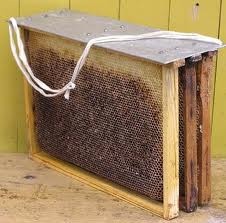
Died July 19, 2004

Source: Wikipedia – Ormond Aebi

Ormond Aebi (1916 – July 2004) was an American beekeeper who was reported to have set the world’s record for honey obtained from a single hive in one year, 1974, when 404 pounds of honey were harvested, breaking an unofficial 80-year-old record of 303 pounds held by A. I. Root. Together with his father Harry, the Aebi’s wrote two books on beekeeping: The Art and Adventure of Beekeeping (1975) and Mastering the Art of Beekeeping (1979) (both currently out-of-print).[1][2]

He was known to have enjoyed beekeeping all his life. In 1981, Mr. Aebi told the Santa Cruz Sentinel[6] he knew his bees so well that, when out driving, his father would say, ” “Ormond, isn’t that one of our bees?,” and I’ll say, “No, I don’t think so,” or “Yep, sure is.”

Ormond told me a curious story that day though, which I’ll retell just as he told it to me. Ormond was a character with very strong beliefs, beliefs that I don’t happen to share, but he was earnest and sincere and his beliefs do make for a good story. So here it is.

He said that Jesus came to him in a dream one night and told him that if he wanted to increase the productivity of his hives that he should attach a wire to the queen excluders of his hives. Jesus was very specific about the length of the wire and Ormond carefully complied with Jesus’ instructions.

For those who don’t know, the queen excluder is a series of parallel wires placed closely together in a bee hive. It sits between the lower brood boxes and the upper supers, the boxes where the honey is stored. It functions to keep the queen from laying eggs in the boxes that contain the honey in them. She’s too big to fit between the wires, but the worker bees can still come and go unimpeded.

So Ormond attaches the precisely measured wires to the queen excluders and waits. Sure enough, just as Jesus promised in the dream, the productivity of the hives increases significantly.

Ormond is a religious man, and so he doesn’t think it is too surprising that Jesus’ advice worked. He mentions his experience to his beekeeping friends, and word eventually reaches the biology department of Stanford University.

Stanford University finds it surprising, very surprising. They come to his home in Santa Cruz to investigate.

What the scientists eventually conclude is that somehow the wires that Ormond attached to his hives were acting as antennae, turning the hives into natural radios and piping in the local classical music radio station to the hives. The bees loved it. (KSCO AM 1080, if you’re curious, it is now a right-wing talk radio station. I wonder what effect Rush Limbaugh would have on honey production.)[7]

In his later years he was diagnosed with Diabetes, which did not seem to affect his health, but did contribute to his decision not to continue beekeeping when his swarms were destroyed by varroa mites. He worked as a part-time handyman at a daycare next door to his home for the last several years of his life, and continued to write to friends he made worldwide due to his books.

Source: Wikipedia – Ormond Aebi


Feel free to share this on:

  • Share on Facebook (Opens in new window) Facebook
  • Share on X (Opens in new window) X
  • Share on Pinterest (Opens in new window) Pinterest
  • Email a link to a friend (Opens in new window) Email
  • Share on LinkedIn (Opens in new window) LinkedIn
  • Share on Reddit (Opens in new window) Reddit
  • Share on Tumblr (Opens in new window) Tumblr
  • Print (Opens in new window) Print
  • Share on Telegram (Opens in new window) Telegram
  • Share on WhatsApp (Opens in new window) WhatsApp
Like Loading...

Exponential my dear Watson

08 Tuesday Feb 2022

Posted by Beekeeping365 in beekeeping

≈ Leave a comment

IMAG1683_BURST001

Exponential, my dear Watson.

Pardon the Sherlock Holmes paraphrase. But for the bees right now it’s “exponential.”

They take every food morsel inside the hive and everything they can gather from outside and bet it all. Nothing to be saved this time of year. Spendthrifts and gamblers. Betting the house on the upcoming nectar flow. Right now the nurse bees are eating as much as they can hold in an effort to maximize production of brood food. The queen is laying as much as she can and together a symphony is playing at breakneck speed.

If their timing is right they’ll reach a large population at the exact moment or just prior to the beginning of the nectar flow. Their goal – reproduction – swarming. Hopefully. Because if a freeze or extended stay inside occurs their exponentially large population can easily deplete their food supply since the nectar flow has not yet started. Interestingly, bees will share the food until it’s gone. But when it’s gone it’s gone and for the bees it’s not only their food but also the means by which they heat themselves and young. If the bees don’t time their buildup correctly, they risk en masse starvation.

Now, you’d think I’d be trying to discourage them from building up so fast. In some ways maybe I can and in other ways I can’t deter them from their program. But one thing I do regardless is keep supplying open comb to the queen. In turn she lays in it and makes more bees. Wait, wasn’t I suppose to be discouraging more hungry mouths?

Therein lies a management paradox for the beekeeper. We need more bees to make a large honey crop but more bees means more mouths to feed and the chance of starvation before the nectar flow begins. And more bees can also increase the likelihood of swarming – sorta. But by opening up the brood area and letting the queen lay they are less likely to swarm. So the dilemma is solving both issues by opening up her brood area AND keeping a close eye on the colony’s food stores. In essence, you, the beekeeper,  get to act like a bee and join the symphony too, playing as loudly as you wish.

Keep a close eye on them.

Feel free to share this on:

  • Share on Facebook (Opens in new window) Facebook
  • Share on X (Opens in new window) X
  • Share on Pinterest (Opens in new window) Pinterest
  • Email a link to a friend (Opens in new window) Email
  • Share on LinkedIn (Opens in new window) LinkedIn
  • Share on Reddit (Opens in new window) Reddit
  • Share on Tumblr (Opens in new window) Tumblr
  • Print (Opens in new window) Print
  • Share on Telegram (Opens in new window) Telegram
  • Share on WhatsApp (Opens in new window) WhatsApp
Like Loading...

Happy Birthday Charles Henry Turner by Ron Miksha

03 Thursday Feb 2022

Posted by Beekeeping365 in beekeeping, birthday, birthdays, famous beekeepers

≈ 1 Comment

Tags

bee biology, birthday, Charles Henry Turner, famous beekeepers, honey bee behavior

Charles Henry Turner (February 3, 1867 – February 14, 1923)

Here’s an excellent post by Ron Miksha of badbeekeeping blog recognizing a bee scientist who went unrecognized in his own time. Thanks Ron for bringing many of us up to speed.

You probably know that Karl von Frisch figured out how honey bees use their waggle-dance to communicate. He won the Nobel Prize for that and for other studies of bee behaviour. I think it was well-deserved and his experiments withstood criticism and independent confirmation. His discovery was intuitive and required hundreds of replicated experiments conducted over years of work in personally risky circumstances in Nazi Germany. But there is another scientist who came close to figuring out many of the things which brought von Frisch fame. The other scientist did his experiments in America, decades earlier. But he’s mostly unknown, largely forgotten.

Read entire article at: The Man Who Discovered that Bees Can Think — Bad Beekeeping Blog

Feel free to share this on:

  • Share on Facebook (Opens in new window) Facebook
  • Share on X (Opens in new window) X
  • Share on Pinterest (Opens in new window) Pinterest
  • Email a link to a friend (Opens in new window) Email
  • Share on LinkedIn (Opens in new window) LinkedIn
  • Share on Reddit (Opens in new window) Reddit
  • Share on Tumblr (Opens in new window) Tumblr
  • Print (Opens in new window) Print
  • Share on Telegram (Opens in new window) Telegram
  • Share on WhatsApp (Opens in new window) WhatsApp
Like Loading...

Happy Birthday George Whitfield Demaree

27 Thursday Jan 2022

Posted by Beekeeping365 in beekeeping, beekeeping author, famous beekeepers

≈ 2 Comments

Tags

beekeeping authors, famous beekeepers, George Demaree

demaree1-290x430
george demaree

Birth 27 Jan 1832

Henry County, Kentucky, USA
Death 14 Jan 1915 (aged 82)

Shelby County, Kentucky, USA
Burial
Christiansburg Cemetery

Christianburg, Shelby County, Kentucky, USA

George Whitfield Demaree was born January 27th, 1832 in Henry County Kentucky. As a beekeeper he is credited with the development of a method of swarm prevention which retains the total population of bees in their parent colony thus greatly increasing honey production. This can’t be emphasized enough – it takes lots of bees to maximize honey production. Other swarm methods which employ splits will adversely affect honey production.

Demaree, also known as “Mr. D” by his contemporaries – was a lawyer, magistrate, breeder of prize Jersey cattle, and a renowned beekeeper on his farm in Christianburg, Kentucky. He was a pioneer in “swarm control,” and his findings allowed bees to be transported out West for the pollination of crops that helped make permanent settlement possible.

The method was first published by in an article in the American Bee Journal in 1892. Demaree also described another swarm prevention method in 1884, but that was a two-hive system that is unrelated to modern “demareeing”.

As with many swarm prevention methods, demareeing involves separating of the queen and forager bees from the nurse bees. The theory is that forager bees will think that the hive has swarmed if there is a drastic reduction in nurse bees, and that nurse bees will think that the hive has swarmed if the queen appears to be missing and/or there is a drastic reduction in forager bees.

The Demaree method is a frame-exchange method, and as such it is more labor intensive than methods that do not involve rearranging individual frames. It requires no special equipment except for a queen excluder. In this method, the queen is confined to the bottom box below the queen excluder.

The method relies on the principle that nurse bees will prefer to stay with open brood, and that forager bees will move to frames with closed brood or with room for food.

In the modern Demaree method, the queen is placed in the bottom box, along with one or two frames of capped brood (but no open brood), as well as one or two frames of food stores, and empty combs or foundation. A queen excluder is placed above the bottom box, thereby restricting the queen to the bottom box but allowing bees to move freely between the bottom box and the rest of the hive. The original hive, along with all open brood, is placed above the queen excluder. The method works best if the nurse bees are remove far away from the queen. The distance between the queen and nurse bees can be increased by placing the brood nest at the very top of the hive, with honey supers between the upper brood nest and the queen excluder. If any swarm cells are present, these must be destroyed by the beekeeper. The relative absence of queen pheromone in the top box usually prompts the nurse bees to create emergency cells. After 7–10 days, the beekeeper destroys the emergency cells, and then either removes the queen excluder (thereby ending the “demaree”) or repeats the process a second or a third time until the swarming impulse is over. (Note: Developed queen cells in upper box could also be harvested for use after they are fully capped and ripe.)

The Demaree method makes it possible to retain the total colony population, thus maintaining good honey production. The technique has the advantage of allowing a new queen to be raised as well.

Ref: American Bee Journal, Wikipedia, Six Mile Creek History

Feel free to share this on:

  • Share on Facebook (Opens in new window) Facebook
  • Share on X (Opens in new window) X
  • Share on Pinterest (Opens in new window) Pinterest
  • Email a link to a friend (Opens in new window) Email
  • Share on LinkedIn (Opens in new window) LinkedIn
  • Share on Reddit (Opens in new window) Reddit
  • Share on Tumblr (Opens in new window) Tumblr
  • Print (Opens in new window) Print
  • Share on Telegram (Opens in new window) Telegram
  • Share on WhatsApp (Opens in new window) WhatsApp
Like Loading...

The Russian Scion

20 Thursday Jan 2022

Posted by Beekeeping365 in beekeeping, equipment, honey bee biology, management, swarms

≈ 9 Comments

Tags

bait hives, beekeeping, honey bee biology, management, scion, swarms

15994633_10209617034517523_2982209005431042923_o

Final stages of Scion creation.  Another coat of propolis, essential oils, and wax and it’s ready to hang.

After reading about the Russian Scion last year I have been eager to make and employ one in my own bee yard. Having used swarm traps with great success I know that swarms can often be retrieved before flying off. However, sometimes issuing swarms choose high branches or remain out of sight of the beekeeper. The scion adds another opportunity to the beekeeper prior to the swarm trap. Since I am home most days and walk my bee yard daily, hopefully I’ll be able to attract them to the easily retrievable scion, and hive them instead of relying on the traps which are also located on site. Below is a good post found on http://www.beesource.com posted by DocBB with some nice pictures:

I found a almost unknown device for us but which is of a common use in every Russian apiary is the “Scion” – (Привой и роевня)

It is a trap or a shelter to catch the swarm as early as possible without (may be) climbing trees.

Can you find it here on the plan?

There are many “designs” but it is commonly settled not far and in front of the hives entrances , one or several of them according to the size of the apiary

The traditional model is a 20-30 cm wide and 30-40 cm plank with one cleat fixed vertically in the middle , more or less rolled with burlap and coated with
alcoholic solution of propolis and flavoured with essential oils (lemongrass, etc.)

as on this blog

the “scion” is then hanged at around 2 to 2,5 m high.

It seems to work !

and the use of one or more old frame is not forbidden

or an old propolised burlap

Source: DocBB on www.beesource.com Forums

Feel free to share this on:

  • Share on Facebook (Opens in new window) Facebook
  • Share on X (Opens in new window) X
  • Share on Pinterest (Opens in new window) Pinterest
  • Email a link to a friend (Opens in new window) Email
  • Share on LinkedIn (Opens in new window) LinkedIn
  • Share on Reddit (Opens in new window) Reddit
  • Share on Tumblr (Opens in new window) Tumblr
  • Print (Opens in new window) Print
  • Share on Telegram (Opens in new window) Telegram
  • Share on WhatsApp (Opens in new window) WhatsApp
Like Loading...

Happy Birthday Johann Dzierzon

16 Sunday Jan 2022

Posted by Beekeeping365 in beekeeping, birthday, birthdays

≈ 5 Comments

Tags

beekeeping

As many of my beekeeping friends might remember, I started December vowing to answer to, and identify myself as, “Lorenzo” to reservation takers, waitresses, and others. I am pleased to report that this has worked out well, with the exception of that overly serious State Trooper, so I am extending the practice another month. But Lorenzo Langstroth’s birthday month has come and gone and it is time to pick another beekeeper to honor. I encourage anyone so inclined to participate in this exercise of giving and responding to the name of a famous beekeeper for the month. Who knows when a question on the Certified Beekeepers test may become a simple remembrance due to your participation in this venture. So, with no further delay, during the month of January I will give and respond to the name, “Johann” in honor of Johann Dzierzon born January 16th, 1811. Apparently he also went by the name “Jan” so try each out from time to time to see how that flies. Try it out, it’s pronounced exactly as it’s spelled. Hey, I’m not sure it matters.

Below Source: Wikipedia Entry

Johann Dzierzon (16 January 1811 – 26 October 1906), was a pioneering apiarist who discovered the phenomenon of parthenogenesis in bees and designed the first successful movable-frame beehive.

Dzierzon came from a Polish family in Silesia. Trained in theology, he combined his theoretical and practical work in apiculture with his duties as a Roman Catholic priest, before being compulsorily retired by the Church and eventually excommunicated.

His discoveries and innovations made him world-famous in scientific and bee-keeping circles, and he has been described as the “father of modern apiculture”.

Scientific career

Stack of Dzierzon hives. Illustration from Nordisk familjebok.

In his apiary, Dzierzon studied the social life of honeybees and constructed several experimental beehives. In 1838 he devised the first practical movable-comb beehive, which allowed manipulation of individual honeycombs without destroying the structure of the hive. The correct distance between combs had been described as 1½ inches from the center of one top bar to the center of the next one. In 1848 Dzierzon introduced grooves into the hive’s side walls, replacing the strips of wood for moving top bars. The grooves were 8 × 8 mm—the exact average between ¼ and ⅜ inch, which is the range called the “bee space.” His design quickly gained popularity in Europe and North America. On the basis of the aforementioned measurements, August Adolph von Berlepsch (de) (May 1852) in Thuringia and L.L. Langstroth (October 1852) in the United States designed their frame-movable hives.

In 1835 Dzierzon discovered that drones are produced from unfertilized eggs. Dzierzon’s paper, published in 1845, proposed that while queen bees and female worker bees were products of fertilization, drones were not, and that the diets of immature bees contributed to their subsequent roles.[15] His results caused a revolution in bee crossbreeding and may have influenced Gregor Mendel‘s pioneering genetic research.[16] The theory remained controversial until 1906, the year of Dzierzon’s death, when it was finally accepted by scientists at a conference in Marburg.[12] In 1853 he acquired a colony of Italian bees to use as genetic markers in his research, and sent their progeny “to all the countries of Europe, and even to America.”[17] In 1854 he discovered the mechanism of secretion of royal jelly and its role in the development of queen bees.

Bust of Jan Dzierżoń, National Museum of Agriculture in Szreniawa

With his discoveries and innovations, Dzierzon became world-famous in his lifetime.[14] He received some hundred honorary memberships and awards from societies and organizations.[12] In 1872 he received an honorary doctorate from the University of Munich.[14] Other honors included the Austrian Order of Franz Joseph, the Bavarian Merit Order of St. Michael, the Hessian Ludwigsorden, the Russian Order of St. Anna, the Swedish Order of Vasa, the Prussian Order of the Crown, 4th Class, on his 90th birthday, and many more. He was an honorary member of the German Academy of Sciences Leopoldina. He also received an honorary diploma at Graz, presented by Archduke Johann of Austria. In 1903 Dzierzon was presented to Emperor Franz Joseph I of Austria.[14] In 1904 he became an honorary member of the Schlesische Gesellschaft für vaterländische Kultur (“Silesian Society for Fatherland Culture”).

Dzierzon’s discoveries concerning asexual reproduction, as well as his questioning of papal infallibility, were rejected by the Church,[12] which in 1869 retired him from the priesthood.[18] This disagreement, along with his public engagement in local politics, led to his 1873 excommunication.[19] In 1884 he moved back to Lowkowitz, settling in the hamlet An der Grenze,[12] (Granice Łowkowskie).[20] Of his new home, he wrote:

In every direction, one has a broad and pleasant view, and I am pretty happy here, despite the isolation, as I am always close to my beloved bees — which, if one’s soul be receptive to the works of the Almighty and the wonders of nature, can transform even a desert into a paradise.[12]

From 1873 to 1902 Dzierzon was in contact with the Old Catholic Church,[12] but in April 1905 he was reconciled with the Roman Catholic Church.[12]

He died in Lowkowitz on 26 October 1906 and is buried in the local graveyard.[12]

Legacy

Dzierzon

Johann Dzierzon is considered the father of modern apiology and apiculture.[21] Most modern beehives derive from his design. Due to language barriers, Dzierzon was unaware of the achievements of his contemporary, L.L. Langstroth,[21] the American “father of modern beekeeping”,[22] though Langstroth had access to translations of Dzierzon’s works.[23] Dzierzon’s manuscripts, letters, diplomas and original copies of his works were given to a Polish museum by his nephew, Franciszek Dzierżoń.[9]

In 1936 the Germans renamed Dzierzon’s birthplace, Lowkowitz, Bienendorf (“Bee Village”) in recognition of his work with apiculture.[24] At the time, the Nazi government was changing many Slavic-derived place names such as Lowkowitz. After the region came under Polish control following World War II, the village would be renamed Łowkowice.

Following the 1939 German invasion of Poland, many objects connected with Dzierzon were destroyed by German gendarmes on 1 December 1939 in an effort to conceal his Polish roots.[10] The Nazis made strenuous efforts to enforce a view of Dzierżoń as a German.[11]

After World War II, when the Polish government assigned Polish names to most places in former German territories which had become part of Poland, the Silesian town of Reichenbach im Eulengebirge (traditionally known in Polish as Rychbach) was renamed Dzierżoniów in the man’s honor.[25]

In 1962 a Jan Dzierżon Museum of Apiculture was established at Kluczbork.[12] Dzierzon’s house in Granice Łowkowskie(now part of Maciejów village was also turned into a museum chamber, and since 1974 his estates have been used for breeding Krain bees.[12] The museum at Kluczbork houses 5 thousand volumes of works and publications regarding bee keeping, focusing on work by Dzierzon, and presents a permanent exhibition regarding his life presenting pieces from collections from National Ethnographic Museum in Wrocław, and Museum of Silesian Piasts in Brzeg[26]

More at: Source: Wikipedia Entry

Feel free to share this on:

  • Share on Facebook (Opens in new window) Facebook
  • Share on X (Opens in new window) X
  • Share on Pinterest (Opens in new window) Pinterest
  • Email a link to a friend (Opens in new window) Email
  • Share on LinkedIn (Opens in new window) LinkedIn
  • Share on Reddit (Opens in new window) Reddit
  • Share on Tumblr (Opens in new window) Tumblr
  • Print (Opens in new window) Print
  • Share on Telegram (Opens in new window) Telegram
  • Share on WhatsApp (Opens in new window) WhatsApp
Like Loading...

Ways to Succeed with your Bees

03 Monday Jan 2022

Posted by Beekeeping365 in beekeeping, education, mentoring

≈ Leave a comment

Tags

beekeeping, education, mentoring

1010599_652084358170944_544498104_n1

Several years ago, at the 2013 South Carolina Beekeepers Conference, I attended a presentation given by Florida Agricultural’s “Hall of Fame,” 3rd generation beekeeper, and recently passed away (February, 2022) Chief Apiary Inspector Lawrence Cutts.

The audience literally groaned as he described at length, one by one, all the negative aspects of beekeeping: the viruses, mites, increased costs, and various diseases. After each lengthy, gruesome description of a malady he raised his voice and proclaimed,

“Never before, in all my years, have I been so excited to be a beekeeper.”

Finally, after much more deliberation, he gave up the punchline: “Why be excited? Because never before in all my life has beekeeping enjoyed the attention it is getting today in the media and public eye.”

The point being, beekeepers are enjoying the attention and support as never before. Beekeeping organizations on all levels are being gifted with a wonderful resource of an ever increasing number of enthusiastic beginners eager to take on the tasks of learning both the science and the art of beekeeping. It is, indeed, an exciting time to be a beekeeper. Clubs and associations have won the lottery with the influx of excited newcomers and the many talents they bring to our organizations.

Can we as local and state organizations meet the needs of these beginning beekeepers and move them towards success in their new interest? Talking with some of our older association members, I’ve learned that at one time interest in local beekeeping was much less than seen today. Meetings were small enough they could be held in any small group room, and sometimes a beginner came. In those days a mentor usually coupled with a beginner and taught them the basics. I looked into this mentoring model of teaching and discovered that it wasn’t uncommon for a new beekeeper to visit the mentor’s bee yard for a season before getting their own bees. And once the mentee received their bees, either through a spring split or swarm the next year, they may have left them at the mentor’s bee yard over the mentee’s second year to work in the presence of the mentor with appropriate guidance.

Times change and nowadays we find ourselves needing ever more mentors to serve our new members. Ironically, as pointed out by Lawrence Cutts, the new beekeeper today has been drawn to a hobby that has increased in difficulty due to an increase in pests, chemicals, lack of forage areas, and increased costs.

Simply stated, the job of mentoring is getting bigger and bigger, beekeeping is ever more complex, and new beekeepers are joining and needing our support more than ever before. All the while, the need for mentors is far outpacing an ever dwindling supply.

To complicate matters, not only has there been in increase in beginning beekeepers, most new beekeepers wish to start their own hives the first year at their homes. I do find the occasional member that started by visiting a mentor’s bee yard for their first year, or spent a year attending club meetings and activities but that seems to be the exception to the rule.

This mentee/mentor dilemma needs solutions to help the new beekeeper become successful. While there are things mentors and clubs can do to help new beekeepers be successful, here I will focus my attention on the new beekeeper and their role in getting themselves through that first year and beyond.

Surfing the web, and various discussion boards, the prospective beekeeper looking for advice is repeatedly told, 1) join a club and 2) get a mentor. That’s good advice but it falls far short. Joining a club is great but sending in your $10 won’t get you any closer to becoming a better beekeeper. And just finding a mentor won’t either unless he’s a good friend or neighbor that’s willing to swap lessons for apple pies. First of all, the number of experienced beekeepers is far fewer than the number of new beekeepers. Add to that that most experienced beekeepers have bees to take care of themselves, limited free time like most, and finding one that is close enough and willing to teach a new beekeeper may be a challenge – finding one that has the heart and willingness to make home visits is like finding gold!

I’m going to suggest a new angle towards getting the new, prospective beekeeper everything they need to find success in this challenging mix of science and art we call beekeeping.

  1. The new beekeeper should find a local club or association and start attending meetings. Local clubs provide opportunities to learn. See if your local club is a fit for you. Are meetings educational? Is time made at each meeting to allow you to network to find a bee buddy or mentor? If you don’t feel it’s a good fit then look elsewhere for a club that fits or join multiple local clubs.
  2. Start your search for a good beginning beekeeper class. Half-day or single day classes are good for determining if beekeeping is something you’d like to learn. Better introductory beekeeping classes span multiple evenings or weekends and offer or encourage Master Beekeeping Program Certified testing. If you’re more advanced look for a club that provides intermediate level topics at meetings or pushes their members towards Journeyman level material and courses. If your local club minimizes education, look for a class at the next closest club and attend their meetings too. The drive may be worthwhile.
  3. Sign up and take the next beginning beekeeper class offered. Read the handouts; read the book. Don’t be satisfied to be spoon fed the information and don’t limit yourself to only the information in the class. Consider this class your toe in the door, your introduction, the beginning of your adventure. Beekeeping is challenging with a steep and expensive learning curve; challenge yourself to learn this craft.
  4. Visit your local library and check out books on beekeeping. You will find some entertaining, some are scientific, and some histories. Read all that you find helpful.
  5. Decide right now that coming to monthly meetings is an important part of your continuing beekeeping education. Monthly meetings are opportunities to learn. Miss one at your own risk. Many club meeting topics follow the bee’s annual cycle through the seasons. Important things to do and observe are discussed at meetings. The meeting you miss may be the one that offers the information you needed to hear that month.
  6. Volunteer for club activities. Club activities are opportunities to learn. If your club offers community outreach at festivals and events talk to your club’s event coordinator. Volunteer to work with someone else “talking bees” with the public. If you took the beginning beekeeper class you know 100% more than the general population. Listen to the experienced volunteer you are paired with and learn from them. Talk with them during breaks. If you enjoy speaking to children there is real need to visit with elementary classes. Senior centers also appreciate visits and often contact clubs to schedule brief talks.
  7. Watch your bees. Even if you aren’t going inside the hive. Get a chair and sit and watch them coming and going. Soak it in. At first you’ll not have anything to compare their coming and going with. As the seasons progress, nectar flows begin and end, temperatures change, their behavior will change as well. Soon you will notice subtle changes in their behavior on the landing board. With time you’ll know when something’s wrong and needs further inspection – just by watching them.
  8. If your club has social events like pre meeting dinners, occasional social events, or days in the bee yard, attend them. Club social events are opportunities to learn and meet other beekeepers. Beekeepers tend to want to talk about bees – exhaustively. Only other beekeepers want to talk about bees as much as you. You will learn a lot talking with others at these events. Bee social. Network.
  9. Find a bee buddy. A bee buddy may be another first year beekeeper in your neighborhood or a second year beekeeper that lives close by. Your bee buddy is the one you call when your hive swarms and you need to borrow a box. A bee buddy is someone to visit and look at their hives; they come over and look at yours too. Bee buddies show you how to do new things with your bees. Find a bee buddy at meetings, events, or during meeting fellowship time.
  10. Enter your hives as often as is prudent. During some seasons the bees are docile and tolerant of your intrusions. In the spring visit them often – even every week. When you enter the hive go in with an idea of what you wish to accomplish in mind. What do you want to observe? The first few times you will be so filled with excitement you’ll forget to look for those things you set as your goal. That’s okay, look on your next visit. There are other seasons when the bees are best left alone such as when they are arranging and securing their winter home or during colder months. Take every opportunity to observe them.
  11. Join your club’s online discussion group if it has one. You’ll find quick answers to questions you have. Often a photo and description to the group will result in helpful responses or allay your anxiety about something you’ve never seen before. If you do have an emergency often a club member can swing by after work and take a look. Both girls and guys participate in forums and sometimes you find that you’re neighbors!
  12. Read your club’s newsletter. Local happenings are listed. Important dates too. Sale ads and articles of interest as well as your club’s minutes, scheduled speakers and topics keep you informed. Often the club will have an article or beekeeping calendar directly related to seasonal beekeeping letting you know what to observe and do in your hives that month.
  13. Attend local educational offerings. Local educational offerings are opportunities to learn. Some clubs  bring in out-of-town speakers for special topics of interest. Other times clubs or local beekeepers offer day classes on specific topics of interest: Queen rearing, Moving hives, Making Splits, Africanized bees, oh my!
  14. Attend state conferences. Conferences are opportunities to learn. Even if you can’t stay for two and a half days, at least go for a single day. The information you hear will be from seasoned beekeepers and scholars in bee research from around the country. They have a knack for breaking it down for us simple beekeepers though so it all works out. Have lunch with fellow beekeepers. If you overnight, find out where your club or neighboring club will be having dinner and socialize. Carpool with your bee buddy. Hang out in the hotel lobby and talk bees until late.
  15. You may never need  if you’re doing all of the above, but if you do: Email your club’s Secretary to see if a bee buddy or mentor lives close to you. Preferably one that also attends meetings. Sit with them, or watch and listen to them teach at the front of the room. If you don’t understand something ask after the meeting. Offer to help do hard work like pulling supers, rotating boxes, or extracting honey. Tell them you’ll gladly help with their next swarm retrieval. Ask them tough questions that show your enthusiasm and that you’re making every effort to learn. If they know you’re dedicated to learning, attending, and making an effort it makes all the difference in the world.
  16. Set high goals for yourself; going from mentee to mentor. Take on the challenge of the Master Beekeeping Program which will guide you to becoming a better beekeeper. After your beginning course, take the Certified level testing. After a period of time you will feel more comfortable with your beekeeping and should take the next step towards Journeyman Certification. Become a mentor by volunteering as a club officer, presenting at a club event, or taking on a mentee yourself. Teaching and serving is an educational opportunity for you as well as for others. It’s also your opportunity to give back and grow from mentee to mentor in whatever job role you feel comfortable.

In the end it’s all about learning about bees, their biology, behavior, and management. Along with that come the seasons, foliage, the bees’ cousins, and foes. Beekeeping is both fun and challenging. It’s learning the biology of animal husbandry along with the age old craft of keeping bees. The new beekeeper that wants to succeed should throw themselves into learning this craft by taking advantage of every opportunity that presents itself rather than assume it will come as a result of passive learning. Today’s prospective beekeeper has more resources that ever before: monthly meetings, progressive educational offerings, club outreach opportunities, fellowship, books, YouTube videos, discussion groups, conferences, and more. Take advantage of every offering available and you will succeed. Now, get to a meeting!

Feel free to share this on:

  • Share on Facebook (Opens in new window) Facebook
  • Share on X (Opens in new window) X
  • Share on Pinterest (Opens in new window) Pinterest
  • Email a link to a friend (Opens in new window) Email
  • Share on LinkedIn (Opens in new window) LinkedIn
  • Share on Reddit (Opens in new window) Reddit
  • Share on Tumblr (Opens in new window) Tumblr
  • Print (Opens in new window) Print
  • Share on Telegram (Opens in new window) Telegram
  • Share on WhatsApp (Opens in new window) WhatsApp
Like Loading...

Lorenzo Langstroth’s Birthday

25 Saturday Dec 2021

Posted by Beekeeping365 in beekeeping, beekeeping equipment, beekeeping history, birthday

≈ 1 Comment

Tags

beekeeping, beekeeping books, beekeeping history, birthday, famous beekeepers, Langstroth, Lorenzo Langstroth's birthday, The Hive and the Honey Bee

toast to langstroth

A Toast to Langstroth

This year, beekeepers are celebrating the 213th year anniversary of “the Father of American Beekeeping.” Lorenzo Lorraine Langstroth was born Christmas Day, December 25, 1810 in Philadelphia, Pennsylvania. L. L. Langstroth developed the modern hive after exploring existing hives including the pre-cursor to the top bar hive. Francis Huber invented the Leaf Hive in 1789 in Switzerland. The leaf hive had movable solid frames that touched making the box like top bar hives. The leaf hive was examined like pages in a book.

(photo: In 2010 the Philadelphia Beekeepers Guild began a wonderful Christmas tradition. They gather each year at 106 South Front Street, Philadelphia; the birthplace of Lorenzo L. Langstroth on Christmas Day, which is also Langstroth’s birthday, for a Champagne / mead toast to Langstroth.) A Toast to Langstroth)

In the summer of 1851 Langstroth developed the hive that is still used today and the “bee space.” Langstroth patented the first movable frame hive on October 5, 1852. Henry Bourquin, a fellow beekeeper and Philadelphia cabinetmaker, made Langstroth’s first hives. Langstroth hives encourage rapid inspection without enraging the bees. Weak colonies can be strengthened. Strong colonies can increase space. Queens are quickly replaced. Diseases, pests and parasites can be quickly determined and remedied. Inspection by removable frames is now required in the United States. Langstroth also began using queen excluders to confine eggs to the lower boxes. Removable frames encouraged honey extraction without destroying the comb. Honey comb requires 7 to 14 pounds of honey for every pound of beeswax. Besides increased honey production, the beehive no longer had to be killed to remove the honey.

Langstroth published “The Hive and the Honey-Bee” in 1853 still in print today after 40 editions. Langstroth died October 6, 1895 while preaching a sermon on the love of God at the Wayne Avenue Presbyterian church in Dayton. L. L. Langstroth is buried at Woodland Cemetery, Dayton, Ohio. Langstroth’s epitaph reads —

Langstroth

INSCRIBED TO THE MEMORY OF REV. L.L. LANGSTROTH, “FATHER OF AMERICAN BEEKEEPING,” BY HIS AFFECTIONATE BENEFICIARIES WHO, IN THE REMEMBRANCE OF THE SERVICES RENDERED BY HIS PERSISTENT AND PAINSTAKING OBSERVATIONS AND EXPERIMENTS WITH THE HONEY BEE, HIS IMPROVEMENTS IN THE HIVE, AND THE LITERARY ABILITY SHOWN IN THE FIRST SCIENTIFIC AND POPULAR BOOK ON THE SUBJECT OF BEEKEEPING IN THE UNITED STATES, GRATEFULLY ERECT THIS MONUMENT.

Langstroth_Hive_Honey-Bee_1206

Ebook:  The Hive and the Honey Bee

Audio recording: The Hive and the Honey Bee

Feel free to share this on:

  • Share on Facebook (Opens in new window) Facebook
  • Share on X (Opens in new window) X
  • Share on Pinterest (Opens in new window) Pinterest
  • Email a link to a friend (Opens in new window) Email
  • Share on LinkedIn (Opens in new window) LinkedIn
  • Share on Reddit (Opens in new window) Reddit
  • Share on Tumblr (Opens in new window) Tumblr
  • Print (Opens in new window) Print
  • Share on Telegram (Opens in new window) Telegram
  • Share on WhatsApp (Opens in new window) WhatsApp
Like Loading...

Winter Solstice for Bees

20 Monday Dec 2021

Posted by Beekeeping365 in management, nectar flow, spring buildup, swarms

≈ Leave a comment

Tags

management, swarms

Bees in March
Bees in March
Bubbling over! These bees are overdue for some spring nectar!
Beginning of bloom
Beginning of bloom

Winter Solstice – A Day for Beekeeper Celebration. Today, we enter the season of growth!

In Columbia, South Carolina, the Winter Solstice will begin today, Sunday, December 21, at 10:03 A.M. EST. The Winter Solstice means something different to honey bees and to beekeepers. It’s typically associated with the beginning of winter for most people but for the bees, and beekeepers, it’s the beginning of spring.

Late dawn. Early sunset. Short day. Long night. In the Northern Hemisphere, the Winter Solstice marks the longest night and shortest day of the year. (On the same date the Southern Hemisphere has its longest day and shortest night.) But tomorrow the days will begin lengthening.

Winter Solstice means something different to beekeepers. It’s typically associated with the beginning of winter for humans. But for the bees it’s the beginning of spring. For beekeepers in the Northern Hemisphere today marks the beginning of growth.

Very slowly, as the days begin to lengthen, the queen will begin to increase in the number of eggs she lays. On a colony level, for the bees, the goal is to have a full staff of bees ready to reproduce on a colony level (i.e. swarm) at the beginning of the coming nectar and pollen flow. This gives the swarming bees the best chance of survival.

In preparation for this reproductive event, brood rearing begins during the first months of the new year resulting in hives bubbling over with bees by early March. But this increase in population and reproductive stimulation has other ramifications for the beekeeper wishing to discourage that workforce from leaving.

The beekeeper seeks to:
1) encourage population growth to make a good honey crop while
2) protect the colony from starvation as the bees burn through their stores
in order to feed ever increasing numbers of larvae, while
3) discouraging upcoming swarm preparations.

In short, your goal is to encourage an expanding bee population, monitor their food stores, and as February and March approach, to try to keep their minds off swarming. It’s like walking a tightrope!

Feel free to share this on:

  • Share on Facebook (Opens in new window) Facebook
  • Share on X (Opens in new window) X
  • Share on Pinterest (Opens in new window) Pinterest
  • Email a link to a friend (Opens in new window) Email
  • Share on LinkedIn (Opens in new window) LinkedIn
  • Share on Reddit (Opens in new window) Reddit
  • Share on Tumblr (Opens in new window) Tumblr
  • Print (Opens in new window) Print
  • Share on Telegram (Opens in new window) Telegram
  • Share on WhatsApp (Opens in new window) WhatsApp
Like Loading...

Happy Birthday Emily Dickinson

10 Friday Dec 2021

Posted by Beekeeping365 in beekeeping history, birthday, birthdays

≈ Leave a comment

Tags

beekeeping history, birthday, Emily Dickinson, The Bee

Happy Birthday Emily Dickinson – Born Dec. 10, 1830

The Bee
By Emily Dickinson

Like trains of cars on tracks of plush
I hear the level bee:
A jar across the flowers goes,
Their velvet masonry
Withstands until the sweet assault
Their chivalry consumes,
While he, victorious, tilts away
To vanquish other blooms.
His feet are shod with gauze,
His helmet is of gold;
His breast, a single onyx
With chrysoprase, inlaid.
His labor is a chant,
His idleness a tune;
Oh, for a bee’s experience
Of clovers and of noon!
…
A team of archaeologists is rediscovering just how extensive Emily Dickinson’s garden was. Historical evidence shows Emily Dickinson’s Garden contained an abundance of blooming flowers. Archaeologists recently uncovered portions of a pathway leading to nineteenth-century flower and vegetable beds.Emily Dickinson – was an American poet born in Amherst, Massachusetts. (December 10, 1830 – May 15, 1886) ~ during her lifetime she “was known more widely as a gardener, perhaps, than as a poet”. Emily Dickinson’s niece, Martha Dickinson Bianchi, remembered “carpets of lily-of-the-valley and pansies, platoons of sweetpeas, hyacinths, enough in May to give all the bees of summer dyspepsia. There were ribbons of peony hedges and drifts of daffodils in season, marigolds to distraction—a butterfly utopia” Archaeology – Remnants of Emily Dickinson’s Gardens Sought

AMHERST, MASSACHUSETTS—Emily Dickinson is known today as one of the greatest poets of the nineteenth century, but in her lifetime she may have been more renowned for her gardening. At her family estate, she helped to tend an orchard, a greenhouse, and an expanse of flower and vegetable gardens. The size of these gardens was dramatically decreased in the decades after Dickinson died in 1886, but now a team of archaeologists is searching for their remnants. Last summer, they uncovered portions of a pathway leading to nineteenth-century flower and vegetable beds. “If we can follow out the historic path to its end, then theoretically we would find the location of past gardens,” Kerry Lynch of Archaeological Services at the University of Massachusetts, Amherst, told the New York Times. If they do locate these gardens, the archaeologists hope to find seeds or other botanical evidence dating back to when Dickinson was alive.

Source:
Archaeology – Remnants of Emily Dickinson’s Gardens Sought
http://www.archaeology.org/news/4458-160513-massachusetts-dickinson-gardens

Emily Dickinson
https://en.wikipedia.org/wiki/Emily_Dickinson


Feel free to share this on:

  • Share on Facebook (Opens in new window) Facebook
  • Share on X (Opens in new window) X
  • Share on Pinterest (Opens in new window) Pinterest
  • Email a link to a friend (Opens in new window) Email
  • Share on LinkedIn (Opens in new window) LinkedIn
  • Share on Reddit (Opens in new window) Reddit
  • Share on Tumblr (Opens in new window) Tumblr
  • Print (Opens in new window) Print
  • Share on Telegram (Opens in new window) Telegram
  • Share on WhatsApp (Opens in new window) WhatsApp
Like Loading...

Happy Birthday Amos I. Root

09 Thursday Dec 2021

Posted by Beekeeping365 in beekeeping history, birthday, birthdays, famous beekeepers

≈ Leave a comment

Tags

A.I. Root, beekeeping authors, beekeeping books, beekeeping history, biography, famous beekeepers


12313960_937545866299910_8189717203741958046_n

Amos Ives Root – Born December 9, 1839 (1839–1923)

Biography of A. I. Root
Written by E. R. Root

A. I. Root was born in a log house, December 9, 1830, about two miles north of the present manufacturing plant of The A. I. Root Co. He was a frail child, and his parents had little hopes of raising him to manhood, although some of the neighbors said his devoted mother would not let him die. As he grew older his taste for gardening and mechanics became apparent. Among his early hobbies were windmills, clocks, poultry, electricity, and chemistry —anything and everything in the mechanical line that would interest a boy who intensely loved machinery. Later on we find him experimenting in electricity and chemistry; and at 18 he is out on a lecturing-tour with a fully equipped apparatus of his own construction.

We next find Mr. Root learning the jeweler’s trade, and it was not long before he decided to go into business for himself. He accordingly went to an old gentleman who loaned money, and asked him if he would let him have a certain amount of money for a limited time. This friend agreed to lend him the amount, but he urgently advised him to wait a little and earn the money by working for wages. This practical piece of advice, coming as it did at the very beginning of his career, was indeed a God-send, and. unlike most boys, he decided to accept it. Imbued with a love for his work, and having indomitable push, he soon earned enough to make a start in business, without borrowing a dollar. The business prospered till A. I. Root & Co. were the largest manufacturers of real coin-silver jewelry in the country. From $200 to $300 worth of coin was made weekly into rings and chains, and the firm employed something like 15 or 20 men and women.

It was about this time, or in 1865, that a swarm of bees passed over his shop; but as this incident is given so fully in the introduction I omit it here. Not long after he became an A B C scholar himself in bees, he began to write for the American Bee Journal under the nom de plume of “Novice.” In these papers he recounted a few of his successes and many of his failures with bees. His frank confession of his mistakes, his style of writing, so simple, clear, and clean-cut, brought him into prominence at once. So many inquiries came in that he was finally induced to start a journal, entitled Gleanings in Bee Culture of this, now his business grew to such a size that the manufacturing plant alone covered five acres, and employed from 100 to 200 men —all this and more is told in the Introduction by the writer.

As an inventor Mr. Root has occupied quite a unique field. He was the first to introduce the one pound-section honey-box, of which something like 50,000,000 are now made annually. He made the first practical ail-metal honey-extractor. This he very modestly styled the “Novice,” a machine of which thousands have been made and are still made. Among his other inventions may be named the Simplicity hive, the Novice honey-knife, several reversible frames, and the metal-cornered frame. The last named was the only invention he ever patented, and this he subsequently gave to the world long before the patent expired.

In the line of horticultural tools he invented a number of useful little devices which he freely gave to the public. But the two inventions which he considers of the most value is one for storing up heat, like storing electricity in a storage battery, and another for disposing of sewage in rural districts. The first named is a system of storing up the heat from exhaust steam in Mother Earth in such a way that greenhouses and dwelling-houses can be heated, even after the engine has stopped at night, and for several days after. The other invention relates to a method of disposing of the sewage from indoor water-closets so that “Mother Earth,” as he calls it, will take it automatically and convert it into plant life, without the least danger to health or life, and that, too, for a period of years without attention from any one.

Some of the secrets of his success in business may be briefly summed, up by saying that it was always his constant aim to send goods by return train, and to answer letters by return mail, although, of course, as the business continued to grow this became less and less practicable. He believed most emphatically in mixing business and religion—in conducting business on Christian principles; or to adopt a modern phrase, doing business “as Jesus would do it.” As might be expected, such a policy drew an immense clientage, for people far and wide believed in him. But how few, comparatively, in this busy world, go beyond the practice that honesty is the best policy! While A. 1. Root believed in this good rule he did not think it went far enough, and, accordingly, tried to adopt and live the Golden Rule.

The severe strain of long hours of work, together with constantly failing health, compelled Mr. Root to throw some of the responsibilities of the increasing business on his sons and sons-in-law. This was between 1886 and 1890. At no definite time could it be said that there was a formal transfer of the management of the supply business and the management of the bee department of Gleanings to his children; but as time went on they gradually assumed the control, leaving him free to engage in gardening and other rural pursuits, and for the last ten years he has given almost no attention to bees, devoting nearly all his time to travel and to lighter rural Industries. He has written much on horticultural and agricultural subjects; indeed, it is probable that he has done more writing on these subjects than he ever did on bees.

Note: He did not invent a section box for holding honey, but only a box just the right size to put 8 into a Langstroth frame.

For the last twenty-five years he has been writing a series of lay sermons, touching particularly on the subject of mixing business and religion, work and wages, and, in general, the great problem of capital and labor. As an employer of labor he had here a large field for observation, and well has he made use of it. Perhaps no series of articles he ever wrote has elicited a more sympathetic response from his friends all over this wide world than these same talks; and through these he has been the means of bringing many a one into the fold of Christ.

It has been a rather difficult matter to get a picture that was in any way satisfactory to the members of his family. Finally the writer, one day, with a Kodak, took a “time view” of him in his favorite place of resort, the greenhouse, among his “posies,” where he spends hours of his happiest moments. This view shows him just as he appears around home in his everyday work clothes. Ill health, or a sort of malaria that has been hanging about him for years, has forced him. during winter, to wear a fur cap and to keep his overcoat constantly on, indoors and outdoors, with the collar turned up.

Mr. Root, ever since his conversion, in 1875 has been a most active working Christian. No matter what the condition of his health, he is a regular attendant at church and prayer-meeting. He takes great interest in all lines of missionary work, and especially in the subject of temperance. He annually gives considerable sums of money to support the cause of missions, and to the Ohio Antisaloon League; and now that the heavier responsibilities of the business have been lifted from his shoulders he is giving more and more of his time and attention to sociological problems.—E. R. Root.Source:
The ABC of Bee Culture, page 438, 1903

Online Books by A.I. Root:

Root, A. I. (Amos Ives), 1839-1923: The ABC of Bee Culture: A Cyclopaedia of Everything Pertaining to the Care of the Honey-Bee: Bees, Honey, Hives, Implements, Honey-Plants, etc.; Facts Gleaned From the Experiences of Thousands of Bee Keepers All Over Our Land, Afterward Verified by Practice Work in Our Own Apiary (100th thousand; Medina, OH: A. I. Root Co., 1905)

More at: The Online Books Page – A.I. Root

Feel free to share this on:

  • Share on Facebook (Opens in new window) Facebook
  • Share on X (Opens in new window) X
  • Share on Pinterest (Opens in new window) Pinterest
  • Email a link to a friend (Opens in new window) Email
  • Share on LinkedIn (Opens in new window) LinkedIn
  • Share on Reddit (Opens in new window) Reddit
  • Share on Tumblr (Opens in new window) Tumblr
  • Print (Opens in new window) Print
  • Share on Telegram (Opens in new window) Telegram
  • Share on WhatsApp (Opens in new window) WhatsApp
Like Loading...

Blenheim bees – news article and response — Oxfordshire Natural Beekeeping Group

15 Monday Nov 2021

Posted by Beekeeping365 in beekeeping

≈ Leave a comment

As the local natural beekeeping group, we’ve got to know and respect Filipe. The recent article in The Guardian about his findings at Blenheim has led to some heated debate in the Twittersphere. In the following article, Guy Thompson addresses some of the controversy. By Guy Thompson This piece in the Observer has caused a […]

Blenheim bees – news article and response — Oxfordshire Natural Beekeeping Group

Feel free to share this on:

  • Share on Facebook (Opens in new window) Facebook
  • Share on X (Opens in new window) X
  • Share on Pinterest (Opens in new window) Pinterest
  • Email a link to a friend (Opens in new window) Email
  • Share on LinkedIn (Opens in new window) LinkedIn
  • Share on Reddit (Opens in new window) Reddit
  • Share on Tumblr (Opens in new window) Tumblr
  • Print (Opens in new window) Print
  • Share on Telegram (Opens in new window) Telegram
  • Share on WhatsApp (Opens in new window) WhatsApp
Like Loading...

Quote

The Honeybee and the Maple Tree by Rock Bridges Trees

12 Friday Nov 2021

Posted by Beekeeping365 in beekeeping

≈ 2 Comments

Tags

maples, trees for bees

The Honeybee and the Maple Tree have an interesting relationship. In the very early spring when the perfect combination of freezing nights and warm days allow, the maple tree runs sap. This process is what allowed the ancient Americans to learn to harvest maple sap to create Maple Syrup and Maple Sugar.

All of our North American maples produce a sweet sap in the spring. The Sugar Maple-Acer saccharum is the most famous. Sugar Maple has the highest sugar content and is the most efficient source for sap to make Maple Syrup. Red maples and Silver Maples are the other two large maple species that are most familiar to us and likely to produce sap for the bees.

Read the complete article here: The Honeybee and the Maple Tree — Rock Bridges Trees

Feel free to share this on:

  • Share on Facebook (Opens in new window) Facebook
  • Share on X (Opens in new window) X
  • Share on Pinterest (Opens in new window) Pinterest
  • Email a link to a friend (Opens in new window) Email
  • Share on LinkedIn (Opens in new window) LinkedIn
  • Share on Reddit (Opens in new window) Reddit
  • Share on Tumblr (Opens in new window) Tumblr
  • Print (Opens in new window) Print
  • Share on Telegram (Opens in new window) Telegram
  • Share on WhatsApp (Opens in new window) WhatsApp
Like Loading...

A Metaphysical Life by Bad Beekeeping Blog

05 Friday Nov 2021

Posted by Beekeeping365 in beekeeping, birthday, birthdays

≈ 1 Comment

Tags

beekeeping, birthday, Dr. Richard Taylor, famous beekeepers

Happy Birthday Richard Taylor.

Richard Taylor (November 5, 1919 – October 30, 2003), born in Charlotte, Michigan, was an American philosopher renowned for his dry wit and his contributions to metaphysics. He was also an internationally known beekeeper.

Today is the  anniversary of the birth of one of my beekeeper-heroes, Professor Richard Taylor. He was an early champion of the round comb honey system, a commercial beekeeper with just 300 hives, and he was a philosopher who wrote the book on metaphysics. Really, he wrote the book on metaphysics – for decades, his college text Metaphysics introduced first-year philosophy students to the most fundamental aspect of reality – the nature of cosmology and the existence of all things.

Although his sport of philosophy was speculative, unprovable, and abstract to the highest degree, Richard Taylor was as common and down-to-earth as it’s possible to become. I will write about his philosophy and how it shaped his politics, but first, let’s celebrate his beekeeping.

Read the complete article at: A Metaphysical Life — Bad Beekeeping Blog

Feel free to share this on:

  • Share on Facebook (Opens in new window) Facebook
  • Share on X (Opens in new window) X
  • Share on Pinterest (Opens in new window) Pinterest
  • Email a link to a friend (Opens in new window) Email
  • Share on LinkedIn (Opens in new window) LinkedIn
  • Share on Reddit (Opens in new window) Reddit
  • Share on Tumblr (Opens in new window) Tumblr
  • Print (Opens in new window) Print
  • Share on Telegram (Opens in new window) Telegram
  • Share on WhatsApp (Opens in new window) WhatsApp
Like Loading...

The nobility of keeping bees: Henry David Thoreau

04 Thursday Nov 2021

Posted by Beekeeping365 in beekeeping, beekeeping history

≈ Leave a comment

Tags

Henry David Thoreau

Jim Stovall's avatarThe Generous Beekeeper

Henry David Thoreau Henry David Thoreau

There are certain pursuits which, if not wholly poetic and true, do at least suggest a nobler and finer relation to nature than we know. The keeping of bees, for instance.

Henry David Thoreau

View original post

Feel free to share this on:

  • Share on Facebook (Opens in new window) Facebook
  • Share on X (Opens in new window) X
  • Share on Pinterest (Opens in new window) Pinterest
  • Email a link to a friend (Opens in new window) Email
  • Share on LinkedIn (Opens in new window) LinkedIn
  • Share on Reddit (Opens in new window) Reddit
  • Share on Tumblr (Opens in new window) Tumblr
  • Print (Opens in new window) Print
  • Share on Telegram (Opens in new window) Telegram
  • Share on WhatsApp (Opens in new window) WhatsApp
Like Loading...

Happy Birthday Albert J. Cook

30 Monday Aug 2021

Posted by Beekeeping365 in beekeeper, beekeeper education, beekeeping, beekeeping history, birthday, birthdays

≈ Leave a comment

Tags

beekeeping, beekeeping history

albert_j__cook_educator

Birth: Aug. 30, 1842
Michigan, USA
Death: Sep. 29, 1916
Shiawassee County
Michigan, USA

Albert J. Cook (1842-1916) was a 19th century educator and writer who influenced an entire generation of American beekeepers. He served as an instructor at Michigan Agricultural College (Michigan Agricultural University) in 1866 (Michigan State University later) where he offered one of the first collegiate courses in beekeeping culture.

Cook published the first textbook on American beekeeping, The Manual of the Apiary, in 1876 based upon his lecture series. The book was an instant success. Beginning as a mere brochure, this textbook expanded through ten editions in less than a decade, growing with each edition.

Albert J. Cook, professor of zoology and entomology, established the insect collection at Michigan Agricultural College (Agricultural University of Michigan) in 1867. By 1878, the collection consisted of nearly 1,200 local specimens collected primarily used for demonstration classrooms, for comparison, and to aid in species identification for farmers Michigan.

External links

  • Works by or about Albert John Cook at Internet Archive

Bibliography

  • Manual of the apiary. Chicago: Newman & Son (1880).
  • Wintering bees. Lansing: Agricultural College of Michigan (1885).
  • Report of apicultural experiments in 1891. (1892).
  • The Bee-Keeper’s Guide; or Manual of the Apiary pp. 543. (17th ed.) Chicago: Newman & Son (1902).

Source: http://beekeeping.wikia.com/wiki/Albert_J._Cook

Feel free to share this on:

  • Share on Facebook (Opens in new window) Facebook
  • Share on X (Opens in new window) X
  • Share on Pinterest (Opens in new window) Pinterest
  • Email a link to a friend (Opens in new window) Email
  • Share on LinkedIn (Opens in new window) LinkedIn
  • Share on Reddit (Opens in new window) Reddit
  • Share on Tumblr (Opens in new window) Tumblr
  • Print (Opens in new window) Print
  • Share on Telegram (Opens in new window) Telegram
  • Share on WhatsApp (Opens in new window) WhatsApp
Like Loading...

Happy Birthday Maurice Maeterlinck

29 Sunday Aug 2021

Posted by Beekeeping365 in beekeeper, beekeeper education, beekeeping, beekeeping history, biography, birthday

≈ Leave a comment

Tags

beekeeping, beekeeping history, biography

Maurice_de_Maeterlinck

Tucker Collection – New York Public Library Archives

From Wikipedia:

Maurice Polydore Marie Bernard Maeterlinck[1] (also called Comte (Count) Maeterlinck from 1932;[2] [mo.ʁis ma.tɛʁ.lɛ̃ːk] in Belgium, [mɛ.teʁ.lɛ̃ːk] in France;[3] 29 August 1862 – 6 May 1949) was a Belgian playwright, poet, and essayist who was a Fleming, but wrote in French. He was awarded the Nobel Prize in Literature in 1911 “in appreciation of his many-sided literary activities, and especially of his dramatic works, which are distinguished by a wealth of imagination and by a poetic fancy, which reveals, sometimes in the guise of a fairy tale, a deep inspiration, while in a mysterious way they appeal to the readers’ own feelings and stimulate their imaginations”. The main themes in his work are death and the meaning of life. His plays form an important part of the Symbolist movement.

maeterlink

From Amazon.com on his book titled, The Life of the Bee.

In an exuberantly poetic work that is less about bees and more about life, Maurice Maeterlinck expresses his philosophy of the human condition. The renowned Belgian poet and dramatist offers brilliant proof in this, his most popular work, that “no living creature, not even man, has achieved in the center of his sphere, what the bee has achieved.” From their amazingly intricate feats of architecture to their intrinsic sense of self-sacrifice, Maeterlinck takes a “bee’s-eye view” of the most orderly society on Earth.
An enthusiastic and expert beekeeper, Maeterlinck did not intend to write a scientific treatise, even though he details such topics as the mathematically accurate construction of the hive, the division of labor among community members, the life of the young queen and her miraculous nuptial flight, and the movement and meaning of the swarm.
An enchanting classic by one of the most important figures of world literature in the twentieth century and winner of the 1911 Nobel Prize in Literature, this fascinating study is a magnificent tribute to one of the most orderly communities in the world. It is also filled with humble lessons for the human race.


Feel free to share this on:

  • Share on Facebook (Opens in new window) Facebook
  • Share on X (Opens in new window) X
  • Share on Pinterest (Opens in new window) Pinterest
  • Email a link to a friend (Opens in new window) Email
  • Share on LinkedIn (Opens in new window) LinkedIn
  • Share on Reddit (Opens in new window) Reddit
  • Share on Tumblr (Opens in new window) Tumblr
  • Print (Opens in new window) Print
  • Share on Telegram (Opens in new window) Telegram
  • Share on WhatsApp (Opens in new window) WhatsApp
Like Loading...

The Rule of 72 and Mite Control

27 Friday Aug 2021

Posted by Beekeeping365 in beekeeping, varroa, varroa destructor, varroa mites

≈ 2 Comments

Tags

beekeeping, rule of 72, varroa, varroa destructor, varroa mites

exponentialgrowth

The rule of 72 and mite control.

The rule of 72 is a financial rule of thumb that says that 72 divided by an interest rate will tell you how long it takes for any given amount of money to double.

There are a lot of factors involved but this is also true with many other things in life. For example, we could determine a similar calculation for mites in honey bee colonies.

How is this relevant? The relevance is in the doubling effect. A financial planner will tell you to start saving early for this reason. No matter how much, or little, it matters to start early. Why? To get more doublings.

Your first year’s savings may take 7 years to double. That may be doubling from $1000 to $2000. Not much in the big picture of retirement, huh? But remember there’s another $1000 for each year you saved after your first year. And so it goes. Compounding takes effect and the total grows.

In ten years lets say you have$15,000. That $15,000 doubles in another 7 years plus any additional you have added. By the second doubling you’ll start to see the effects of compound interest.

So, here’s the kicker. By the time you are ready to retire, let’s  say you have $500,000. That’s great but what if you had started 7 years earlier? Think about this. The answer is you’d have another doubling in the equation. That’s right, $1,000,000. The big One Million. Or an additional $500,000 in just seven years. Crazy huh?

And to the point of this post. A mite population has a rule of 72 which can be calculated by it reproductive rate. What does that mean when it comes to mites? It means, just like the rule of 72 and money, it isn’t the first doubling that kills the colony, it’s the last doubling. Now doesn’t this explain some things that sometimes seem unexplainable? Like sudden colony crashes and what appears to be abscondings? That last doubling is simply overwhelming. The viral load transmitted by the mites becomes unsurvivable by the bees. Of course, with bees, the rule of 72 with mites in beehives has a limiting factor – the survivability of the bees.

Feel free to share this on:

  • Share on Facebook (Opens in new window) Facebook
  • Share on X (Opens in new window) X
  • Share on Pinterest (Opens in new window) Pinterest
  • Email a link to a friend (Opens in new window) Email
  • Share on LinkedIn (Opens in new window) LinkedIn
  • Share on Reddit (Opens in new window) Reddit
  • Share on Tumblr (Opens in new window) Tumblr
  • Print (Opens in new window) Print
  • Share on Telegram (Opens in new window) Telegram
  • Share on WhatsApp (Opens in new window) WhatsApp
Like Loading...

Happy Birthday George W. Imirie, Jr.

27 Friday Aug 2021

Posted by Beekeeping365 in beekeeper, beekeeper education, beekeeping, birthday, birthdays, management

≈ Leave a comment

Tags

beekeeping, management

Birth: Aug. 27, 1923
Death: Aug. 6, 2007

​imirie1By Patricia Sullivan

Washington Post Staff Writer
Saturday, October 6, 2007

George Wady Imirie Jr., 84, a master beekeeper who tirelessly promoted the value of bees and beehives, died of congestive heart failure Sept. 6 at the Casey House in Rockville.

As a beekeeper since 1933, Mr. Imirie knew enough about the stinging insects to brave the swarms at his Rockville home without the usual head-to-toe beekeeping garb.

“Bees don’t like socks, especially woolly ones,” he told a reporter in 1997. “A hat is a good idea, because if a bee gets tangled up in your hair, it’ll sting you. I don’t wear a shirt, because that way, if a bee is on me, I can feel it and brush it away.”

Far more than stings, Mr. Imirie worried about the decline in bee colonies over the past several decades, infestation of the wild bee population by mites, and the level of knowledge and skill of those who keep apiaries.

“He definitely was someone who didn’t feel it necessary to tolerate any ignorance around him,” said Marc Hoffman, a member of the Montgomery County Beekeepers Association, which Mr. Imirie founded. “He would interrupt someone to ask, ‘How many hours is it before the larva emerges from the egg?’ and you’d better know the answer.”

But he also shared his knowledge, writing an opinionated and blunt newsletter called the “Pink Pages,” which addressed how to prevent swarming, how to prepare in fall so bees would overwinter well and how to deal with pests. The newsletter was read by beekeepers around the world. He coined a phrase now popular in bee circles, “Be a bee-keeper, not a bee-haver.”

In addition, Mr. Imirie and his sons thrilled Montgomery County Fair visitors and schoolchildren with demonstrations with a live hive of honeybees.

A Bethesda native born to a family that has been in the area for 298 years, Mr. Imirie started tending hives at age 9, following in the footsteps of his father and grandfather. He dropped the hobby when he went to the University of Michigan for his undergraduate degree.

He was studying for a graduate degree in atomic engineering when World War II broke out. He was briefly in the Army, then joined the Manhattan Project in Oak Ridge, Tenn., and Los Alamos, N.M., working on the atomic bombs that were dropped on Hiroshima and Nagasaki.

After the war, he studied engineering at Washington University in St. Louis and American University, one of his sons said. Mr. Imirie returned to Bethesda and helped run the family auto parts business for most of his working life until it was sold 18 years ago.

Mr. Imirie resumed beekeeping on his six-acre property in Rockville. He set up the hives in a square around a gnarly old apple tree. A hedge trimmed to a height just taller than Mr. Imirie surrounded the yard so that when bees emerged from the hives in search of nectar they would fly high enough to clear the bushes and avoid bystanders.

He founded the beekeepers association in the 1980s and for many years ran it almost single-handedly. After five strokes in 1990, Mr. Imirie began using a scooter. Throat cancer further slowed him in the late 1990s.

When Maryland agreed to produce auto license plates with a beekeeping insignia, Mr. Imirie was given the prototype, BEE 001, which he affixed to his scooter.

The association named its annual award for education after him.

Source: http://www.washingtonpost.com/wp-dyn/content/article/2007/10/05/AR2007100502370.html

Birth: Aug. 27, 1923
Death: Aug. 6, 2007

Feel free to share this on:

  • Share on Facebook (Opens in new window) Facebook
  • Share on X (Opens in new window) X
  • Share on Pinterest (Opens in new window) Pinterest
  • Email a link to a friend (Opens in new window) Email
  • Share on LinkedIn (Opens in new window) LinkedIn
  • Share on Reddit (Opens in new window) Reddit
  • Share on Tumblr (Opens in new window) Tumblr
  • Print (Opens in new window) Print
  • Share on Telegram (Opens in new window) Telegram
  • Share on WhatsApp (Opens in new window) WhatsApp
Like Loading...

Happy Birthday Walt Wright

24 Tuesday Aug 2021

Posted by Beekeeping365 in beekeeper, beekeeping, beekeeping history, birthday, birthdays, education, famous beekeepers, swarms

≈ Leave a comment

Tags

beekeeping, beekeeping history, education, famous beekeepers, honey bee swarms, swarm prevention, swarms, Walt Wright

walt-wrightWalt Wright was born and raised in Burtonsville, MD, then a barefoot country boy area, and now suburbia of a sprawling Washington, DC. He enlisted in the Air Force to get electronics training, and served as a radar repairman. After service time he joined General Electric in maintaining overseas sites of the Security Service (spell that SPY).

Still with GE, in 1960 he relocated to Huntsville, Ala./Redstone Arsenal to make his contribution on the nation’s quest to put a man on the moon. Development of the propulsive stages of the Saturn V moon rocket was accomplished by NASA on Redstone Arsenal. His responsibility on that program was electronic compatibility of subsystems within stages and compatibility between propulsive stages and the electronics of the instrument ring. No interaction (interference/noise) was permitted between systems on the man-rated launch vehicle.

For the Shuttle program, an added responsibility was systems engineer for on-board Range Safety components. The Air Force has autonomous authority to destroy any launch from the Cape area that poses a threat to populated areas of eastern Florida. Astronauts on board is no exception. If the launch strays from the predicted trajectory, the Air Force can destroy the vehicle by radio command. On-board equipment to implement destruct includes the command receiving and processing electronics and pyrotechnics to disperse propellants.

Walt is aware that the above work history provides very weak credentials to be considered as a honey bee “expert.” He took up beekeeping in his late fifties to supplement retirement income. Confident in his trouble shooting skills, he accepted the challenge “very early” to get to the bottom of the swarming problem. He credits observation skills, sharpened by years of electronics trouble-shooting, for solving the riddle. He was surprised that it was as easy as it was. When his hypothesis was in place in three years, he thought at first it must be in error. Surely, thousands of beekeepers, looking into millions of hives, could not possibly have missed the obvious. His conclusion: beekeepers see, but do not observe, or ask themselves why the bees do what they do.

Honey bees are motivated by survival of the colony. Survival of the existing colony is priority one. In the spring, priority two is the generation of the reproductive swarm. Not even that much is described in the popular literature. Walt concentrated his investigation of swarming in terms of colony activities that support those survival objectives. His findings are a radical departure from literature conventional wisdom. As an example, he claims that all the elements of “congestion”, such as bee crowding and nectar in the brood nest, are deliberate steps to implementing the reproductive swarm process, and not the other way around. The literature has congestion as the “cause” and that’s backwards.

Getting his observations published has been slow moving. Editors of the magazines have an obligation to their subscribers to weed out the chaff from crackpots. Natural skepticism creates mostly rejections of submitted articles. For the year 06 he resorted to writing articles on general beekeeping techniques to build a base of credibility.

He looks forward to presenting his observations through Beesource. It should not be necessary via this medium to appease editors or their advisors. As a start in telling it like it is, he announces point blank: The mystery of reproductive swarming has been solved.

*******************
Walter William Wright
August 24, 1932 – February 6, 2016
*******************

Reference:

http://beesource.com/point-of-view/walt-wright/

Title Publication Date
*Spring Reversal Not Good Management for All Areas? American Bee Journal Jan-96
*Spring Management is Mandatory With Tracheal Mites American Bee Journal Feb-96
*A Different Twist on Swarm Prevention, Part 1 American Bee Journal Mar-96
*A Different Twist on Swarm Prevention, Part 2 American Bee Journal Apr-96
*Checkerboarding – A Preliminary Update on My Swarm Control Method American Bee Journal Jun-96
*Checkerboarding Works American Bee Journal Jul-96
*Swarm Prevention Alternative – Checkerboarding Results and Conclusions American Bee Journal Nov-96
*Tennessee Early Spring Management Bee Culture Dec-96
*Playing It Safe Bee Culture Feb-97
*Swarm Prevention in Tennessee Bee Culture Mar-97
*Apply Survival Traits of Honey Bees for Swarm Prevention and Increased Honey Production, Part 1 American Bee Journal Feb-02
*Apply Survival Traits of Honey Bees for Swarm Prevention and Increased Honey Production, Part 2 American Bee Journal Mar-02
*Nectar Management 101 Bee Culture Feb-02
*Is It Congestion? Bee Culture Feb-03
*Survival Traits of the European Honey Bee Bee Culture Mar-03
*Seasonal Colony Survival Traits Bee Culture Apr-03
*Swarm Preperation Bee Culture May-03
*Colony Spring Operation Bee Culture Jun-03
*Colony Decision Making – And a Look at Observation Hive *Behavior Bee Culture Oct-03
*Evils of the Double Deep Bee Culture Nov-03
*Survival Traits #6 – Operational Effects on Nectar Accumulation Bee Culture Apr-04
Pollen Box Overwintering Bee Culture Sep-04
Do You Get Black Locust in the Supers? Bee Culture Jan-05
Are They Supersedure or Swarm Cells? Bee Culture Jul-05
Fall Feeding Bee Culture Nov-05
Nine Frame Brood Chamber? Never! Bee Culture Jan-06
Drone Management Bee Culture Mar-06
Deficiencies in Design of the Queen Excluder Bee Culture Apr-06
Advantages/Disadvantages of Swarm Prevention By Checkerboarding/Nectar Management Bee Culture May-06
The Reasons Why the Queen Excluder Limits Honey Production Bee Culture Jun-06
“Attic” Ventilation Bee Culture Jul-06
Yarn # 1 – Little Momma Bee Culture Aug-06
*Backfilling – What’s That? Bee Culture Sep-06
Freebees Bee Culture Oct-06
Nest Scouts and the Dance Language Bee Culture Nov-06
Boardman Feeder/Stimulative Feeding Bee Culture Feb-07
Splits Are a Sound Investment Bee Culture Mar-07
*The Capped Honey Reserve Bee Culture Apr-07
Art of Beekeeping Bee Culture Sep-07
CCD – Another Opinion Bee Culture Sep-08
How Many Eggs CAN a Queen Lay? Bee Culture Nov-08
More on the Pollen Reserve BeeSource POV Mar-09
Adverse Effects of the “Patty” Bee Culture Apr-09
Propolis – Another 5 Percenter Bee Culture May-09
Objections To The Double Deep Bee Culture Dec-09
Colony Age Effects Bee Culture Feb-10
Small Hive Beetle – My Perspective Bee Culture Jul-10
*Prevent Swarming – Before The Bees Even Think About It Bee Culture Feb-11
*Increased Honey Production of Checkerboarded Colonies Bee Culture Apr-11
*CB Saves Work, Time, And Expenses Bee Culture Jun-11
*Nectar Storage Before The Main Flow BeeSource POV
Nectar Management Works! – by Rob Koss BeeSource POV
Management For Honey Production BeeSource POV
Supplement To Management For Honey Production Handout BeeSource POV
Note: Title with an asterisk (*) in front are pertinent to Nectar Management.

Feel free to share this on:

  • Share on Facebook (Opens in new window) Facebook
  • Share on X (Opens in new window) X
  • Share on Pinterest (Opens in new window) Pinterest
  • Email a link to a friend (Opens in new window) Email
  • Share on LinkedIn (Opens in new window) LinkedIn
  • Share on Reddit (Opens in new window) Reddit
  • Share on Tumblr (Opens in new window) Tumblr
  • Print (Opens in new window) Print
  • Share on Telegram (Opens in new window) Telegram
  • Share on WhatsApp (Opens in new window) WhatsApp
Like Loading...
← Older posts
Newer posts →
Follow Beekeeping365 on WordPress.com

Enter your email address to follow this blog and receive notifications of new posts by email.

Calendar

October 2026
S M T W T F S
 123
45678910
11121314151617
18192021222324
25262728293031
« Sep    

Posts by Month:

  • October 2026 (26)
  • September 2026 (32)
  • August 2026 (6)
  • July 2026 (1)
  • May 2026 (2)
  • January 2026 (3)
  • July 2025 (1)
  • April 2024 (1)
  • July 2022 (1)
  • March 2022 (13)
  • February 2022 (17)
  • January 2022 (4)
  • December 2021 (4)
  • November 2021 (4)
  • August 2021 (11)
  • July 2021 (18)
  • June 2021 (5)
  • May 2021 (2)
  • April 2021 (9)
  • March 2021 (2)
  • February 2021 (5)
  • January 2021 (16)
  • December 2020 (15)
  • November 2020 (5)
  • October 2020 (2)
  • July 2020 (1)
  • February 2020 (1)
  • March 2019 (2)
  • February 2019 (4)
  • January 2019 (1)
  • December 2018 (10)
  • November 2018 (8)
  • October 2018 (13)
  • September 2018 (18)
  • August 2018 (3)
  • July 2018 (11)
  • June 2018 (27)
  • May 2018 (33)
  • April 2018 (20)
  • March 2018 (20)
  • February 2018 (12)
  • January 2018 (22)
  • December 2017 (18)
  • November 2017 (15)
  • October 2017 (19)
  • September 2017 (17)
  • August 2017 (21)
  • July 2017 (29)
  • June 2017 (28)
  • May 2017 (19)
  • April 2017 (17)
  • March 2017 (19)
  • February 2017 (12)
  • January 2017 (13)
  • December 2016 (5)

Posts by Categories:

  • absconding (1)
  • africanized honey bees (1)
  • apitherapy (1)
  • bee health (7)
  • bee law (2)
  • bee lining (2)
  • bee removals (2)
  • beekeeper (5)
  • beekeeper education (18)
  • beekeeping (613)
    • South Carolina (3)
  • beekeeping author (10)
  • beekeeping books (12)
  • beekeeping calendar (7)
  • beekeeping chores (10)
  • beekeeping equipment (23)
  • beekeeping history (48)
  • beekeeping management (38)
  • beekeeping pest management (9)
  • beekeeping seasons (27)
  • beekeeping vocabulary (15)
  • beeswax (11)
  • biography (5)
  • biology (13)
  • birthday (37)
  • birthdays (31)
  • book review (16)
  • breakfast (1)
  • calendar (6)
  • CCD (1)
  • chores (6)
  • comb (6)
  • comb honey (10)
  • commercial beekeeping (1)
  • cutouts (2)
  • dearth (4)
  • defensiveness (1)
  • diseases (9)
  • drawn comb (5)
  • ecology (4)
  • education (31)
  • equipment (21)
  • extracting (1)
  • fall nectar flow (1)
  • famous beekeepers (26)
  • feeding bees (8)
  • first blog entry (1)
  • folklore (1)
  • food (7)
  • forage (4)
  • hacks (3)
  • hive inspections (6)
  • hive placement (2)
  • hive products (6)
  • honey (86)
  • honey as food (22)
  • honey bee anatomy (3)
  • honey bee behavior (23)
  • honey bee biology (43)
  • honey bee genetics (4)
  • honey bee losses (1)
  • honey bee nutrition (1)
  • honey bee photos (6)
  • Honey Bee Research (1)
  • honey bee vocabulary (11)
  • honey bees (14)
  • honey judging (3)
  • honey recipe (65)
  • humor (13)
  • inspections (9)
  • journal (1)
  • log book (1)
  • making increase (3)
  • management (84)
  • mentoring (2)
  • mites (4)
  • national pollinator week (2)
  • nectar flow (6)
  • nomenclature (1)
  • opinion (5)
  • out yards (1)
  • outyards (2)
  • oxalic acid (1)
  • package bees (2)
  • pears (1)
  • pests (17)
  • plants for bees (3)
  • polish (1)
  • pollen (4)
  • pollination (11)
  • pollinators (7)
  • product review (1)
  • production (1)
  • products (3)
  • propolis (2)
  • queens (17)
  • raw honey (6)
  • recipe (88)
  • removals (1)
  • safety (3)
  • sales (2)
  • season (2)
  • seasons (22)
  • sideliner (1)
  • small hive beetles (1)
  • spring buildup (4)
  • state fair (2)
  • sustainable (8)
  • swarms (27)
  • ursurpation (1)
  • usurpation (1)
  • varroa (21)
  • varroa destructor (12)
  • varroa mites (24)
  • Winter (6)
  • winter solstice (2)
  • woodenware (3)
  • yellow jackets (2)

Sassafras Bee Farm on Facebook

Sassafras Bee Farm on Facebook

Sassafras Bee Farm

Sassafras Bee Farm

Recent Posts

  • Happy Birthday Julius Hoffman
  • A pint is a pound the world around…
  • The Man Who Never Hurried
  • Journeyman Beekeeper Study Guide and Sample Test
  • Happy Birthday Juraj Fándly

Beekeeping365 on Facebook

Beekeeping365 on Facebook

Top Posts & Pages

  • The Russian Scion
    The Russian Scion
  • Autumn Absconding and Other Odd Events
    Autumn Absconding and Other Odd Events
  • Happy Birthday Julius Hoffman
    Happy Birthday Julius Hoffman

Blog Stats

  • 146,310 hits

Website Built with WordPress.com.

  • Subscribe Subscribed
    Beekeeping365
    Join 417 other subscribers

    Have a WordPress.com account? Log in now.

  • Beekeeping365
    View site in Reader
    Manage subscriptionsSign upLog in
    Report this content
    Collapse this bar
Loading Comments...
%d